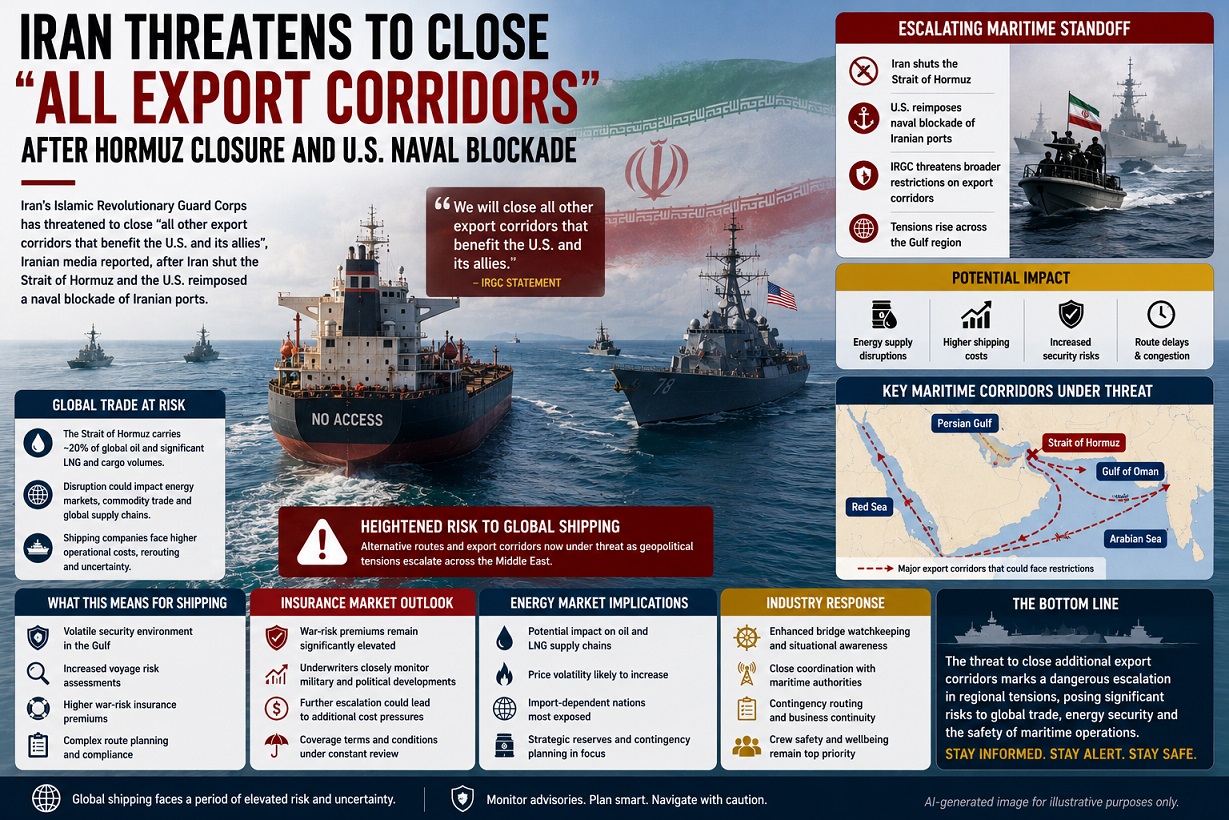
IRGC Threatens Wider Maritime Restrictions After Hormuz Closure, Raising Fresh Risks for Global Trade
July 2026 | Maritime Security & Geopolitics Desk
Iran’s Islamic Revolutionary Guard Corps (IRGC) has reportedly threatened to close “all other export corridors that benefit the United States and its allies” following the closure of the Strait of Hormuz and the reimposition of a U.S. naval blockade targeting Iranian ports. The statement marks a significant escalation in the ongoing maritime and geopolitical standoff, raising concerns over the security of global energy supply chains and commercial shipping routes.
The development has intensified uncertainty across international shipping markets, where operators are already contending with elevated war-risk premiums, rerouting decisions, and heightened security advisories throughout the Gulf region.
Regional Tensions Escalate Further
The latest remarks from the IRGC come amid an increasingly volatile maritime environment that has witnessed:
- The closure of the Strait of Hormuz.
- U.S. naval enforcement operations targeting Iranian maritime activities.
- Increased military deployments across Gulf waters.
- Growing disruptions to tanker and commodity shipping.
- Heightened geopolitical tensions affecting commercial navigation.
Iranian state media reported that Tehran is prepared to expand restrictive measures beyond Hormuz should regional tensions continue to escalate.
While the exact scope of the threatened measures remains unclear, analysts are closely monitoring their potential implications for international maritime commerce.
Global Shipping Routes Under Increased Pressure
The Strait of Hormuz remains one of the world’s most critical maritime chokepoints, facilitating the movement of:
- Crude oil exports
- Liquefied Natural Gas (LNG)
- Petroleum products
- Bulk commodities
- Containerized cargo
Any disruption affecting alternative export corridors could have broader implications for:
- Energy markets
- Freight costs
- Commodity supply chains
- Global shipping schedules
Shipping companies are increasingly required to maintain flexible voyage planning strategies as regional developments continue to evolve rapidly.
Alternative Trade Routes Face Greater Scrutiny
Industry observers note that the IRGC’s comments have shifted attention toward other strategic maritime corridors that support regional and global trade, including:
- The Gulf of Oman
- Arabian Sea shipping lanes
- Red Sea approaches
- East-West energy transportation networks
- Deep-sea commodity routes serving Asian and European markets
The possibility of additional operational restrictions could further complicate voyage planning for shipowners and charterers already navigating elevated security risks.
Insurance Markets Respond to Heightened Risk
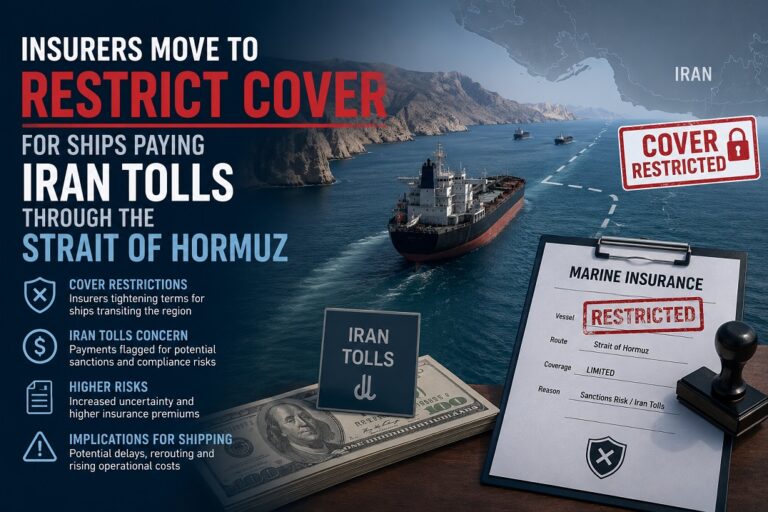
Marine insurers continue to closely assess developments across the Gulf region.
Current underwriting considerations include:
- Military activity affecting commercial shipping.
- Port accessibility.
- Regional security advisories.
- Vessel routing decisions.
- Exposure to sanctioned or restricted maritime zones.
War-risk insurance premiums for Gulf transits remain significantly elevated compared with normal trading conditions, and further geopolitical escalation could contribute to additional cost pressures for commercial operators.
Energy Markets Monitor Supply Chain Implications
Global energy markets remain particularly sensitive to developments affecting Gulf shipping routes.
Major import-dependent economies—including:
- India
- China
- Japan
- South Korea
- Several European nations
continue to rely heavily on uninterrupted maritime energy transportation.
Analysts warn that prolonged uncertainty surrounding regional export corridors could influence:
- Oil price volatility
- LNG transportation costs
- Tanker availability
- Strategic reserve planning
- Commodity market stability
The resilience of global supply chains will increasingly depend upon the availability and security of alternative transportation routes.
Maritime Security Advisories Remain in Force
Commercial vessels operating in the region continue to receive guidance emphasizing:
- Enhanced bridge watchkeeping.
- Continuous monitoring of maritime security advisories.
- Dynamic voyage risk assessments.
- Immediate reporting of suspicious activity.
- Close coordination with regional maritime authorities.
Shipowners are also reviewing contingency plans for:
- Alternative routing options.
- Emergency communications procedures.
- Crew safety protocols.
- Business continuity arrangements.
Shipping Industry Adapts to a New Operational Reality
The Gulf’s evolving security landscape is accelerating broader changes across the maritime industry, including:
- Intelligence-driven voyage planning.
- Increased investment in maritime security services.
- Greater supply-chain diversification.
- Enhanced geopolitical risk monitoring.
- Expanded operational resilience programs.
Rather than treating geopolitical disruptions as isolated events, shipping companies are increasingly integrating regional risk assessments into everyday commercial decision-making.
The Bottom Line
The IRGC’s reported threat to restrict additional export corridors following the closure of the Strait of Hormuz represents another significant development in an already fragile maritime environment.
For the global shipping industry, the implications extend well beyond a single waterway. Energy security, supply-chain resilience, and freedom of commercial navigation remain closely intertwined with geopolitical developments across the Gulf region.
As tensions continue to evolve, shipowners, insurers, and commodity markets will be watching closely—not only for the reopening of critical maritime corridors but also for signs of greater stability across one of the world’s most strategically important trade routes.
This article is based on publicly reported statements regarding geopolitical developments and maritime trade implications. The situation remains fluid, and operational conditions may change as new information becomes available.