Amendments to the NOx Technical Code 2008 adopted as resolution MEPC.398(83) entered into force on 1 September 2026. The NOx limits in MARPOL Annex VI regulation 13 did not move. What changed is the survey path when an installed marine diesel engine has been substantially modified, or when an owner wants that engine certified to a Tier it did not hold when it was fitted. Hong Kong Marine Department Information Note 51/2025, UK Merchant Shipping Notice MGN 717 (M+F), and Gard’s 2026 regulatory round-up all treat 1 September as the date operators, engine makers and recognised organisations must now follow. Early application was invited after MEPC 83 in April 2025. From this month, “we will sort the EIAPP after sea trials” is no longer a workable plan.
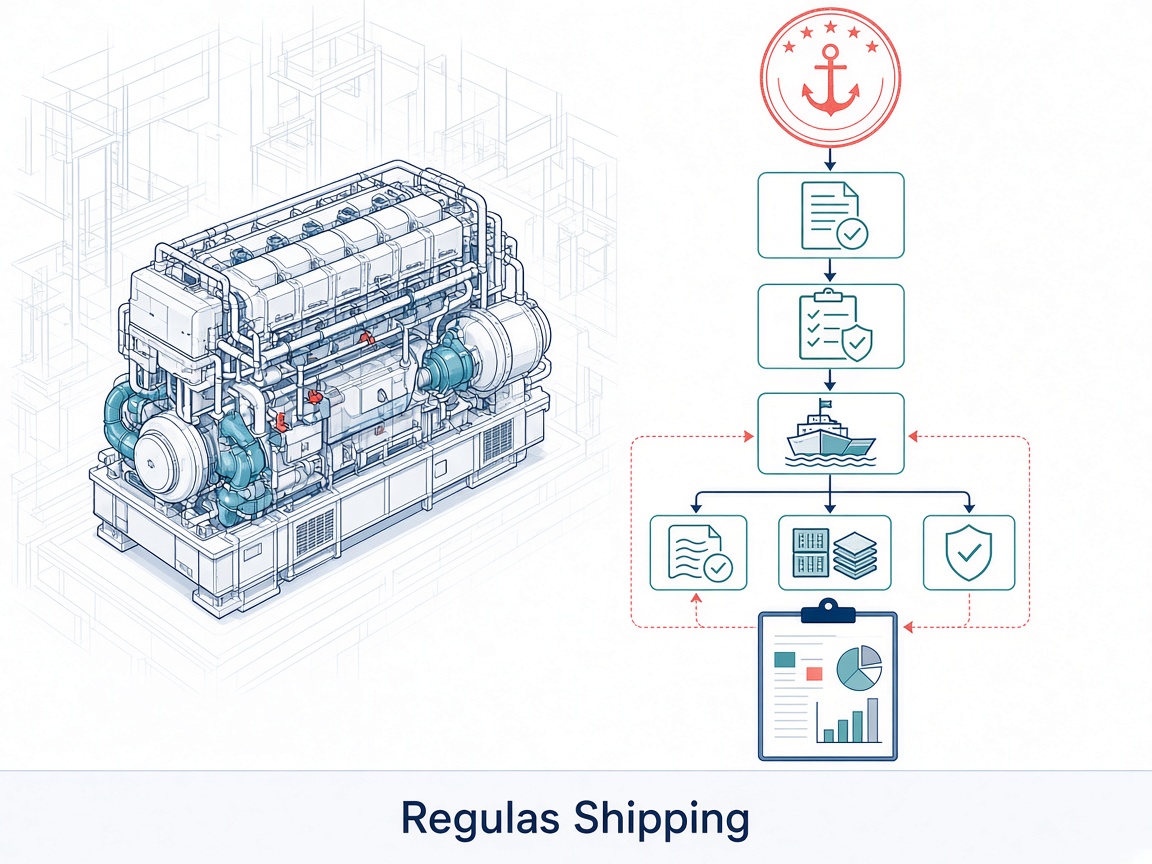
The gap the amendment closes is familiar to anyone who has converted a main engine, added selective catalytic reduction, changed a rating, or tried to take a Tier II engine to Tier III for an Emission Control Area. The original Code was written around shop-test certification of new engines and around the existing-engine path in old chapter 7 for regulation 13.7 (the North American ECA pre-2000 engine piece). It did not spell out, in one place, how to recertify a shipboard engine after a substantial modification or to a new Tier. Class and flag were left to improvise with onboard tests, parent-engine logic and technical files that did not always match. MEPC.398(83) splits chapter 7 in two. Section 7.1 keeps the existing-engine certification under regulation 13.7. New section 7.2, paragraphs 7.2.1 to 7.2.12, is the recertification procedure. Appendix II adds figure 4 as the survey flowchart. Where the drawing and the text disagree, the text of the Code wins.
The scope is narrow and easy to miss on a repair specification. Section 7.2 applies where an installed marine diesel engine has been subject to substantial modification, or is to be certified to a Tier it was not certified to at installation. The procedure may be used for an Individual Engine or for an Engine Group represented by a Parent Engine. It is not accepted for Engine Family certification. That last sentence matters for series conversions. An owner who wants to push a whole class of sister ships through the same SCR or derate package cannot treat the first ship as a family parent and photocopy the result. Each conversion is an Individual Engine or a properly established Engine Group under 7.2, with Member Engines then following the 2.2.2 procedures.
Onboard testing is constrained in ways that will hit drydock and sea-trial planning. When setting load points, paragraph 6.4.6.7 applies. The 100 percent load point may, if the Engine Emission test plan allows, be no lower than 85 percent of rated power. If the ship cannot reach that power — fouled hull, weather, shaft-generator load, a trial area that will not permit full revolutions — the test is deferred until it can. The 100 percent weighting factor in paragraph 3.2 still applies even if the actual power at that point is only 85 percent. For the E3 cycle, if the real propeller curve is not the E3 curve, the load point is set from measured engine power. Humidity and temperature NOx corrections follow 6.4.13, and performance and ambient monitoring follow 6.4.5.1. If rated power or rated speed changes because of the modification, the engine nameplate is replaced. None of that is optional wording for the superintendent to “see on the day.”
The document that now gates the diary is the Engine Emission test plan. Paragraph 7.2.10 says the plan, prepared by the applicant, shall be agreed with the Administration before the test is scheduled. MEPC.1/Circ.921, issued on 22 July 2025 so parties could apply the amendments early, tells applicants what that plan must cover: measurement arrangements, how power will be assessed, how each test-cycle load point will be reached and held, fuel, and the practical constraints of a ship that is not on a shop test bed. Voyage window, sea area, loading condition and the likelihood of interruption all belong in the plan. Flag or the recognised organisation acting for flag has to accept that paper before anyone books the emissions team, the analyser calibration or the trial area. A yard that files the plan in week two of a drydock, after the engine has already been opened, is already behind the Code.
Operational implications sit with technical managers, not only with class. Dual-fuel retrofits, ECA-driven Tier III upgrades, derates for CII, turbocharger and injection-system changes that meet the Code’s “substantial modification” test, and any attempt to put a new EIAPP against a different Tier, now have a statutory onboard-test path. The NOx Technical File, the EIAPP certificate, the nameplate and, where power or speed changed, the ship’s certificates all have to line up after the test. Port State Control will not need a new campaign to ask for them. A ship that has had a “performance upgrade” in 2026 without a 7.2 file is the one that will be asked, at the next intermediate or renewal survey, why the engine in the room is not the engine on the certificate. Engine Family shortcuts will not answer that question.
Timing is the other cost. Because the 100 percent point cannot be taken below 85 percent of rated power, a conversion completed in a winter North European yard may still be waiting on a loaded sea trial in better weather before the new EIAPP can be issued. Charterers who assume the ship is Tier III from undocking day need a contract line that follows the Administration-agreed test, not the yard’s completion certificate. Insurers and financiers who treat a dual-fuel or SCR job as delivered when the ship sails will be holding an engine that is, until 7.2 is closed, still certified to its old Tier. The emission limits did not tighten on 1 September. The paperwork for changing an engine did.
What Operators Should Note
- Assume MEPC.398(83) is in force for any substantial engine modification or Tier change started on or after 1 September 2026. NOx limits are unchanged. The recertification path in NOx Technical Code section 7.2 is now mandatory. Early application was invited; late application is no longer available.
- Agree the Engine Emission test plan with the Administration before scheduling the test. Circ.921 is the content list: measurement set-up, power assessment, load-point method, fuel, voyage and sea-area constraints. Do not open the engine on a conversion that will need 7.2 until flag or the RO has accepted the plan.
- Do not use Engine Family certification for a 7.2 job. Individual Engine or Engine Group (Parent plus Member Engines under 2.2.2) only. Sister-ship series conversions need a Group structure, not a copied family parent.
- Plan the sea trial to reach at least 85 percent of rated power at the 100 percent load point. If that power cannot be achieved, the test waits. The 100 percent weighting factor still applies. Weather, hull condition and trial-area limits belong in the project schedule, not in a surprise deferral after undocking.
- Replace the nameplate if rated power or rated speed changed, and keep the NOx Technical File and EIAPP in step. A performance upgrade, derate or Tier III kit that leaves the old plate and the old certificate on board is a survey finding waiting for the next PSC inspector.
- Write the 7.2 close-out into the retrofit contract and the charter. Yard completion is not recertification. Delivery of a new Tier, or of a modified engine, should be defined as Administration-agreed test plus updated EIAPP, Technical File and nameplate, not as “engine installed.”
- Brief class, the engine maker and the superintendent on figure 4 of appendix II, but follow the Code text if the flowchart and the paragraphs differ. Paragraph 7.2.12 is explicit: the text takes precedence. Arguments at the surveyor’s desk should start from 7.2.1–7.2.12, not from a yard slide.
Regulas Shipping will keep lining MEPC.398(83) engine-recertification tests, Administration-agreed emission plans and EIAPP close-outs against drydock and dual-fuel diaries so operators do not treat a 1 September Code change as a paperwork footnote.