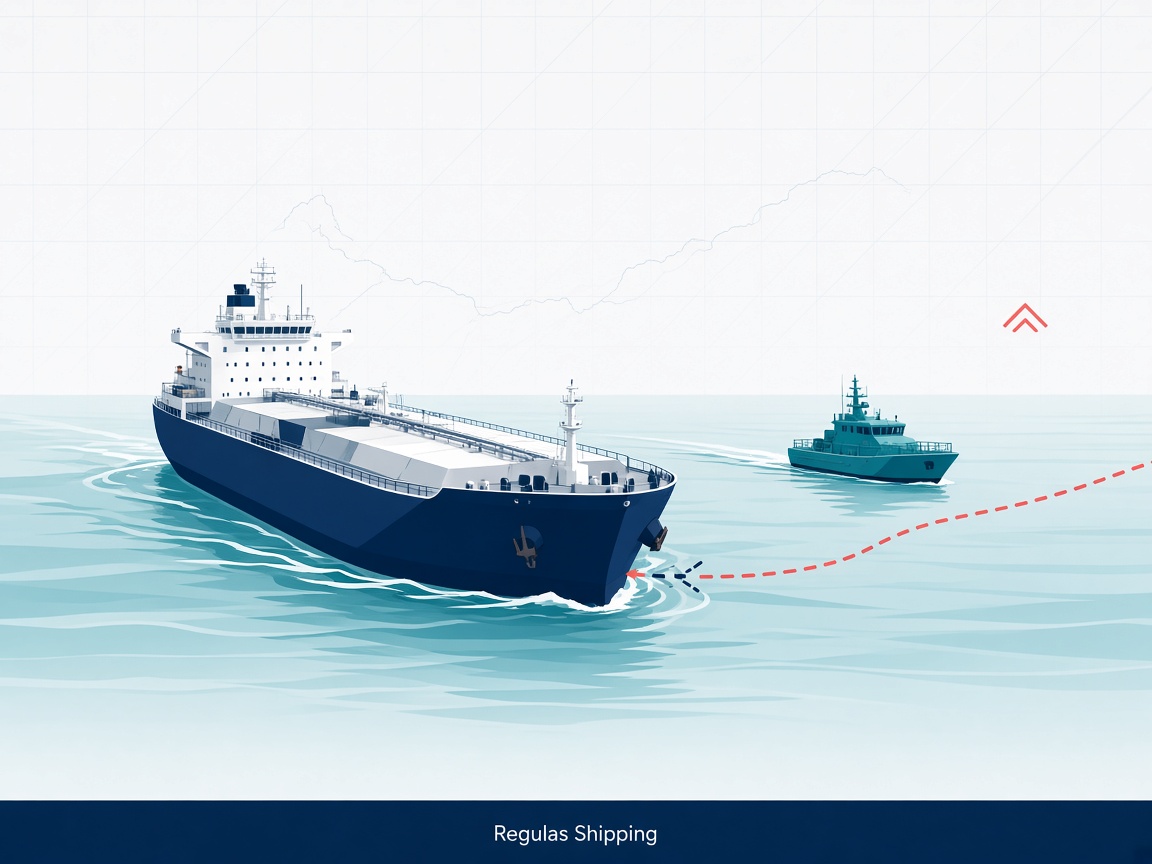
Yemen’s internationally recognised government Coast Guard intercepted the Comoros-flagged product tanker Nereida (IMO 9163269, about 35,994 dwt) in the Gulf of Aden on 6 September 2026, after the ship had discharged cargo at Houthi-controlled Ras Isa in Al-Hudaydah governorate. Government sources, carried by Anadolu Agency, SAFETY4SEA and The Maritime Executive, said the call was made without Yemeni government approval and without the UN Verification and Inspection Mechanism for Yemen (UNVIM) procedures that still apply to commercial cargo bound for ports outside government control. The tanker is the same hull previously named Peterpaul. The United States listed it under OFAC sanctions in February 2025. Equasis has treated the Comoros flag as false. No casualties were reported in the intercept, but armed men on board opened fire at the patrol before the ship complied and was escorted to Aden.
That sequence is a law-enforcement and sanctions file, not a Houthi projectile file. Tuesday’s strikes on southern Saudi energy sites sit on a different ledger. Ras Isa is a Houthi-held oil terminal on the Red Sea; UNVIM was set up in December 2015 at the Yemeni government’s request to give effect to UN Security Council Resolution 2216, which remains the arms-embargo and cargo-control baseline for calls at ports the government does not hold. The mechanism is based in Djibouti and run by the UN Office for Project Services. Clearances for Ras Isa itself were suspended by the government in June 2017. UNVIM still issues clearances for Hodeidah and Saleef. A product tanker that works Ras Isa without that paper is, on the government’s account, already in breach before anyone asks what was in the tanks.
AIS behaviour is the operational marker masters will actually see. Authorities said Nereida switched off Automatic Identification System transmissions for parts of the voyage. The signal briefly reappeared south of Al-Hudaydah after the ship left Ras Isa and shaped for the Bab el-Mandeb Strait. Coast Guard patrols then stopped it in the Gulf of Aden. The ship first failed to stop. Armed security on board reportedly fired toward the patrol boat. The tanker later answered the order and was taken to Aden anchorage. Yemeni authorities have opened an investigation covering the voyage, the cargo, the documents, the Ras Isa call, the AIS shutdown, the refusal to stop, and the shooting. International naval forces in the region were told the interception was a law-enforcement operation, not a combat boarding.
The hull history matters for screening. Nereida was sold in 2025 to undisclosed interests, dropped a previously unknown flag, and reappeared as Comoros. That is the classic identity reset used on sanctioned product tonnage: a new name, a convenience flag that Equasis will not treat as valid, and an AIS pattern that goes dark on the approach to a restricted terminal. OFAC’s February 2025 listing under the former name Peterpaul did not expire when the paint changed. Charterers and managers who screen only the current name, or who treat “Comoros-flagged product tanker, AIS gap, Ras Isa” as a commercial inconvenience rather than a detention and sanctions event, are running the same gap that put this ship alongside Aden.
The firing on a government patrol is the part that will not stay inside a cargo-documentation file. Gulf of Aden and southern Red Sea masters already hold two other armed-approach drills: pirate boarding off Puntland and Houthi or affiliated craft in the strait. A Yemeni government Coast Guard intercept after a Houthi-port call is a third pattern. Failure to stop, then small-arms fire from embarked security, converts a UNVIM paperwork problem into an exchange of fire in an international strait approach. Companies that still write private-armed-security orders as “deter pirates, do not engage state craft” need that sentence in the actual brief, not only in the contract. The government’s notice to international naval forces is the other side of the same coin: a coalition or independent warship that closes an AIS-dark tanker in the Gulf of Aden this week may be looking at a Yemeni LE stop, not a Houthi seizure.
Cargo interests are exposed even when the physical barrels are already ashore. Ras Isa has been used as a Houthi-held energy node for years. An unauthorised discharge without UNVIM inspection is the exact fact pattern the mechanism was built to catch — not because every product cargo is an arms shipment, but because the UN process is the only agreed filter between a commercial tanker and a port the government does not control. Charterparties that name “Yemen” or “Red Sea discharge” without distinguishing government ports from Houthi-held Ras Isa, and without a UNVIM-clearance condition precedent, leave the owner holding a detained ship, a sanctions-screening problem, and a crew under investigation in Aden. War-risk underwriters who already rewrote Saudi-touchpoint language after the July Houthi blockade and this week’s energy-site strikes will treat a Ras Isa call by a listed hull as a separate, and worse, warranty issue.
Crew welfare follows the detention, not the cargo. Once a ship is escorted to Aden after shots have been fired, the master, security team and officers are witnesses in a national investigation. Next-of-kin, flag, P&I and the company security officer need a single story that matches the AIS log, the port-call file and the armed-security rules of engagement. A “we were only delivering products” line will not close an OFAC listing, a false-flag finding, or a firearms complaint. Companies that still use Yemen calls as a spot-market option should treat Ras Isa, Hodeidah and Saleef as three different legal ports, only two of which currently sit inside UNVIM clearance practice, and none of which is a quiet commercial call while the Houthi–government war is live on the same coast.
What Operators Should Note
- Screen the hull, the former name and the OFAC list, not only the AIS label. Nereida is IMO 9163269, previously Peterpaul, listed in February 2025. A 2025 sale and a Comoros flag do not clear the designation. Equasis already flags the flag as false.
- Treat Ras Isa as a no-go without government approval and UNVIM paper. UNVIM still clears Hodeidah and Saleef. Ras Isa clearances have been suspended since 2017. A product discharge there without that process is the detention trigger, independent of what the bill of lading says.
- Put AIS gaps on the CSO watchlist for the Gulf of Aden, not only for Hormuz. Dark transit into Ras Isa, a brief paint south of Hodeidah, then a Bab el-Mandeb heading, is now a documented intercept pattern. Charterers should require a continuous AIS warranty and an explanation file for any gap longer than a harbour stay.
- Rewrite private-armed-security ROE for state craft. Embarked guards who fire on a Yemeni government patrol turn a cargo case into a shooting case. The standing order should name government Coast Guard, coalition warships and recognised LE boats as units that are not engaged.
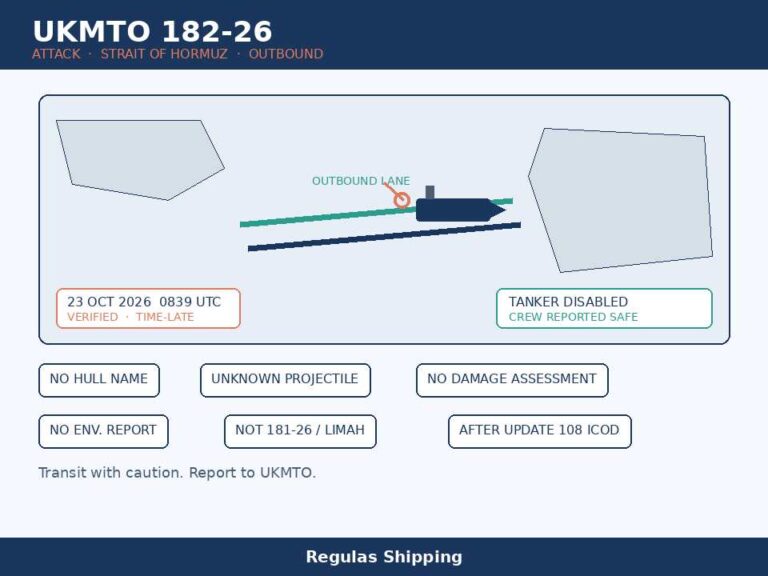
- Do not conflate this intercept with Tuesday’s Houthi strikes on Saudi energy sites. One is a government stop of a sanctioned tanker after a Houthi-port call. The other is a missile and drone campaign against Saudi infrastructure. Routing, war-risk and crew briefs should carry both, separately.
- Assume international naval forces have been told this is law enforcement. If a UKMTO or coalition unit queries an AIS-dark tanker in the Gulf of Aden this week, the first working hypothesis is a Yemeni LE escort, not a Houthi prize. Masters should answer and identify, not run.
- Close Yemen discharge clauses before the next fixture. Name the terminal, require UNVIM clearance where it still applies, exclude Ras Isa unless government approval is in hand, and give the master written authority to abort an approach if AIS, flag or screening data do not match the voyage order.
Regulas Shipping will keep lining Yemeni Coast Guard intercepts at Ras Isa and in the Gulf of Aden against UNVIM clearance, OFAC hull lists and armed-security rules of engagement so operators can separate a government law-enforcement stop from the Houthi projectile threat on the same coast.