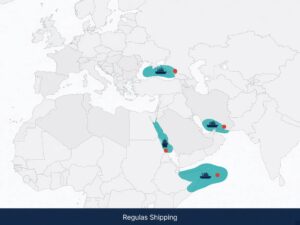
The Gibraltar-flagged oil products tanker Hercules Star (IMO 9916135, 7,998 dwt) was at anchor about 24 nautical miles northwest of Dubai’s Port Rashid when the United Kingdom Maritime Trade Operations centre logged a listing hull and possible water ingress after an unidentified projectile. Charterer Peninsula confirmed on 9 September 2026 that one seafarer had been killed and a second crew member was missing, with a specialist team searching and the remainder of the crew accounted for. Maritime security sources told Reuters the ship may have been struck by a drone. UKMTO issued Warning 130-26 the same day and told traffic in the area to proceed with caution. The vessel is a 2022-built bunker and products tanker chartered by Peninsula from sister company Hercules Tanker Management. She had already taken minor damage from an unknown projectile off the UAE earlier this year. Anchorage off a major bunkering and crew-change port is no longer a quiet holding pattern.
The same 24-hour window put a second hull in the northern Gulf. UKMTO reported a tanker struck by an unknown projectile about 28 nautical miles southeast of Al Faw, Iraq. Iraqi authorities and Reuters identified the ship as the Panama-flagged VLCC New Andros (IMO 9294252, 302,477 dwt), carrying about two million barrels of Iraqi fuel oil and chartered by the Iraqi Oil Tankers Company. The hit came around 06:00 local time on 9 September inside Iraqi territorial waters. A fire was put out by rescue craft. All 22 crew were unharmed, including a Greek master and chief engineer. Hull damage was described as minor and there was no cargo leak. Iraq’s oil ministry later said only that the source of the strike was unknown. At least four projectile or drone attacks have been reported in Iraqi waters since the Iran war opened in late February, including two foreign-flagged fuel tankers set on fire near Al Faw in March.
Neither incident sat in isolation. UKMTO Advisory 129-26, issued around 8–9 September, said several merchant vessels in the northern Gulf and the Gulf of Oman had been subjected to “disabling fire” amid ongoing military activity. The centre could not confirm casualties or pollution from those reports. The IRGC had already threatened tankers near Bahraini and Kuwaiti ports, whether at anchor or at berth. On 9 September the U.S. military said it had destroyed five Iranian oil tankers in the Gulf of Oman and near Kharg Island after accusing the IRGC of two ballistic-missile attempts against a U.S. Navy warship. Iran then claimed attacks on two U.S. vessels, eight oil tankers and ten “non-compliant” ships, and said it had added parts of the Gulf of Oman and the Arabian Sea to a new prohibited zone, with coordinates to follow. The United States denied that its ships were hit. Brent crude moved back above $100 a barrel, closing at $101.21. Preliminary ship-tracking on 10 September put Hormuz transits at seven on 9 September, against 12 the day before and a ten-day average of 14.
On Thursday 10 September the International Bunker Industry Association put the human cost in writing. IBIA said recent attacks had killed seafarers, injured others and left some missing, and that crews continue to bear the cost of conflicts they are not party to. Executive director Alexander Prokopakis aligned the association with IMO Secretary-General Arsenio Dominguez: attacks on innocent seafarers and civilian shipping are unacceptable. Seafarers, he said, deliver energy, food and essential goods and should be able to do that work without becoming targets. For a bunker supplier’s chartered hull, that is not a press-line. Hercules Star is the kind of ship that stems other ships. A fatality on a 8,000-dwt products tanker at a Dubai anchorage means the threat picture now covers coastal holding grounds, not only the Hormuz traffic lane or a laden VLCC on a long-haul voyage.
The operational implication is that “outside the Strait” and “at anchor awaiting orders” are no longer risk-reducing phrases in the northern Gulf. A ship waiting off Port Rashid, holding in Iraqi waters as a floating storage unit, or lying near Bahrain or Kuwait under an IRGC threat, is inside the same projectile envelope as a transit. Company security officers who still treat UAE coastal waters as a default safe haven for bunkers, stores and crew change need a written threat assessment for that specific anchorage, not a copy of last month’s Hormuz note. Passage plans should assume UKMTO warnings can arrive while the ship is stopped. Damage-control and citadel drills belong on the pre-arrival checklist for Al Faw, Umm Qasr, Port Rashid, Hamriyah and the Bahrain–Kuwait holding grounds as much as they do for a Hormuz transit. Charterers of bunker barges and small products tankers should not assume the ship is less exposed because it is not a VLCC; Hercules Star shows the opposite.
Reporting and welfare follow the same stack as any other high-risk incident, and they have to be in the SMS before the next projectile, not drafted after the first fatality. Masters should report to UKMTO, register with MSCIO under BMP Maritime Security, and file with IFC-IOR when operating in the Gulf, Gulf of Oman or Arabian Sea. Next-of-kin, P&I and flag notification clocks start on a missing-seafarer case immediately. A search team on a listing hull is a SAR and a security event at once. Insurers and war-risk underwriters will ask whether the ship was in a declared high-risk area, whether AIS and lookouts were in accordance with the Ship Security Plan, and whether the company had treated coastal UAE waters as excluded. Silence in the voyage order on remaining at an exposed anchorage, or on waiting as floating storage in Iraqi waters, will land on the owner.
What Operators Should Note
- Treat UAE and Iraqi coastal anchorages as inside the projectile envelope, not as a safe hold. Hercules Star was stopped 24 nautical miles off Port Rashid. New Andros was in Iraqi territorial waters near Al Faw. A “waiting orders” or floating-storage position is now a targeting geometry.
- Read UKMTO Advisory 129-26 and Warning 130-26 into the bridge pack for the northern Gulf and Gulf of Oman. “Disabling fire” on several merchant ships is a theatre-wide warning, not a single-hull accident. Report suspicious activity and projectile incidents to UKMTO while they are happening.
- Do not assume small products and bunker tankers are lower value to an attacker. Hercules Star is 7,998 dwt. One seafarer is dead and one is missing. Voyage-specific threat assessments should cover bunker barges, STS support hulls and coastal feeders, not only laden VLCCs.
- Re-check Bahrain, Kuwait and Al Faw holding grounds against the current IRGC language. Threats against ships at anchor or at berth near those ports sit on top of the Al Faw and Dubai events. If the fixture requires waiting in that box, say so in the security assessment and the war-risk notice.
- Keep BMP MS, UKMTO, MSCIO and IFC-IOR live for Gulf and Gulf of Oman voyages, including when the ship is stopped. AIS policy, extra lookouts and citadel readiness apply at anchor. A dark or idle AIS picture at a known bunkering roadstead is still a public track.
- Write the missing-crew and next-of-kin procedure before the next call. Peninsula’s statement on a fatality and a missing seafarer is the case the SMS should already describe: flag, P&I, family, SAR coordination, and a named company officer who owns the clock.
- Re-open war-risk, deviation and waiting clauses for Gulf storage and bunker stems. Name who pays extra waiting at an exposed anchorage, who authorises remaining as floating storage in Iraqi waters, and what happens if UKMTO logs disabling fire in the same sector. IBIA’s 10 September statement is the industry line charterers will be quoted: seafarers are civilians and the ship is not a party to the war.
Regulas Shipping will keep lining UKMTO Gulf and Gulf of Oman projectile warnings against anchorage, bunker and floating-storage positions so operators can treat a Dubai or Al Faw hold as a security decision, not a quiet wait.