Damaged LNG Carrier Arctic Metagaz Drifts to Libya, Fate Remains Uncertain
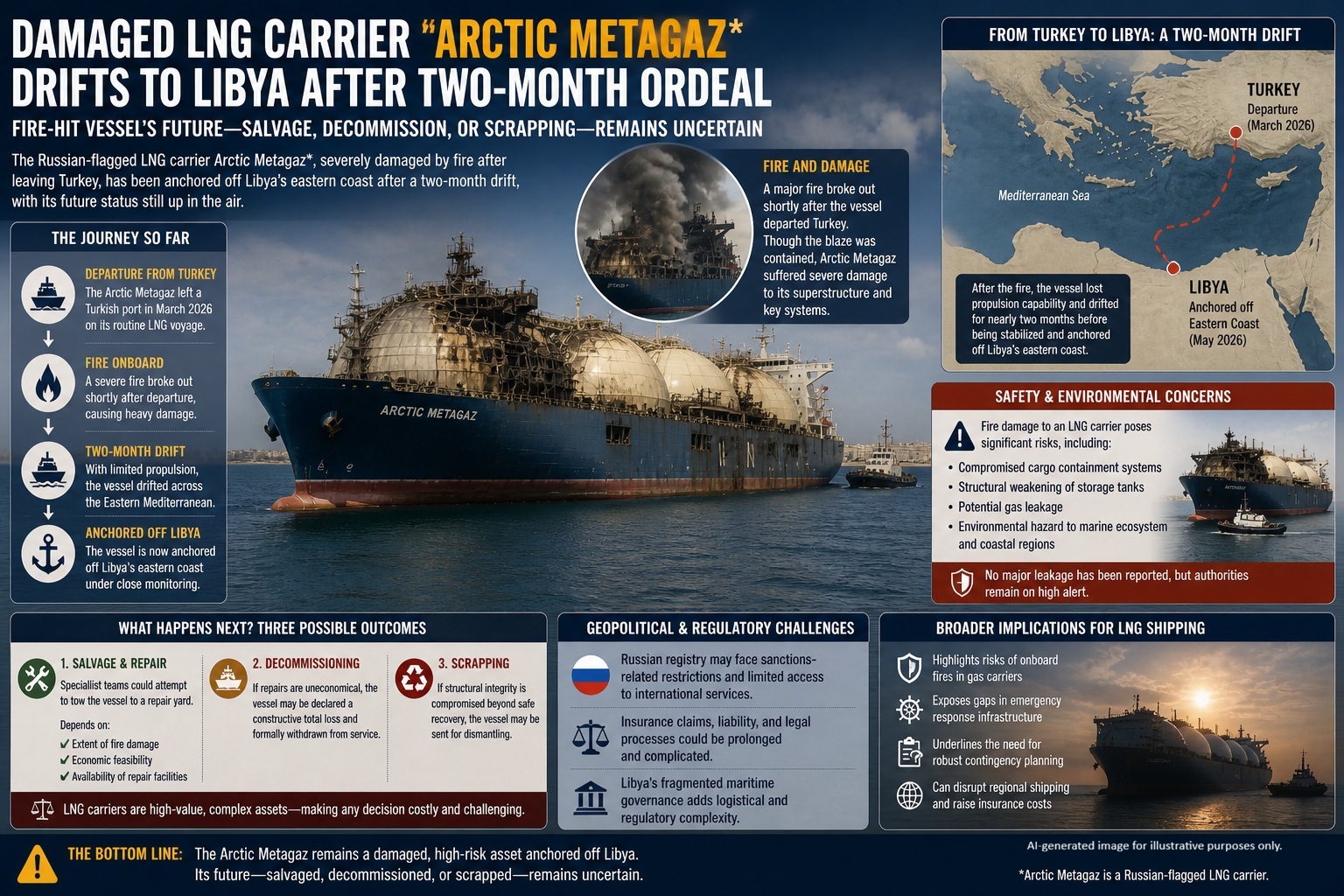
The Russian-flagged LNG carrier Arctic Metagaz has come to a precarious halt off Libya’s eastern coastline after drifting for nearly two months, following a severe onboard fire shortly after departing Turkey. The vessel, now anchored in a holding position, has become the focus of growing concern within maritime safety and energy circles.
From Fire Incident to Prolonged Drift
According to maritime tracking data and industry sources, the incident began when a fire broke out onboard the LNG carrier soon after it left Turkish waters. While the crew reportedly managed to contain the blaze, the vessel sustained significant structural and systems damage, rendering it largely inoperable.
Unable to continue its voyage and with limited propulsion capability, the ship entered a prolonged drift across the Eastern Mediterranean—raising alarms over:
- Navigational hazards to nearby shipping lanes
- Potential environmental risks
- The safety of remaining onboard systems, including LNG containment
After weeks of uncertainty, the vessel has now been stabilized and anchored off Libya’s eastern coast, where it remains under monitoring.
Safety and Environmental Concerns
The condition of Arctic Metagaz continues to pose serious operational and environmental questions.
LNG carriers are designed with advanced containment systems, but fire damage introduces risks such as:
- Compromised cargo insulation systems
- Structural weakening of storage tanks
- Potential gas leakage under certain conditions
While no major spill or leakage has been reported so far, maritime authorities and regional stakeholders are maintaining heightened vigilance.
Uncertain Future: Salvage or Scrap?
The vessel’s next steps remain undecided, with three primary scenarios under consideration:
1. Salvage and Repair
Specialist salvage teams could attempt to tow the vessel to a repair yard. However, this option depends heavily on:
- The extent of fire damage
- Economic feasibility of restoration
- Availability of suitable repair facilities
2. Decommissioning
If repairs prove too costly or technically unviable, the vessel may be declared a constructive total loss and formally withdrawn from service.
3. Scrapping
In the worst-case scenario, Arctic Metagaz could be sent for dismantling, particularly if structural integrity is found to be compromised beyond safe recovery.
Industry analysts note that LNG carriers are high-value, technically complex assets, making salvage decisions far more intricate than for conventional tankers.
Geopolitical and Regulatory Dimensions
The vessel’s Russian registry adds an additional layer of complexity. Ongoing geopolitical tensions and sanctions-related constraints could:
- Limit access to international salvage services
- Complicate insurance claims and liability processes
- Restrict port access for repairs
Libya’s role as the current anchorage location also raises logistical and regulatory challenges, given the region’s fragmented maritime governance environment.
Broader Implications for LNG Shipping
The Arctic Metagaz incident underscores the vulnerabilities within the global LNG shipping sector, particularly:
- The risks associated with onboard fires in gas carriers
- Limited emergency response infrastructure in certain regions
- The growing importance of contingency planning for high-value vessels
It also highlights how quickly a single incident can evolve into a multi-week operational and environmental concern, impacting regional maritime traffic and safety oversight.
The Bottom Line
The fate of Arctic Metagaz remains uncertain as it sits anchored off Libya—a damaged, high-risk asset awaiting a complex decision.
Whether salvaged, decommissioned, or scrapped, the vessel’s journey from fire-stricken tanker to drifting hazard serves as a stark reminder of the operational, environmental, and geopolitical risks shaping modern LNG shipping.