Strait of Hormuz Remains Functionally Contested as Security Risks and Shipping Costs Escalate
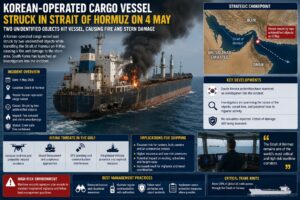
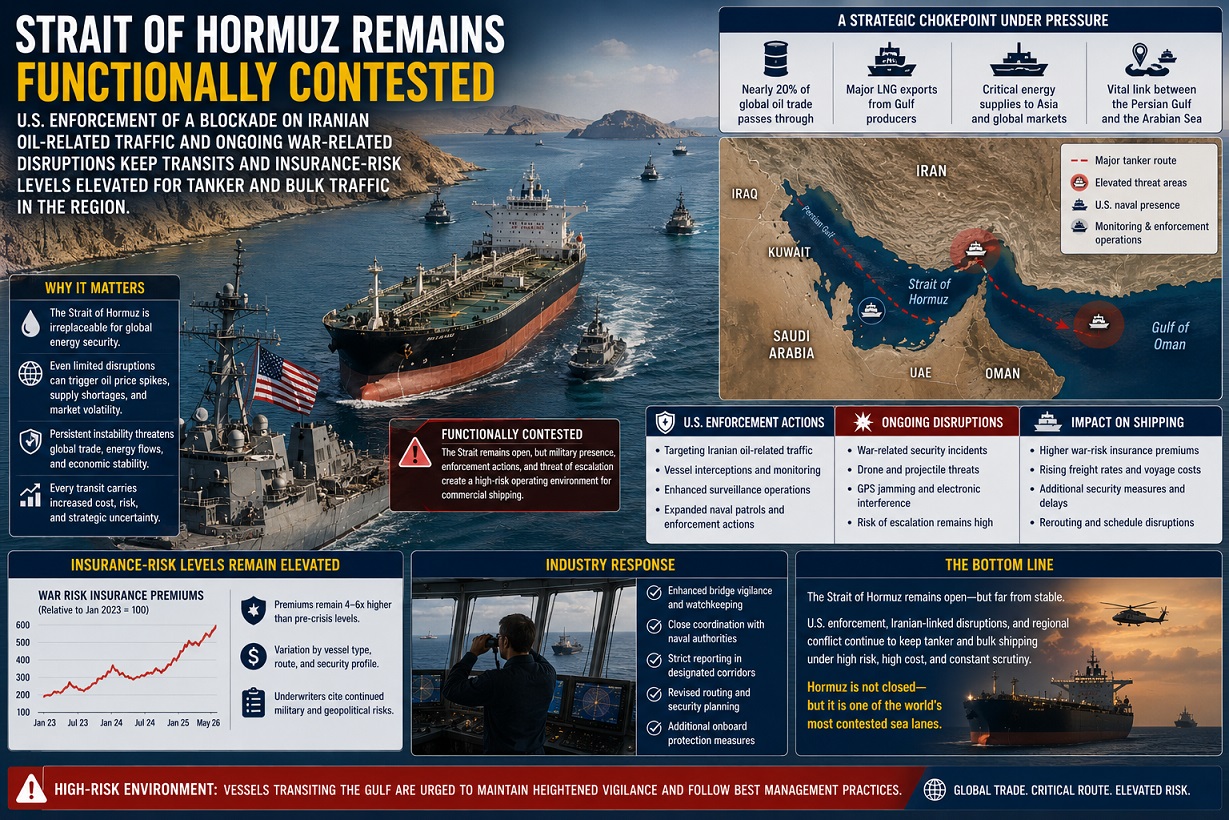
The Strait of Hormuz—one of the world’s most strategically critical maritime chokepoints—remains under severe operational strain as U.S. enforcement actions against Iranian oil-related traffic and ongoing regional conflict continue to disrupt commercial shipping across the Gulf.
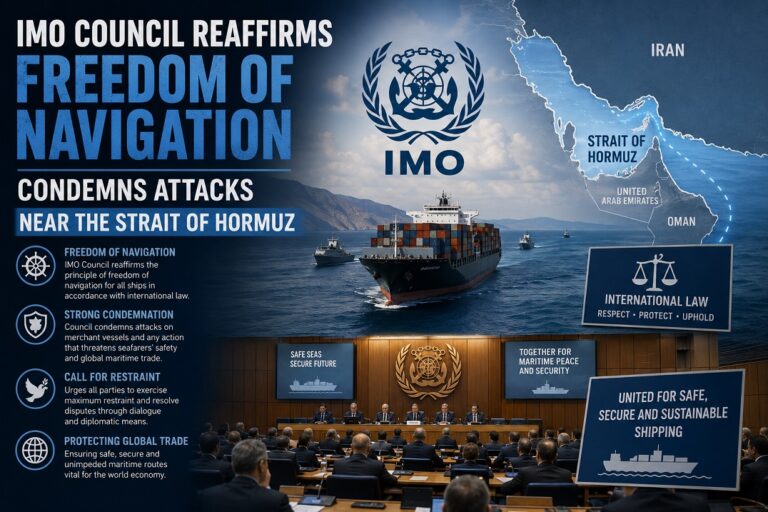
Although vessel movements through the strait have not ceased, maritime analysts describe the corridor as “functionally contested”, where military presence, geopolitical confrontation, and elevated security threats are increasingly shaping daily shipping operations.
A Strategic Artery Under Pressure
Connecting the Persian Gulf to the Arabian Sea, the Strait of Hormuz handles:
- Nearly 20% of global oil trade
- Major LNG exports from Gulf producers
- Critical crude flows to Asia, including India, China, Japan, and South Korea
Despite its indispensable role in global energy markets, the route has become increasingly unstable due to:
- U.S.-led maritime enforcement operations
- Iranian-linked shipping disruptions
- Military escalation risks
- Heightened vessel security incidents
Shipping activity continues, but under significantly altered operating conditions.
U.S. Enforcement Actions Intensify Maritime Tensions
Recent U.S. operations targeting Iranian-linked oil movements have reinforced the perception of the Gulf as a heavily monitored and militarized trade environment.
Measures have reportedly included:
- Vessel interception and monitoring
- Enhanced surveillance operations
- Expanded naval patrol activity
- Enforcement actions against suspected sanctions-related traffic
The resulting atmosphere has increased uncertainty for commercial operators transiting near Iranian waters and key Gulf approaches.
Insurance and Freight Markets React to Elevated Risk
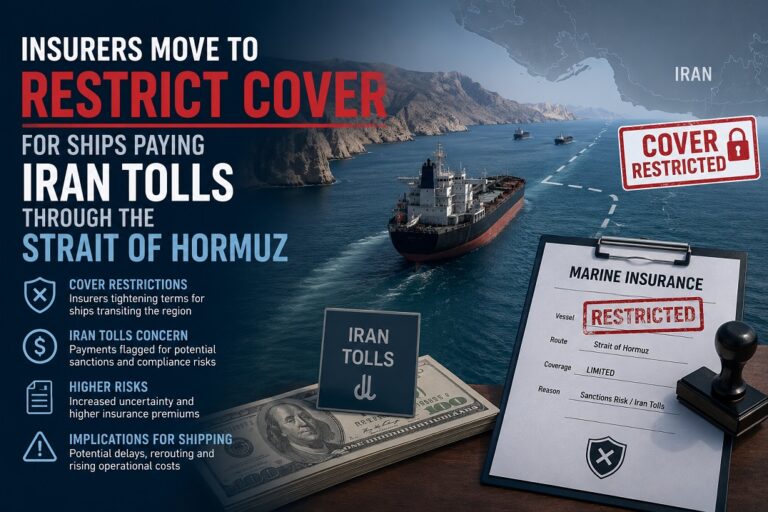
War-risk insurance premiums for vessels entering the Gulf region remain substantially elevated, particularly for:
- Oil tankers
- LNG carriers
- Bulk carriers transporting strategic commodities
Underwriters continue to factor in:
- Potential vessel strikes or seizures
- Drone and projectile threats
- GPS interference and electronic disruption
- Escalation involving naval forces
The higher risk environment has translated into:
- Rising voyage costs
- Increased freight volatility
- Longer security procedures and route planning
- Greater demand for onboard protection measures
Commercial Shipping Faces Persistent Operational Challenges
Shipping companies operating in the region are now navigating a complex mix of:
- Geopolitical uncertainty
- Security threats
- Military congestion
- Regulatory scrutiny
Maritime security advisories continue to urge vessels to:
- Maintain heightened vigilance
- Use designated reporting corridors
- Coordinate closely with naval authorities
- Implement enhanced bridge and watchkeeping procedures
Many operators are also reassessing:
- Crew safety protocols
- Voyage scheduling
- Charter pricing structures
- Exposure to Gulf transit risk
Global Energy Markets Closely Watching Hormuz Stability
The Strait’s stability remains essential for global energy supply continuity.
Even limited disruptions can:
- Trigger oil price spikes
- Tighten tanker availability
- Increase LNG delivery uncertainty
- Impact refining and industrial supply chains in Asia and Europe
While no full closure of the strait has occurred, analysts warn that the cumulative effect of persistent disruption is creating a “high-friction maritime corridor” where commercial movement remains possible—but increasingly costly and unpredictable.
A Region Operating Under Strategic Tension
Security experts note that the Gulf is now characterized by:
- Continuous naval deployments
- Hybrid and asymmetric maritime threats
- Increased drone and electronic warfare risks
- Greater potential for accidental escalation
The overlap between military operations and commercial navigation has created an environment where even routine tanker movements carry heightened geopolitical sensitivity.
The Bottom Line
The Strait of Hormuz remains open—but far from stable.
As U.S. enforcement actions, Iranian-linked disruptions, and regional conflict continue to shape the Gulf security landscape, tanker and bulk carrier operations are increasingly conducted under conditions of elevated risk, higher cost, and strategic uncertainty.
For global shipping and energy markets, the message is clear:
Hormuz remains operational, but it is now one of the world’s most contested and closely watched maritime corridors.