IMO MEPC 84 Sets Direction for Shipping Decarbonisation, But Key Decisions Delayed
May 2026 | Maritime Regulation & Sustainability Desk
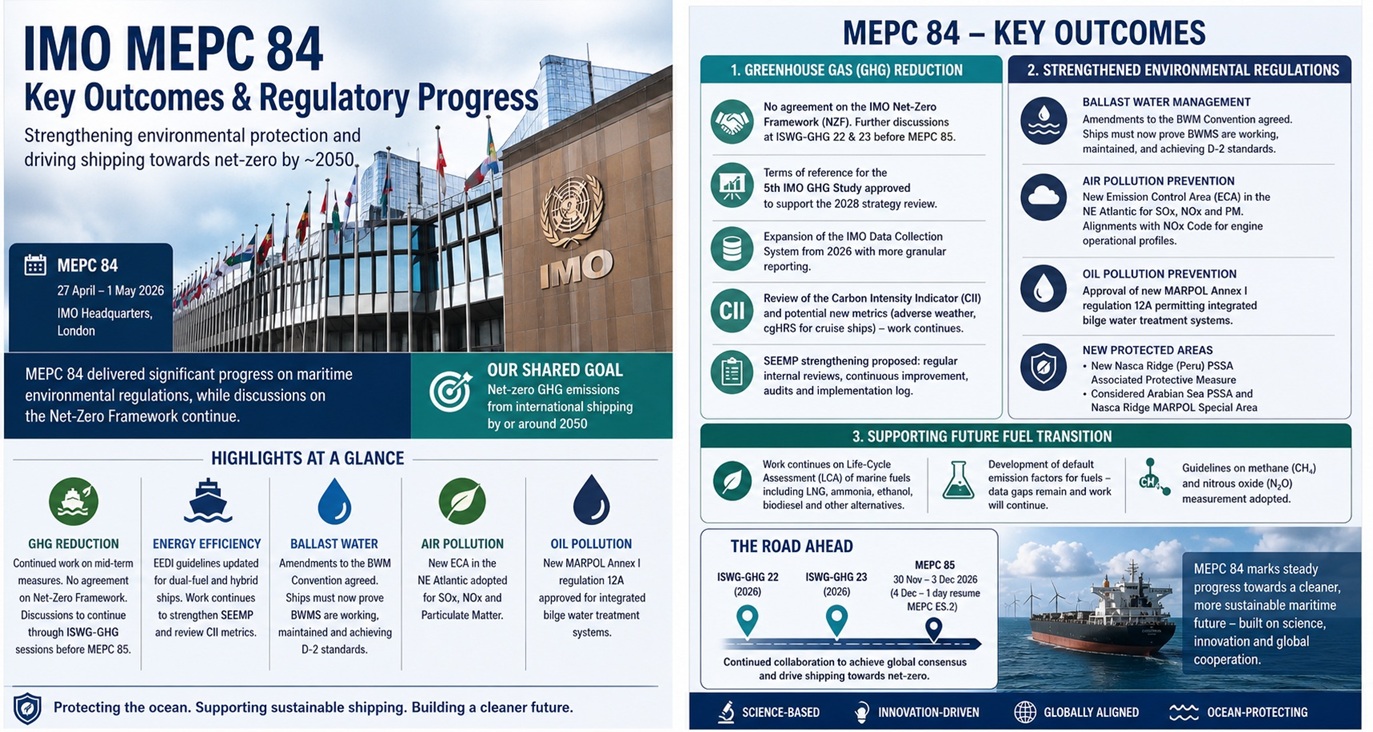
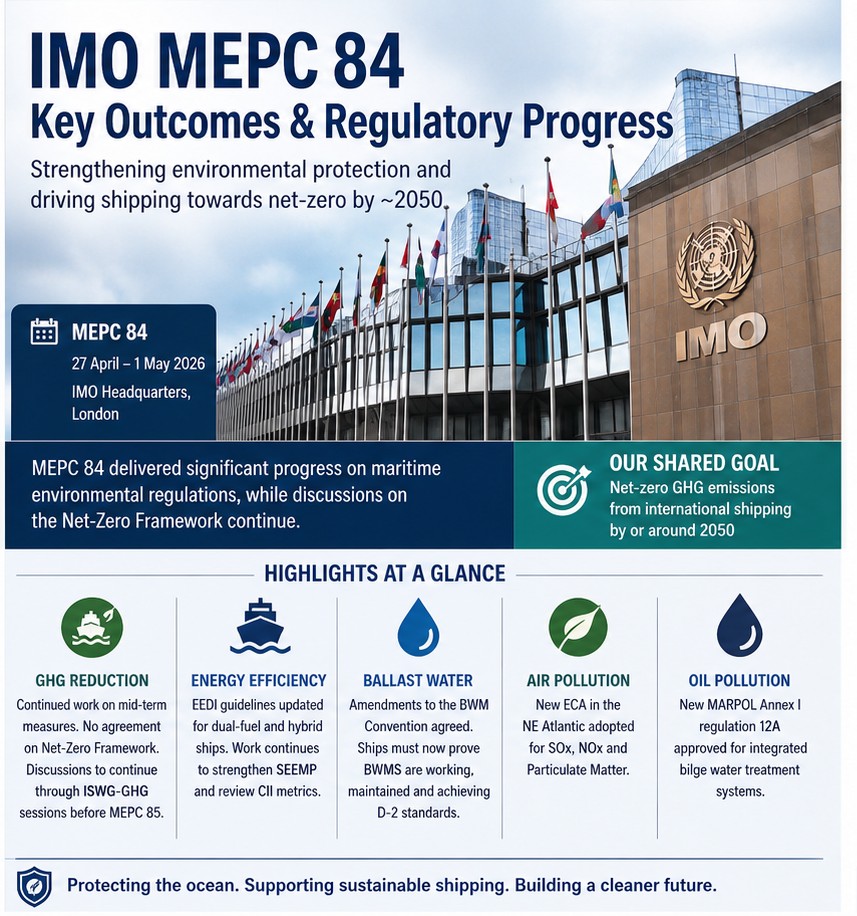
The International Maritime Organization’s Marine Environment Protection Committee (MEPC 84) has concluded with significant regulatory progress—but no final agreement on the much-anticipated Net-Zero Framework, highlighting ongoing divisions among member states on the future of shipping decarbonisation.
Held in London from April 27 to May 1, 2026, the session focused on greenhouse gas (GHG) reduction, fuel standards, energy efficiency, and environmental protection measures shaping the industry’s path toward net-zero emissions by around 2050.
Net-Zero Framework: No Consensus Yet
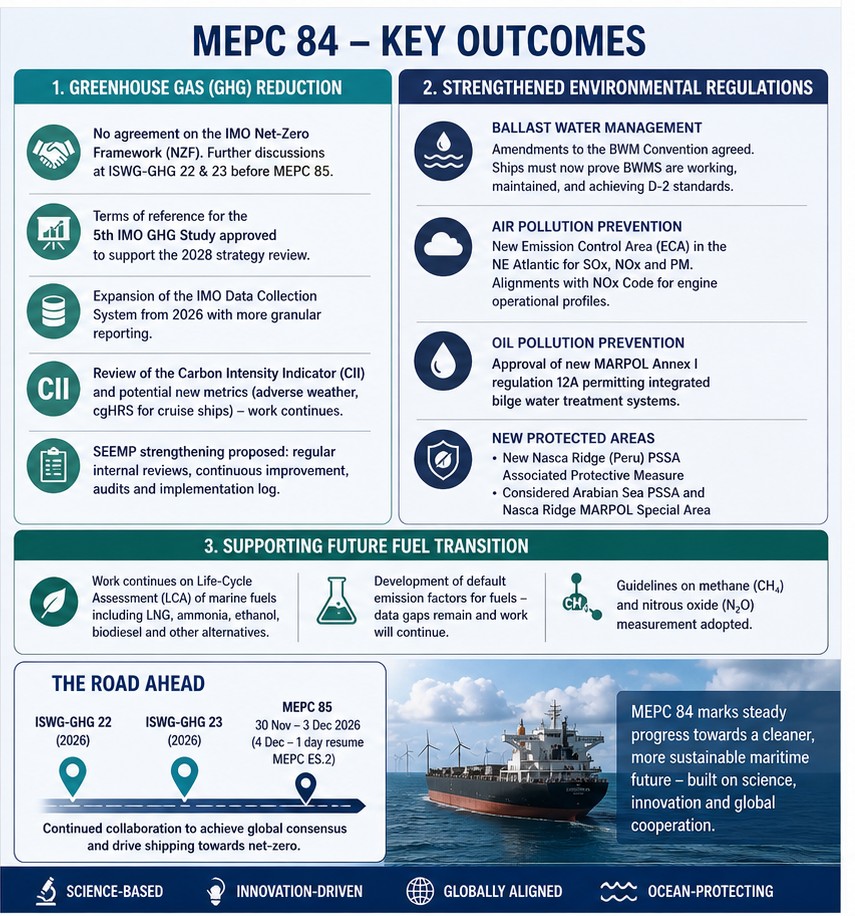
One of the most critical outcomes of MEPC 84 was the lack of agreement on the IMO Net-Zero Framework (NZF).
Member states remained divided between:
- Immediate adoption of the framework
- Further refinement to reach consensus
- Alternative approaches based on fuel market readiness
As a result, discussions will continue through intersessional working groups ahead of MEPC 85 later this year.
👉 This delay signals continued regulatory uncertainty for shipowners and investors, particularly around future carbon pricing and fuel standards.
Stronger Push on Energy Efficiency and Emissions Data
MEPC 84 reinforced efforts to improve operational efficiency and emissions transparency:
- Updates to EEDI guidelines to better cover dual-fuel and hybrid ships
- Continued review of Carbon Intensity Indicator (CII) framework
- Expansion of the IMO Data Collection System (DCS) with more granular reporting from 2026
- Proposal to strengthen SEEMP (Ship Energy Efficiency Management Plan) with continuous improvement and audit mechanisms
Notably, shipping’s carbon intensity has already improved by:
- 31.5% (supply-based)
- 38.6% (demand-based) since 2008
However, debates continue over fairness, enforcement, and real-world applicability of current metrics.
Ballast Water Rules Tightened: Compliance Goes Beyond Installation
A major regulatory shift was agreed under the Ballast Water Management (BWM) Convention:
- Ships must now prove BWMS systems are functioning effectively, not just installed
- Mandatory maintenance logs and performance verification
- Increased inspections by port state control
- Crew familiarisation and operational accountability now enforceable
These changes mark a transition toward “active compliance”, where poor system operation could lead to detention.
New Emission Control Area in North-East Atlantic
MEPC 84 adopted a new Emission Control Area (ECA) covering:
- Greenland, Iceland, Faroe Islands
- UK and Irish coasts
- Extending down to Spain and Portugal
Key requirements:
- SOx limit: 0.10% sulphur fuel (from 2028)
- NOx Tier III rules for new ships (from 2027 onward)
This expands global low-emission zones and increases compliance pressure for vessels trading in the Atlantic region.
Fuel Transition and Lifecycle Emissions Under Focus
The IMO continued work on Life-Cycle Assessment (LCA) of marine fuels, covering:
- LNG, ammonia (including CCS pathways)
- Ethanol, biodiesel, and alternative fuels
- Development of default emission factors
However, many submissions were incomplete or lacked sufficient data, delaying full integration into guidelines.
Fifth IMO GHG Study Approved
MEPC approved the terms for the Fifth IMO GHG Study, which will:
- Assess emissions from 2018–2025/26
- Provide projections to 2050
- Support the 2028 review of IMO climate strategy
The study will be a key scientific foundation for future regulations and policy decisions.
Air Pollution and Methane Emissions: New Technical Guidelines
New measures were adopted to improve emissions monitoring:
- Guidelines for methane (CH₄) and nitrous oxide (N₂O) measurement
- Introduction of Engine Load Monitoring (ELM) and Continuous Emission Monitoring Systems (CEMS)
- Focus on methane slip and real-world emissions tracking
These tools are expected to support future integration into global decarbonisation frameworks.
The Bigger Picture: Progress Without Final Clarity
MEPC 84 delivered important technical and regulatory progress, but stopped short of decisive action on the most critical issue—how global shipping will achieve net-zero emissions.
Key Takeaways
- Decarbonisation direction is clear, but policy path remains uncertain
- Compliance requirements are becoming more data-driven and operationally strict
- Environmental regulations are expanding beyond emissions to system performance and lifecycle impact
The Bottom Line
MEPC 84 underscores a defining reality for the maritime industry:
👉 Regulation is accelerating—but consensus is lagging.
As the IMO moves toward MEPC 85, shipowners, operators, and regulators must navigate a complex transition phase, balancing compliance, investment decisions, and evolving environmental expectations in an increasingly uncertain regulatory landscape.