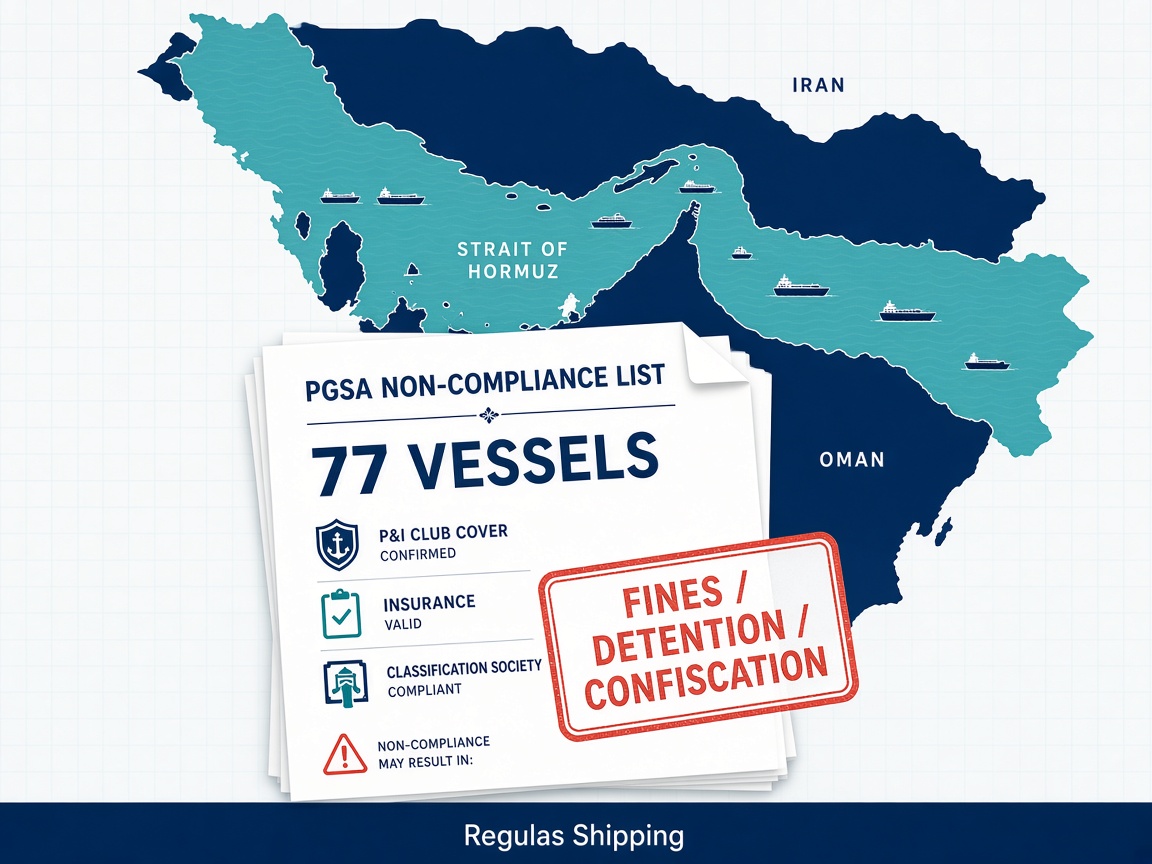
Iran’s Persian Gulf Strait Authority published on Monday, 14 September 2026, an updated Non-Compliance List naming 77 vessels it accuses of violating Iranian protocols for the Strait of Hormuz. The list grew from 56 ships on 3 September, adding 21 hulls in 11 days. It began with 45 vessels at the end of August. Ships on the list, identified by name and IMO number, are warned they may face fines, detention or confiscation on a future passage. In the same notice, PGSA told insurance companies, P&I clubs and classification societies to stop serving those ships “to avoid consequences arising from dealing with them.”
That warning is the operational point. The list is not an IMO circular and it is not a coastal-state traffic scheme adopted under UNCLOS. It is an Iranian permission regime sitting on top of a waterway that is still taking projectiles. A company that treats the update as a charter-party courtesy, or as a reason to file with PGSA to stay off the next version, walks into a second problem. The U.S. Treasury’s Office of Foreign Assets Control designated PGSA as a Specially Designated National on 27 May 2026 under counterterrorism authorities, listing the body as linked to the Islamic Revolutionary Guard Corps. Treasury said anyone cooperating with the so-called strait authority may be providing support to and receiving services from the IRGC. OFAC FAQ 1249 treats receiving Iranian “safe passage” services as prohibited for U.S. persons even when no payment is made. Secondary sanctions exposure can reach non-U.S. companies and foreign financial institutions that facilitate significant transactions involving PGSA.
The 77 names are not only crude tankers. The Maritime Executive reported that the list includes hulls operated by Saudi Arabia’s Bahri and the Kuwait Oil Tanker Company, and that it ranges across crude, LPG, LNG, product tankers and bulkers. Earlier iterations named ships linked to ADNOC Logistics and Shipping and Navig8 Tankers. PGSA has also listed tankers used for shuttle operations and ship-to-ship transfers outside the Persian Gulf. Cooperation that can put a previously clean ship on the list includes STS oil transfers and transshipment with a listed vessel. Cargo owners were told on 23 August to check the Non-Compliance List before chartering for voyages to or from the Gulf. The 14 September notice did not specify the individual violation attributed to each of the 77 ships. Delisting requires a formal application with justifications, previously directed to PGSA. The authority has not said when, or under what circumstances, it would actually fine, detain or confiscate a named hull.
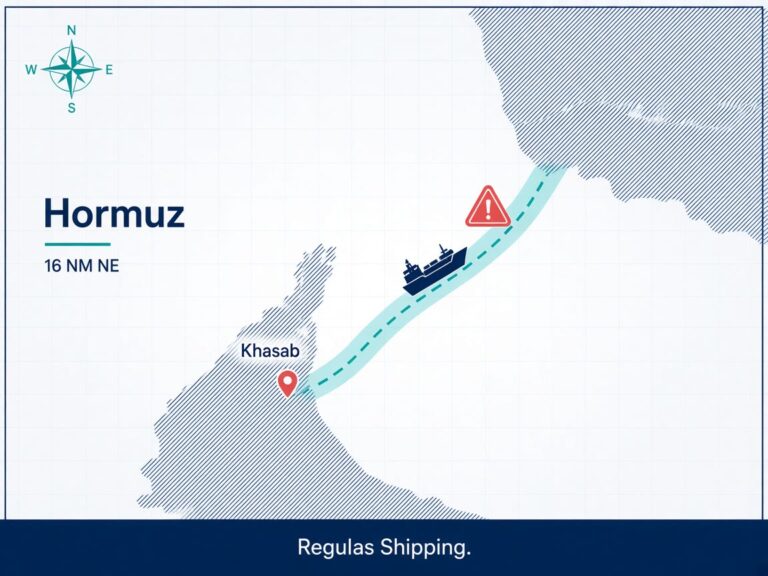
The traffic around that list is still a wartime lane, not a reopening. TankerTrackers said early on Tuesday, 15 September, that satellite imagery as of 14 September showed bi-directional daytime VLCC traffic in the strait and increased STS volumes of crude, LNG and LPG in the Gulf of Oman. Reuters still had weekend commodity traffic at four exits and 10 entries, against a 10-day average of about 14 and a pre-war daily count near 125. U.S. Central Command said American forces had redirected 101 commercial vessels as of 13 September, up from 96 on 10 September, while enforcing the blockade of Iranian ports reinstated in July. The Maritime Executive noted little evidence that the industry is following PGSA’s edicts; the low traffic is more likely the product of attacks. UKMTO Warning 134-26, the El Gaia casualty and the postponed Salalah briefing remain on the same file. The list is a second control layer, not a substitute for lookouts.
STS is the hinge. Gulf of Oman transfers let cargo leave without the original hull making a conventional Gulf port call, which is why PGSA has been adding shuttle and STS tankers. A company that uses a listed ship as a lightering partner can put a previously clean hull onto the same list. Charterers who have been using STS as a Hormuz workaround now have to screen both the shuttle tanker and the export tanker against the 77 names, and against OFAC, before the stems are confirmed. A VLCC that appears in daytime satellite imagery is not evidence that war-risk cover, class attendance or a P&I letter of undertaking will be available if that hull, or its lightering partner, is on the Iranian list and the club has been told to walk away.
The operational implication is dual exposure. A master who coordinates with PGSA to stay off the list, or to get off it, may be dealing with an SDN. A master who transits without Iranian permission may be the next name added, and may still be in a projectile envelope. P&I and class have been told, in Iranian language, to drop listed ships. Those clubs and societies remain bound by their own sanctions screens and by the International Group’s pooling rules. Voyage orders for Gulf calls and Gulf of Oman STS need a named person who can decide whether the ship will file with PGSA, whether it will lighter with a listed tanker, and what happens if the ship appears on the next update. Silence in the voyage order will land on the master if an Iranian controller calls the bridge, or if a club asks why the ship was still offering services to a listed STS partner.
What Operators Should Note
- Screen every Gulf fixture and every Gulf of Oman STS partner against the 77-name list by IMO number. PGSA identifies ships by name and IMO. A name match without an IMO check is not enough. Repeat the screen when the charterer nominates a shuttle tanker, a transshipment hull or a lightering partner, not only at fixture.
- Do not treat a PGSA delisting application as a routine port-state filing. OFAC designated PGSA on 27 May. Treasury’s language covers cooperation and the receipt of “safe passage” services, not only a cash toll. Legal, sanctions and P&I advice belong in the same email as any proposal to write to PGSA. A U.S. person, a U.S.-dollar payment chain or a club with U.S. exposure may have no lawful way to make that filing.
- Write the STS contamination rule into the charter and the SMS. PGSA has said that vessels cooperating with listed ships via STS or transshipment will be added. A clean export tanker that lighters from a listed shuttle can inherit the problem. Name who may approve an STS partner in the Gulf of Oman and what happens if that partner appears on a later list.
- Treat the P&I and class warning as a service-chain risk, not as a new IMO instrument. The notice tells insurers, clubs and societies to stop serving listed ships. It does not create an internationally recognized detention power. It can still delay a letter of undertaking, a class survey or a war-risk quote if a provider decides the Iranian language is now part of its own sanctions screen.
- Keep the kinetic file in the same briefing as the list. Warning 134-26, the El Gaia fire and oil spill, and CENTCOM’s 101 redirected ships are the water the list claims to administer. BMP MS, UKMTO, MSCIO and IFC-IOR reporting stay live. A Non-Compliance List does not thin the watch.
- Do not read Tuesday’s VLCC imagery as a return to a 125-ship day. Bi-directional daytime traffic and higher Gulf of Oman STS volumes are a wartime pattern. Weekend commodity counts were still in the low teens against a 10-day average of about 14. Passage plans written for “Hormuz is recovering” need a second sentence for a projectile, a boarding, or a new list update while the ship is in the last miles.
- Name who may speak to PGSA, who may pay, and who must hold. Iranian officials have described permission, coastal routing and fees. Bahrain’s UNCLOS-and-IMO test, and OFAC’s SDN listing, are the two legal screens underwriters and flags will quote. Put the named decision-maker in the voyage order before the next inbound is asked to coordinate.
Regulas Shipping will keep matching the PGSA Non-Compliance List against OFAC, STS partners and the live Hormuz projectile file so operators can treat a 77-name update as a sanctions and routing decision, not as a traffic-control courtesy.