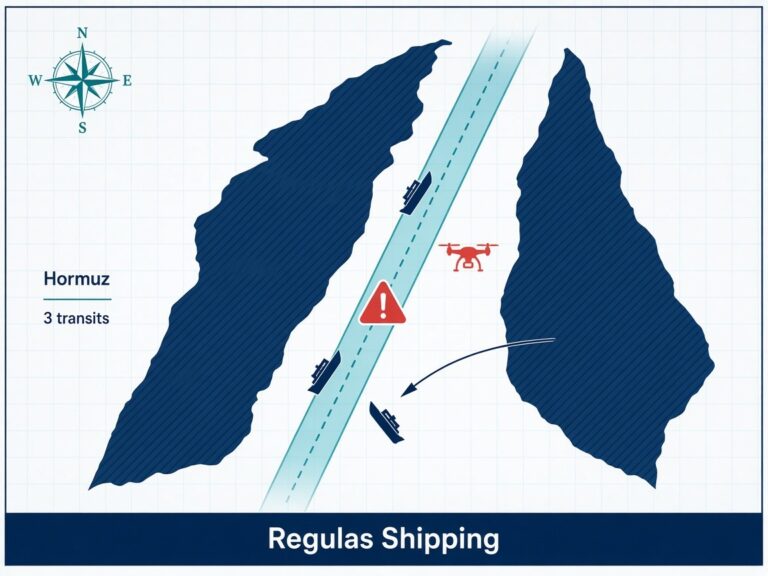
Preliminary Kpler data reported by Reuters on Friday, 18 September 2026, put commodity-vessel transits through the Strait of Hormuz at four on Thursday, 17 September, down from six a day earlier and below the preceding ten-day average of about 16. Three of the four were entering the Gulf. One was exiting. The mix was two Panamax tankers, one Supramax and one Kamsarmax. None of the named hulls was a very large crude carrier. None was an LNG carrier in the transit count itself. The waterway that carried about one-fifth of the world’s oil and gas before the Iran conflict, and on the order of 125 large commercial vessels a day, remains a single-digit strait.
That print is a floor, not a census. Reuters again noted that some ships switch off transponders in the conflict zone and are therefore not counted. Friday’s Kpler snapshot was taken at 0200 GMT. The more useful operational fact is the mix and the LNG file sitting just outside the strait, not the difference between four and six.
What actually moved
Thursday’s four-ship product is another day without a visible VLCC or an LNG carrier in the transit set. Two Panamax tankers, a Supramax and a Kamsarmax can move dirty products, clean products or dry bulk. They do not restore Gulf crude to Asia. A VLCC lifts on the order of two million barrels. A Panamax products tanker does not. Cargoes not lifted this week are deliveries that do not arrive in six to eight weeks. Physical tightness in the barrel still tends to print after the shipping data, not on the same morning.
The Wednesday comparison needs a correction before it is briefed. Reuters on Thursday, 17 September, had put Wednesday’s commodity count at three against a then-revised Tuesday of 12. Friday’s product puts Wednesday at six. That is the same AIS-fill pattern already seen on Tuesday, which moved from four in Wednesday’s first Kpler read to 12 in Thursday’s. Use Friday’s six as the working Wednesday figure unless a later product revises it again. Do not brief charterers on a three-ship Wednesday as if the later fill had not happened. The direction is not in dispute either way: the strait is in single digits against a ten-day average now near 16, itself already a collapse against the pre-war baseline.
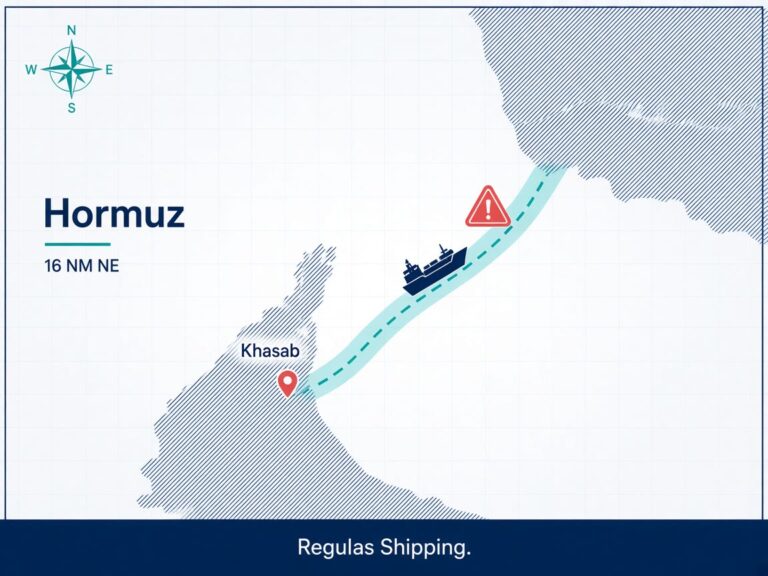
The same-day threat picture is why the count stays suppressed. UKMTO on Friday reported a tanker hit by an unknown projectile in the Strait of Hormuz, with a fire later extinguished and the crew said to be safe. Environmental impact was unconfirmed. That is a separate hull and a separate day from Thursday’s security incident 16 nautical miles northeast of Khasab. UKMTO also verified, time-late, a 16 September outbound tanker struck by an unknown projectile, again with the crew reported safe. Four AIS-visible commodity transits on Thursday sat on top of that cadence, not in a pause.
The LNG file is outside the strait, not in the transit count
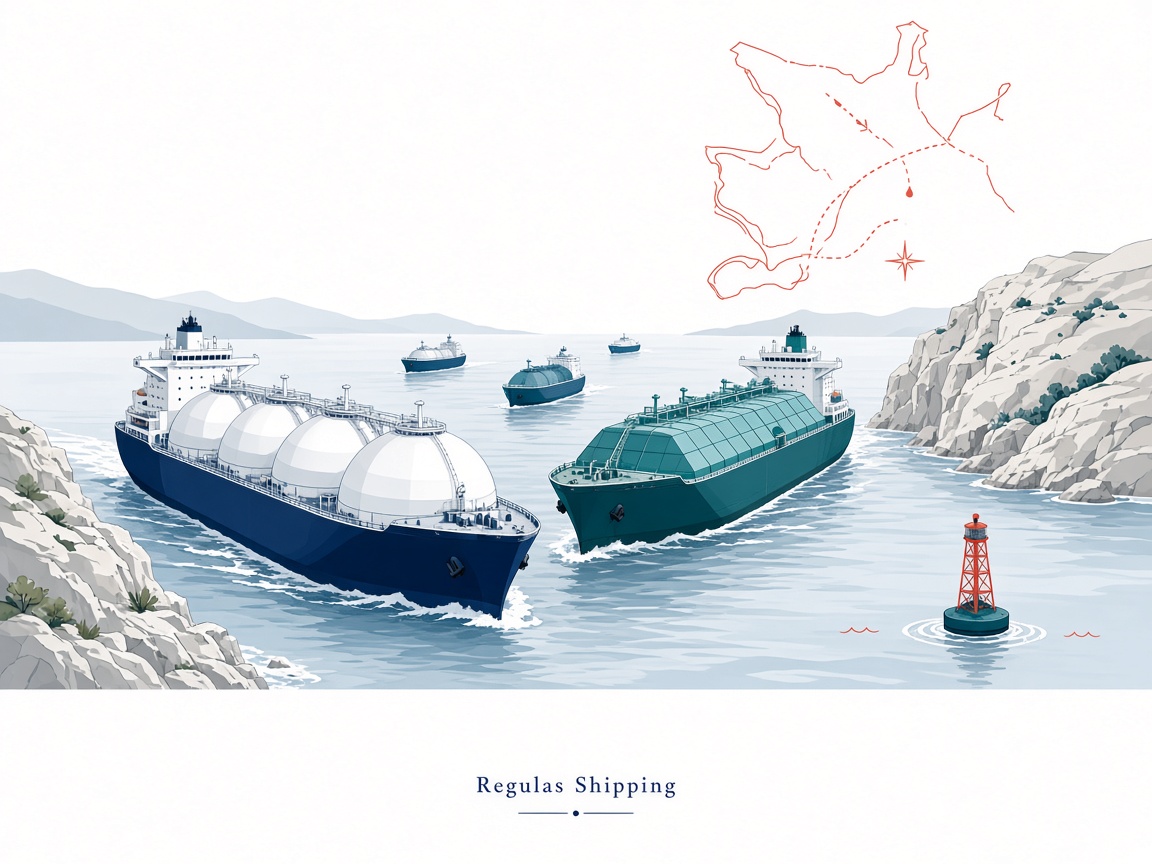
Three liquefied natural gas vessels reappeared outside the Strait of Hormuz on Thursday, according to the same Kpler data. That is not a resumption of LNG transits through the lane. It is evidence that cargoes loaded inside the Gulf are being worked around the strait rather than sailed through it.
Al Daayen and Al Samriya both loaded at Ras Laffan in Qatar. Kpler last saw Al Daayen inside the strait on 13 September and Al Samriya on 14 September. Both are now outside. Reuters identified Al Samriya as QatarEnergy-controlled and Al Daayen as owned and managed by Seapeak. Open-register particulars match a Bahamas-flagged LNG tanker Al Daayen (IMO 9325702, MMSI 311133000, call sign C6VF7): 2007-built, 288 metres, 99,106 gt, 90,617 dwt, about 151,700 cubic metres, commercial manager Seapeak Maritime Glasgow Ltd, ISM manager Seapeak Maritime Ltd. Al Samriya (IMO 9388821, MMSI 538003295, call sign V7PV3) is a Marshall Islands-flagged Q-Max, 2009-built, 345 by 55 metres, 168,189 gt, 154,900 dwt. Treat those identifications as tracker-derived until a warning product or a company statement carries the IMO.
The third hull, Marigold LNG, is operated by UAE-based Kratos Gas Transport and was signalling for arrival at Dabhol, India, after loading at Das Island in the United Arab Emirates. Open-register particulars match a Marshall Islands-flagged LNG tanker (IMO 9230062, MMSI 538011391, call sign V7A7065): 2003-built, 278 metres, 77,410 dwt, registered owner Marigold LNG Ltd, ISM manager Executive Ship Management. QatarEnergy, Kratos Gas Transport and Seapeak did not immediately respond to Reuters’ requests for comment.
The workaround that makes those reappearances possible is ship-to-ship transfer in the Gulf of Oman, including dark STS. Vortexa said in a Wednesday report that the QatarEnergy-linked Al Rayyan engaged in a dark STS with another Qatari carrier off the coast of Oman, without giving the timing. Kpler dated an STS between Al Rayyan and Al Mashabiyyah to 13 September. Open-register matches: Marshall Islands-flagged Al Rayyan (IMO 9086734, MMSI 538009768, call sign V7A5140), 1997-built, 298 by 46 metres, 111,128 gt, 72,430 dwt, about 137,400 cubic metres; Singapore-flagged Al Mashabiyyah (IMO 9986611, MMSI 563266400, call sign 9V9760), 2025-built, 299 by 46 metres, 115,513 gt, on the order of 174,000 cubic metres. Dark in this context means transponders were off for the transfer, not that the cargo is necessarily illicit. It does mean the next ship’s AIS picture will not show the cargo changing hulls.
That pattern is not new this month. Qatar–UAE LNG STS pairs off Ras Laffan and the Gulf of Oman were already on the operator file in early September, including Al Rekayyat–Tembek. Thursday’s three reappearances are the same mechanism printing again: load inside, transfer or wait outside, deliver to India or the Far East without a counted Hormuz LNG transit. An LNG carrier that reappears outside the strait is not a sign that the lane is open for gas. It is a sign that the owners who still have a cargo to move are paying for a second hull and a second risk period rather than sailing the loaded ship through.
Bab el-Mandeb is thinner, not closed
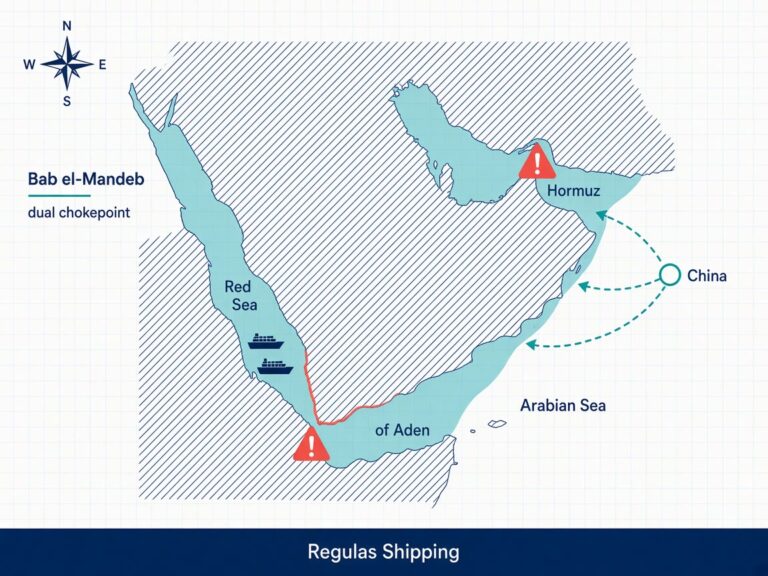
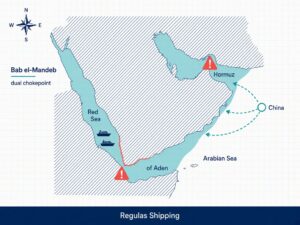
In the Bab el-Mandeb Strait, Kpler counted 23 commodity vessels on Thursday, 13 heading towards the Red Sea and 10 towards the Gulf of Aden. The mix included a Panamax and a Suezmax tanker, four Supramax vessels and six Aframax tankers. The ten-day average for that waterway is around 26. Wednesday’s product had put Bab el-Mandeb at 21 against 24 on Tuesday. The Red Sea lane is therefore still an order of magnitude above Hormuz, and still below its own recent average, against the Houthi seizure of Yemen’s Red Sea coastline, including Mokha, the Hanish islands and Perim.
That gap is the operational fact for routing. Liner schedules that have been put back through Suez are using a strait that is still moving mid-20s a day, not a strait that is moving four. Crude and LNG that used to leave the Gulf through Hormuz do not automatically follow them. Saudi Arabia’s East–West Petroline to Yanbu, the main Hormuz bypass for Saudi barrels, remains stopped after the pumping-station strikes. A 23-ship Bab el-Mandeb Thursday is residual Red Sea traffic, not a substitute VLCC programme out of Ras Tanura.
Why the mix still governs the insurance decision
Formal closure is still not what is stopping merchant traffic. War-risk underwriting is, and it works faster than a blockade notice. When the additional premium erases the charter, the owner declines the business. Crew contracts that allow seafarers to refuse a designated war-risk area add a second stop. Thursday’s four-ship, no-VLCC, no-LNG-in-the-lane print is consistent with that arithmetic.
Do not read U.S. facilitation statistics or NCAGS flow numbers as a commercial TSS. JMIC has continued to rate the strait SEVERE and to record IRGC UAV overflights, targeted surveillance and VHF hailing. Iran’s Persian Gulf Strait Authority Non-Compliance List stood at 77 vessels as of 14 September, with warnings to P&I clubs and class. SAFETY4SEA on Friday noted a spread between single-digit independent tracking and U.S. NCAGS data averaging nearly 30 transits a day over a preceding 96-hour window. Whatever the precise count, the commercial picture in the Kpler commodity set is still a strait that is not exporting Gulf crude or LNG on a counted day. Residual oil under naval cover is a military logistics file. It is not a fixture list.
What Operators Should Note
- Use Friday’s Kpler print as the working Hormuz figure, and keep Wednesday’s revision beside it. Reuters put Thursday at four commodity transits, three in and one out, against a ten-day average of about 16. Friday’s product revises Wednesday from three to six. Neither figure includes AIS-off hulls. Do not brief a “residual 16-ship average” as if Thursday had not printed, and do not keep Wednesday at three after the fill.
- Log the mix, not only the headcount. Two Panamax tankers, one Supramax, one Kamsarmax. No VLCC and no LNG carrier in Thursday’s visible transit set. That is not a crude-export day and not a Qatari LNG-export day through the lane. The energy that is still moving is being worked around the strait.
- Treat the three LNG reappearances as an STS and dark-AIS file, not as a reopening. Al Daayen (IMO 9325702) and Al Samriya (IMO 9388821) loaded at Ras Laffan and were last seen inside on 13 and 14 September. Marigold LNG (IMO 9230062) loaded at Das Island and was signalling Dabhol. Screen those hulls against current sanctions and PGSA lists before the next fixture that assumes they are ordinary intra-Gulf gas tonnage.
- Put the 13 September Al Rayyan–Al Mashabiyyah STS in the CSO pack. Vortexa called Al Rayyan’s transfer dark. Kpler dated the pair to 13 September. Open-register matches: Al Rayyan IMO 9086734, Al Mashabiyyah IMO 9986611. Dark STS off Oman means the cargo can change hull without a counted Hormuz transit. Charterparties that still assume a single loaded LNGC through the strait are mis-describing the voyage.
- Keep Friday’s UKMTO tanker-fire report on a separate line from Thursday’s Khasab incident. Unnamed tanker, unknown projectile, fire extinguished, crew safe, pollution unconfirmed. It is not a reason to treat the Khasab 16-nautical-mile report as the last Hormuz hit. Extra lookouts, a written small-boat and USV standoff, and a pollution-response briefing remain live on approach.
- Do not substitute Bab el-Mandeb’s 23-ship Thursday for a Hormuz VLCC programme. Thirteen towards the Red Sea, ten towards the Gulf of Aden, against a ten-day average of about 26, with a Panamax, a Suezmax, four Supramaxes and six Aframaxes in the mix. Petroline/Yanbu is still offline. If the fixture still assumes a Hormuz VLCC or a Yanbu–Bab el-Mandeb workaround, name the alternative (Gulf of Oman STS, Mediterranean outturn, Cape, or cancellation) before the ship is stemmed.
Regulas Shipping will keep lining Kpler, Vortexa and UKMTO products against the daily Hormuz count so operators can treat a four-ship, no-VLCC Thursday and LNG reappearances outside the strait as a routing and insurance decision, not as a reopening of the gas lane.