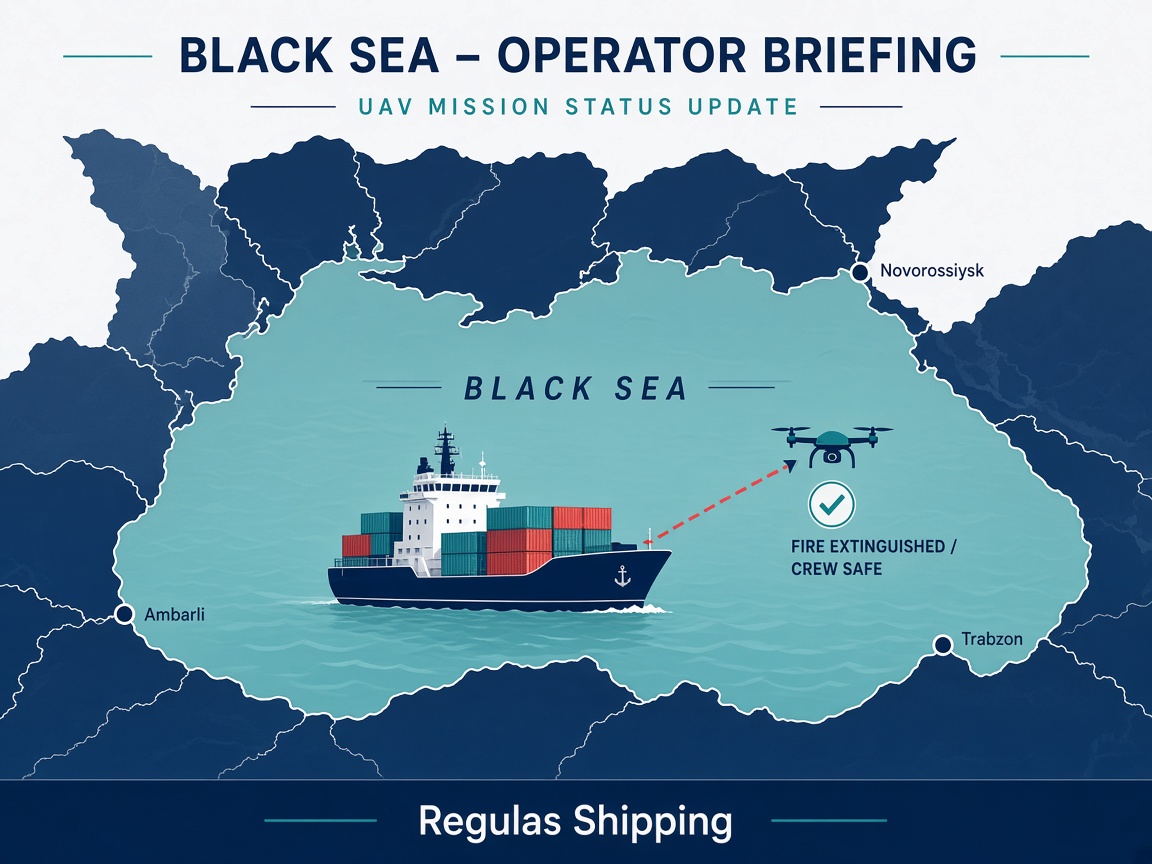
The Turkish-flagged container/Ro-Ro feeder Lionfish was struck by a drone while underway in the Black Sea, according to reports that reached the Istanbul-based IMEAK Chamber of Shipping and Turkish maritime press on 13 September 2026. The 1997 Hamburg-built feeder, IMO 9162667, is 139 metres long, about 24 metres in beam, 13,059 dwt and 9,991 gt. She flies the Turkish flag, is registered in Istanbul, carries call sign TCA7558, and is owned by Feeder Link Denizcilik (Feeder Link Maritime). The drone hit the container section. A fire broke out. The crew extinguished it. No deaths or injuries were reported. Lionfish had been on a civilian commercial voyage from Ambarlı toward Novorossiysk. After the hit she continued toward Trabzon. Authorities have not identified which side launched the drone. Treating the strike as a confirmed Ukrainian or Russian attack is not supported by the public record.
The strike is part of a September pattern in which unmanned systems are hitting commercial ships both in port and in open water. EOS Marine assessed as high-confidence that the Russian-flagged bulk carrier Matros Koshka, IMO 9550137, was hit on 12 September while alongside at Novorossiysk. Damage was reported to the superstructure, navigation bridge, accommodation and crew cabins. A fire was brought under control with port-authority help. Three seafarers were injured and taken to hospital. The ship remained stationary on 13 September pending inspection. Broader Turkish reporting on the first two weeks of September said commercial and service vessels were hit in sequence by unmanned air and marine vehicles, with two seafarer deaths in that window, and named Baryon, Siren, TEDY and Lionfish among ships struck while underway. Ukraine’s Unmanned Systems Forces had already released footage of a drone that hit the Russian products tanker Armada Leader near Sochi after a helicopter escort failed. Ukrainian authorities separately reported a Russian drone damaging a Panama-flagged corn carrier leaving Chornomorsk, with some crew injured. The Black Sea is no longer a port-only UAV problem.
Lionfish matters because she is a Turkish-flagged feeder on a commercial Ambarlı–Novorossiysk run, not a tanker in a declared high-risk oil lane. Container bays and Ro-Ro decks do not have the same fire-isolation design as a tanker cargo system. A UAV into boxes is a hold fire, a lashing and IMDG problem, and a crew-response problem at the same time. The fact that the crew put the fire out and the ship could divert to Trabzon is the good outcome. It is not evidence that the next hit will be survivable. Novorossiysk remains a grain and oil export node. Ambarlı is a Marmara container gateway. A feeder that has to abort to Trabzon after a drone strike is a schedule, insurance and cargo-interest event for every box on board, including any that were destined for a Russian Black Sea port.
The geography of the run is itself a briefing item. Ambarlı sits on the Marmara approaches to Istanbul. A ship bound from there to Novorossiysk must pass the Bosphorus and then steam the length of the Black Sea toward the Russian Caucasus coast. That is a long UAV envelope, not a coastal hop. Trabzon, on Turkey’s south-eastern Black Sea shore, is a sensible abort if the ship can still make way and if the fire is out. It is not a container hub on the scale of Ambarlı, and it is not a substitute for a written diversion port with fire-fighting, residual-heat monitoring and a plan for damaged boxes. Masters who have been treating the Turkish coast as a civilian sanctuary need to put that assumption back in the risk assessment. A drone that finds a feeder on a Novorossiysk heading can also find a feeder on a Trabzon heading.
The operational implication is that Black Sea BMP is still a lookout, AIS, citadel and fire-party problem, and that accommodation hits and cargo-bay hits are now in the same week. Matros Koshka was struck in port, in the superstructure. Lionfish was struck underway, in the containers. Passage plans that only harden the bridge windows, or only close up the cargo fire party, will miss one of those two geometries. War-risk underwriters will ask whether the ship was bound for Novorossiysk, whether AIS was transmitting, whether the fire party was closed up, and whether the company had a named diversion port. Flag and P&I will want the VDR, the fire log and the security message to MRCCs. Charterers who still send feeders and bulkers into the north-eastern Black Sea need a written abort to a Turkish port that can take a fire-damaged container ship, and a written rule for when the voyage is no longer worth the UAV envelope.
Attribution will lag the damage. Turkish reporting was explicit that no official confirmation had identified the operator of the drone that hit Lionfish. Company security officers who brief the incident as a Ukrainian strike on a ship bound for Russia, or as a Russian strike on a Turkish feeder, are writing a political story into the SMS before the evidence is in. The facts that can go into the voyage order now are simpler: a UAV reached a commercial container bay on a Black Sea passage; the crew had to fight a fire; the ship diverted; two seafarers have already died in other Black Sea hits this month. That is enough to raise ISPS and fire readiness without waiting for a ministry statement.
What Operators Should Note
- Treat Lionfish as an underway UAV-into-cargo event, not as a near-miss. The drone hit the container section, a fire started, and the crew put it out. No casualties were reported. The ship still had to abort a Novorossiysk run and head for Trabzon. Brief the fire party, the IMDG list and the lashing plan, not only the bridge team.
- Keep attacker attribution open until a state or a UKMTO/MSCIO product names it. IMEAK and Turkish maritime press recorded the hit and the owner. They did not record a confirmed shooter. Do not write “Ukrainian drone” or “Russian drone” into the master’s orders for this hull until that confirmation exists.
- Close up fire parties and container-bay boundary cooling on Black Sea passages, including feeders. A UAV into boxes is a cargo fire. Boundary cooling, CO2 or foam capability where fitted, and a plan for residual heat in a stack belong in the passage-plan checklist alongside the citadel and the extra lookout.
- Write Trabzon, or another named Turkish port with fire-fighting and container-handling capacity, as the abort. Lionfish could still make way. The next ship may not. Name the diversion port, the person who may order it, and what happens to cargo interests if the ship never reaches Novorossiysk.
- Put Matros Koshka’s accommodation hit in the same briefing as Lionfish. The bulk carrier, IMO 9550137, was hit in port at Novorossiysk on 12 September. Bridge, cabins and superstructure were damaged; three seafarers were injured. Hardening only the cargo bay, or only the accommodation, is a half-measure.
- Re-price Novorossiysk and other Russian Black Sea calls for feeders and bulkers, not only for tankers. Lionfish was a container/Ro-Ro on a commercial Ambarlı run. Grain, steel and box traffic using the same envelope inherit the same UAV risk. War-risk, delay and cargo-interest clauses should be read before the next stem is confirmed.
- Preserve VDR, AIS, fire logs and MRCC traffic from the moment of impact. P&I, flag and cargo underwriters will ask whether the fire party was closed up, whether the ship reported, and whether the diversion was ordered in time. A clean log is part of the defence of the crew as well as of the company.
Regulas Shipping will keep lining Black Sea UAV hits against Turkish, Russian and Ukrainian commercial traffic so operators can treat a feeder fire that was put out as a warning, not as proof the theatre is manageable.