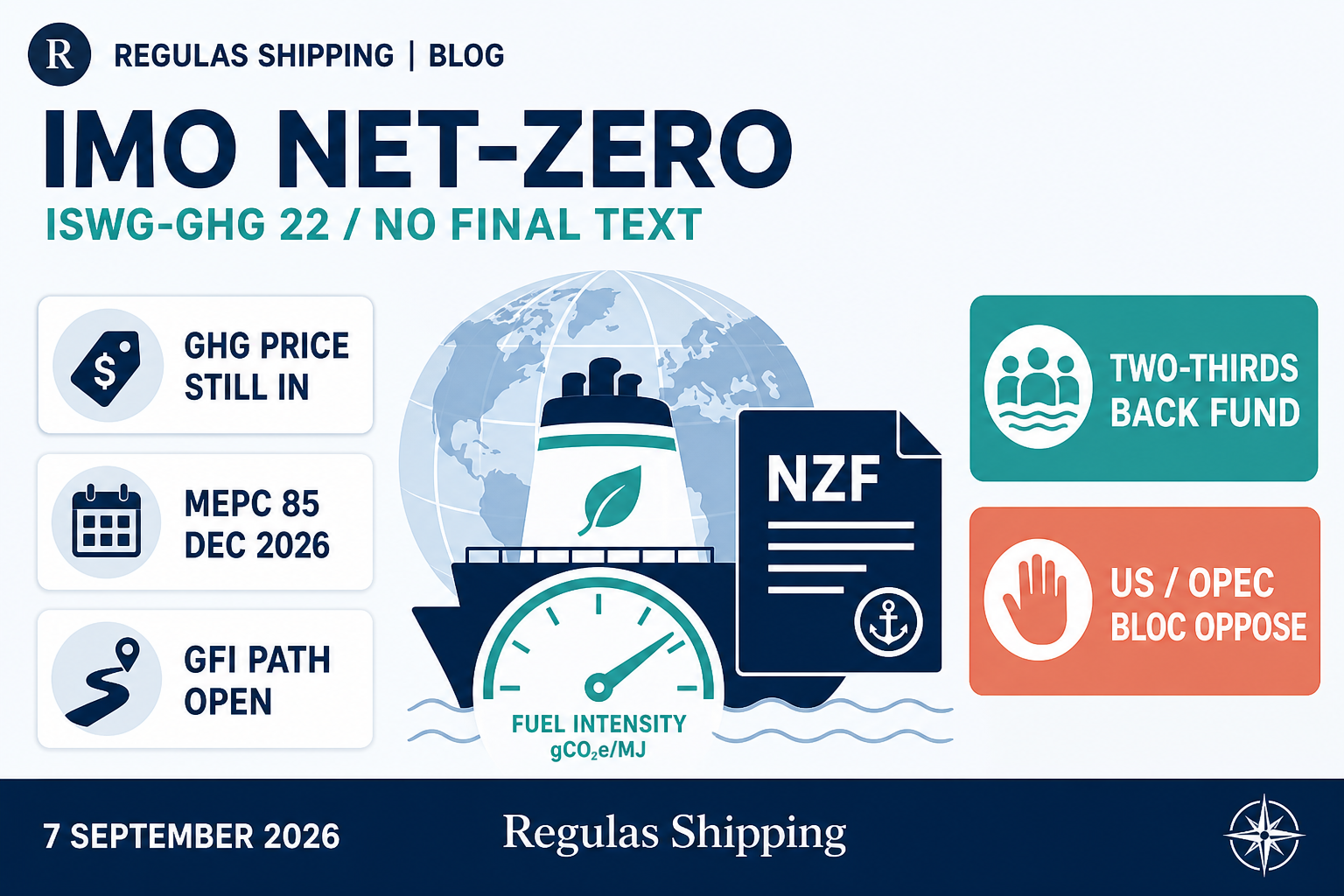
On 4–5 September 2026 the IMO’s 22nd Intersessional Working Group on Reduction of GHG Emissions from Ships (ISWG-GHG 22) closed four days of talks in London without a clean MARPOL Annex VI text and without a new political bargain. Nearly 1,200 participants registered. Delegates spent the week arguing architecture — fuel-intensity pathways, surplus units, rewards and a central fund — rather than consolidating amendment language. That is the operator-relevant fact: the Net-Zero Framework (NZF) is still the centre of gravity, but it is not yet a compliance instrument you can load into a 2027–2030 bunker and newbuild model with a single number.
Observer tallies from the closed sessions are consistent on the core split. About two-thirds of the states that took the floor still backed a centralised GHG price (the remedial-unit, or RU, price) feeding a fund or facility that would pay rewards for early zero- and near-zero (ZNZ) fuels and support a just and equitable transition. gCaptain’s count of explicit interventions put 38 countries on the side of keeping carbon pricing and the revenue mechanism, against 17, largely oil-producing states, that opposed it on cost grounds. The United States and Saudi Arabia continued to push to strip or replace key NZF elements. Japan’s proposal to swap GHG pricing for shipowner-directed contributions was, in UCL’s readout of the room, “robustly rejected.”
The NZF itself is not new. Member states agreed the package in April 2025: a tightening global fuel-intensity standard plus an economic mechanism expected to raise on the order of US$10–15 billion a year. Formal adoption was then delayed after a 57–49 vote under pressure from Washington and Riyadh. ISWG-GHG 22 did not reverse that delay, but it also did not produce a majority for a technical-only alternative. Liberia’s bid to tie obligations more tightly to the availability and price of clean fuels, and to lean on transferable surplus units instead of a fund, did not displace the existing structure. China’s idea of netting RU charges against reward payments into a single transaction drew broad interest, with the detail pushed to guidelines.
What did move — and this is where voyage economics get messy — is the likely shape of the Global Fuel Intensity (GFI) curve. UCL’s post-meeting note is that GFI is likely to be softened around 2030 and then steeper toward 2040. ZNZ rewards remain widely supported; a multiplier that had been taken off the table at the previous session still has enough friends that it could return as an incentive. Most interventions backed keeping NZF compliance tools “as is,” especially GHG-intensity reduction and pooling/transfer of surplus units. A majority opposed minting extra energy-efficiency surplus units to cushion an SU price shock, on the grounds that it would wreck investment predictability. The lifecycle-assessment framework was not even taken this week and was deferred.
The calendar is now the compliance calendar. ISWG-GHG 23 is set for 23–27 November 2026. MEPC 85 runs 30 November to 3 December. The extraordinary MEPC session that was suspended in October 2025 is due to resume on 4 December, which is still the working date for possible adoption — if MEPC 85 actually produces a text. The chair told the group he was confident of a conclusion at MEPC 85. UCL’s caution to industry is the right one for owners and charterers: do not treat this week as a signal you can finalise capex around. Several design choices stayed wide open, and informal drafting between now and November will matter more than any single press line from London.
Operationally, the vacuum is already expensive. EU ETS and FuelEU Maritime continue to bite on European calls regardless of IMO timing. LNG dual-fuel orders made against a soft 2030 GFI can become stranded if the 2040 slope and ZNZ reward design come in hard. Conversely, a delayed or hollowed-out IMO price keeps a two-speed market: European trades with a known carbon bill, and the rest of the world still waiting for an RU price, a reward formula and a fund governance rule. Pacific Island states and the EU continue to argue that weakening the price would freeze alternative-fuel investment. Flag states and oil exporters continue to argue that a global levy hits remote, trade-dependent economies. Neither camp left London.
For commercial teams the practical read-through is narrower than the climate politics. Time-charter and newbuild files for 2027–2032 delivery should carry two cases until December: NZF “as is” with a central RU price and a fund, and a delayed or softened 2030 GFI with a steeper 2040 catch-up. Pooling and SU transfer look more durable than Japan-style owner contributions. Do not assume energy-efficiency credits will be printable as a safety valve. And do not drop EU carbon-cost lines from European voyage estimates just because IMO talks sounded constructive. Constructive is not adopted text.
What Operators Should Note
- Keep two NZF cases in 2027–2032 cost models — central RU price plus fund versus a delayed/soft-start GFI — until MEPC 85 actually publishes amendment text.
- Do not treat ISWG-GHG 22 as a final investment signal. No MARPOL drafting was completed; informal text between now and 23 November is where the real numbers will move.
- Diary 23–27 November, 30 November–3 December and 4 December 2026 as the decision window. Charter-party carbon clauses that assume “IMO price from 2028” still need a fallback if adoption slips again.
- Assume pooling and SU transfer survive; do not assume extra energy-efficiency SUs will be printed to cap price shocks. Majority opposition this week makes that hedge unreliable.
- Watch the 2030 versus 2040 GFI slope, not the 2050 slogan. A softer early pathway plus a steep 2040 step is a stranded-asset risk for LNG-leaning orders if ZNZ rewards then arrive late.
- Leave EU ETS and FuelEU costs in European voyage files. Regional measures are in force now; they are not paused for IMO politics.
- Price ZNZ offtake and reward eligibility as an open commercial item, including the possible return of a multiplier. Fuel contracts signed before December should say who keeps any future IMO reward.
Regulas Shipping will keep lining ISWG-GHG and MEPC papers against EU carbon rules so operators can see which GHG costs are already live and which still depend on a December IMO text.