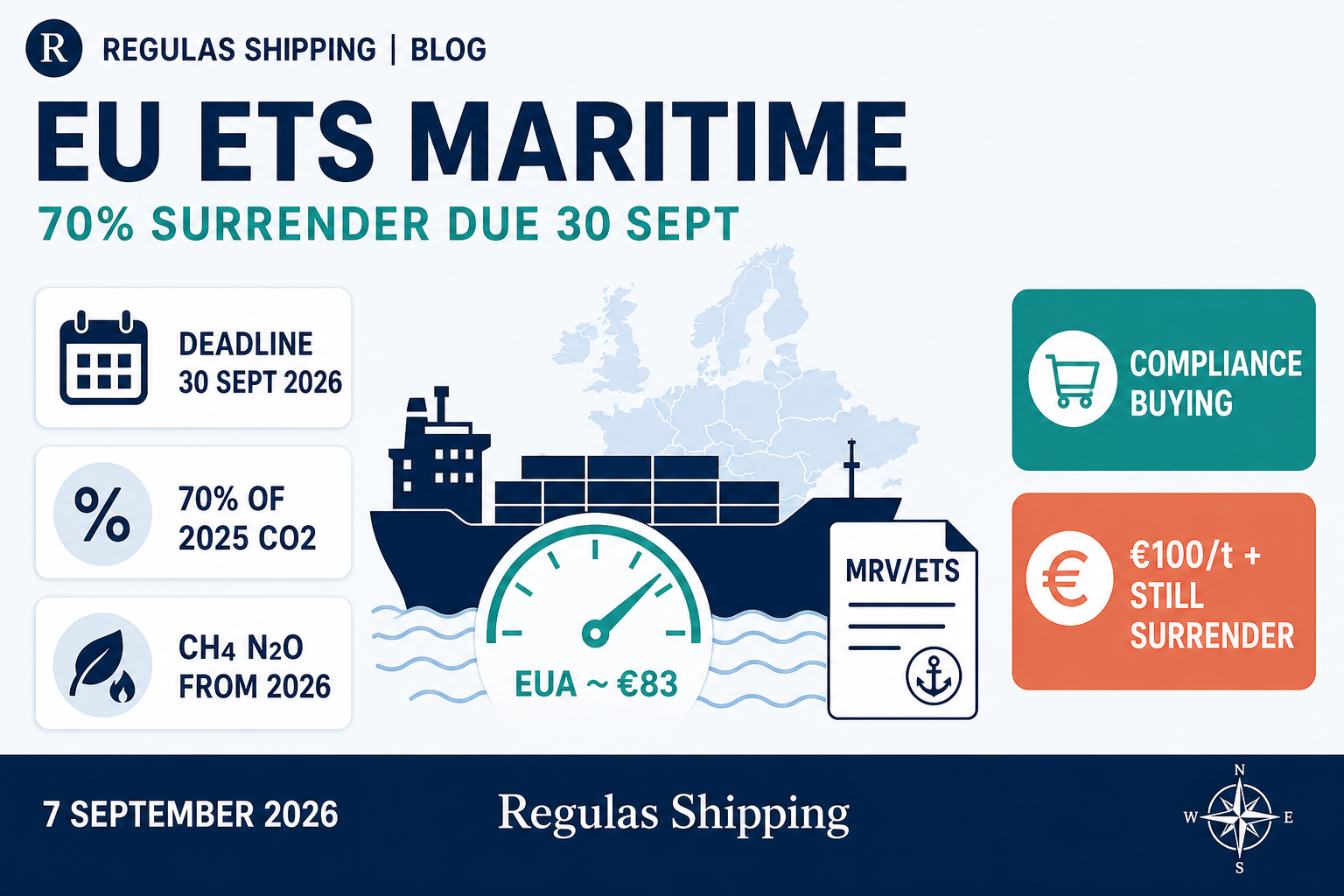
Shipping companies have 23 days to surrender EU Allowances covering 70 percent of verified 2025 CO2 in the maritime EU ETS. The deadline is 30 September 2026. That is not a new legal date — it is the second phase-in step set when maritime transport entered the system on 1 January 2024 — but it is now a cash, registry and charter-party date. Intermodal’s latest weekly note, carried by SAFETY4SEA, put the front December 2026 EUA at about €83.30/t after an August average of €82.36/t, some 6.5 percent above the 2026 year-to-date average, with compliance buying already supporting the tape, including from shipping.
The arithmetic is flag-neutral and route-based. For cargo and passenger ships of 5,000 GT and above, the ETS covers 100 percent of emissions on intra-EEA voyages and at berth in an EEA port, and 50 percent of emissions on voyages between an EEA port and a non-EEA port. The 2025 reporting year is still CO2 only for surrender. Methane (CH4) and nitrous oxide (N2O) sit in MRV already, but they enter the allowance obligation from 2026 emissions, due at the 30 September 2027 surrender. Mixing those two clocks is the most common modelling error in current voyage files: this month’s bill is 70 percent of 2025 CO2; next year’s bill is 100 percent of 2026 CO2 plus CH4 and N2O in CO2-equivalent.
The first maritime cycle was administratively clean. Companies surrendered allowances by 30 September 2025 for 40 percent of 2024 emissions; the European Commission later said shipping covered more than 99 percent of that requirement. 2026 is the step-up year. Verified 2025 ship-level and company-level reports should already be in THETIS-MRV and the Union Registry via the Maritime Operator Holding Account (MOHA). If company-level data are not in the registry, administering authorities can block the MOHA. Surrender is then a registry action, not an email to the verifier: the company must hold enough EUAs in the MOHA and surrender them against the 70 percent figure by the deadline.
Price risk is no longer theoretical. At roughly €83/t, each tonne of in-scope 2025 CO2 costs about that amount times 0.7. On a short intra-EU leg the carbon line can rival a slice of the bunker bill; on a Far East–North Europe head-haul the 50 percent inbound/outbound split still leaves a seven-figure annual exposure for a large containership once the full year is stacked. EUA prices recovered from a March low below €65 and traded a 2026 range that analysts have put from the low €60s to the low €90s. Intermodal flagged European gas (TTF), stronger eurozone manufacturing PMI and fuel-switching as the near-term supports, while the Commission’s July post-2030 ETS-reform outline — a slower cap contraction, conditional free allocation and a softer Market Stability Reserve — is the medium-term supply overhang. None of that moves the 30 September date.
Enforcement is the part operators still under-price. Failure to surrender on time triggers an excess-emissions penalty of €100 per tonne of CO2-equivalent, indexed, plus a continuing duty to surrender the missing allowances. Names of non-compliant companies can be published. Administering authorities — Germany’s BAFA, France’s DGEC, Spain’s OECC and their peers — run the checks. The penalty is not a buy-out: you pay €100/t and you still have to deliver the tonnes. For listed owners the disclosure line can cost more than the EUA line.
Contract leakage is the other operational hole. A large share of 2024 BIMCO ETSS and house ETS clauses were written for CO2 only and for the 40 percent year. They do not automatically pass through 70 percent of 2025 CO2, and they will not automatically pass through 2026 CH4/N2O unless the wording names those gases and the applicable phase-in rate. Time-charter files that still say “ETS as from 2024” without a surrender-year percentage, a gas list and a who-buys-when rule will leave the registered shipping company holding the MOHA shortfall. The same gap appears on LNG dual-fuel tonnage: methane slip does not hit this month’s surrender, but it will hit 2027 cash if 2026 MRV is sloppy. Low-pressure two-stroke LNG plants with slip around 3 percent can give back a large share of the CO2 advantage versus VLSFO once GWP is applied; high-pressure ME-GI-type plants with slip well below 0.2 percent keep most of it. That is a 2026 measurement and clause problem, not a 30 September one — but the same compliance team is running both clocks.
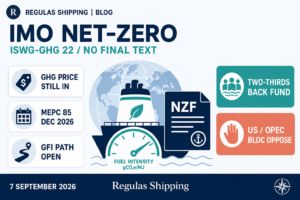
FuelEU Maritime is already in a different phase and should not be conflated with this surrender. 2025 FuelEU reporting, verification and Document of Compliance cycles ran through the first half of 2026. Ships calling EEA ports still need a valid FuelEU DoC. IMO’s Net-Zero Framework remains unadopted after ISWG-GHG 22; it does not pause EU ETS. UK ETS maritime timing is separate again. The practical stack for a Europe-calling ship this month is: 70 percent of 2025 CO2 into the MOHA by 30 September; FuelEU DoC on board; 2026 CH4/N2O monitoring running for next year’s 100 percent year.
What Operators Should Note
- Diary 30 September 2026 as a registry deadline, not a reporting deadline. 2025 MRV verification should already be closed. The remaining task is EUA inventory in the MOHA versus 70 percent of verified 2025 CO2, with a buffer for price and settlement lag.
- Keep 2025 CO2 and 2026 CH4/N2O on separate ledgers. This surrender is CO2 only. Methane and nitrous oxide start in the ETS obligation on 2026 emissions, due 30 September 2027. Do not inflate this month’s purchase order with those gases, and do not omit them from 2026 monitoring plans.
- Budget around €83/t, not last year’s print. Intermodal’s Dec-26 EUA was about €83.30/t after an €82.36 August average. A €10 move either way on a large Europe-calling fleet is material; do not freeze the voyage estimate at the 2025 realised average.
- Missing the date is €100/t plus the tonnes. The excess-emissions penalty does not extinguish the surrender obligation, and non-compliant names can be published. Treat under-surrender as a dual cash and disclosure event.
- Re-open ETSS and house carbon clauses before the next fixture, not after the invoice. Confirm the clause states the 70 percent 2025 rate, names the registered shipping company as the MOHA holder, and says who procures EUAs and when. Add CH4 and N2O language for 2026 time charters even though those gases are not in this month’s bill.
- Check LNG methane-slip evidence now for the 2026 year. This month’s surrender will not show slip. Next year’s 100 percent year will. Independent measurement on low-pressure two-stroke dual-fuel plants is the hedge; clause silence is not.
- Do not net FuelEU or a hoped-for IMO levy against this surrender. FuelEU DoC and EU ETS allowances are separate instruments. ISWG-GHG 22 left the IMO Net-Zero Framework without adopted MARPOL text. European carbon costs remain live regardless of London.
Regulas Shipping will keep lining the 30 September EU ETS surrender against FuelEU and the still-unadopted IMO Net-Zero Framework so operators can see which European carbon costs are cash this month and which still sit on the 2027 clock.