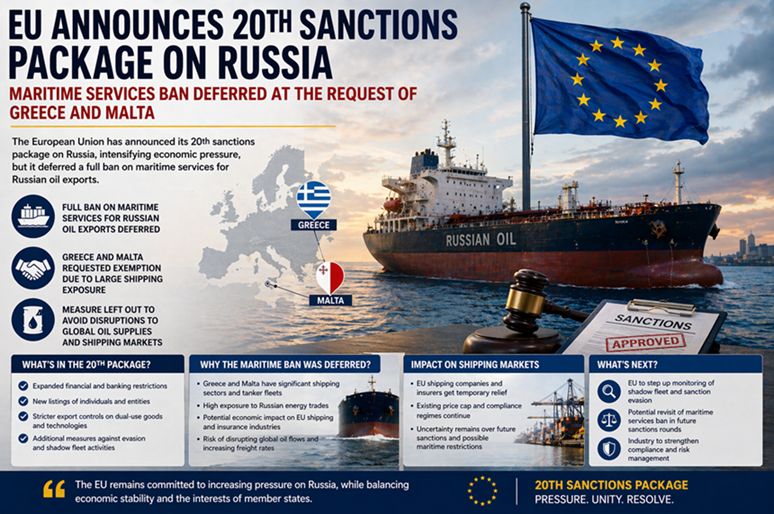
EU’s 20th Russia Sanctions Package Stops Short of Maritime Services Ban
The European Union has unveiled its 20th package of sanctions against Russia, intensifying economic pressure while stopping short of a full ban on maritime services supporting Russian oil exports. The decision reflects a delicate balance between tightening restrictions and safeguarding the interests of key member states with significant shipping exposure.
Maritime Exemption Highlights Internal Divisions
While the latest sanctions package expands financial, trade, and technology restrictions, a proposed blanket prohibition on maritime services—such as shipping, insurance, and brokering for Russian oil—was ultimately deferred. The exclusion came at the request of Greece and Malta, two EU members with substantial stakes in global shipping and tanker operations.
Both countries have large merchant fleets and play a pivotal role in transporting energy commodities worldwide. Industry observers note that a full maritime services ban could have had disproportionate economic consequences for these nations, potentially disrupting their shipping sectors and related financial ecosystems.
Continued Pressure, But Measured Approach
The EU’s move signals a continued commitment to sanctioning Russia over ongoing geopolitical tensions, but also underscores the bloc’s pragmatic approach. By omitting the maritime ban, policymakers appear to be avoiding unintended disruptions to global oil flows and freight markets, which remain sensitive to regulatory shocks.
Shipping analysts suggest that a sudden restriction on maritime services could have tightened tanker availability, driven up freight rates, and forced Russian oil exports further into opaque or non-compliant trading channels.
Impact on Global Shipping Markets
The decision offers temporary relief to European shipowners and marine insurers, particularly those involved—directly or indirectly—in Russian energy logistics. Greek shipowners, who control one of the world’s largest tanker fleets, are expected to remain key players in crude transportation, albeit under existing price cap and compliance frameworks.
However, the deferral also leaves uncertainty hanging over the maritime sector. Market participants are closely watching whether the EU may revisit the ban in future sanctions rounds, especially if geopolitical conditions escalate.
Strategic and Political Implications
The compromise highlights ongoing tensions within the EU between political objectives and economic realities. While northern and eastern member states have pushed for stricter measures, maritime-focused economies have advocated for a more calibrated approach.
This balancing act reflects broader challenges facing policymakers: how to sustain pressure on Russia without destabilizing critical global industries such as shipping and energy.
What Comes Next?
With the 20th sanctions package now in place, attention turns to enforcement and compliance. Authorities are expected to tighten monitoring of “shadow fleet” operations and sanction evasion tactics, particularly involving ship-to-ship transfers and flag changes.
At the same time, the maritime industry is preparing for potential future restrictions. Shipowners, insurers, and charterers are reassessing risk exposure and compliance strategies as regulatory uncertainty continues.
Conclusion:
The EU’s latest sanctions package reinforces its stance against Russia, but the omission of a maritime services ban reveals the complexity of aligning geopolitical strategy with economic interests. For now, global shipping markets remain stable—but the prospect of stricter maritime measures still looms on the horizon.