Six months into the effective closure of the Strait of Hormuz, Qatar and the UAE have started to move a handful of LNG cargoes the hard way. Ship-tracking compiled by Kpler and Vortexa, reported on 8 September 2026, shows three Gulf cargoes transferred ship-to-ship off Oman and the UAE in August before the receiving vessels sailed to buyers in Asia. Two of the three operations involved hulls that had already been damaged or caught in an incident in the strait. This is not a new commercial STS market. It is an emergency workaround for a loading system that still has no pipeline equivalent of Fujairah.
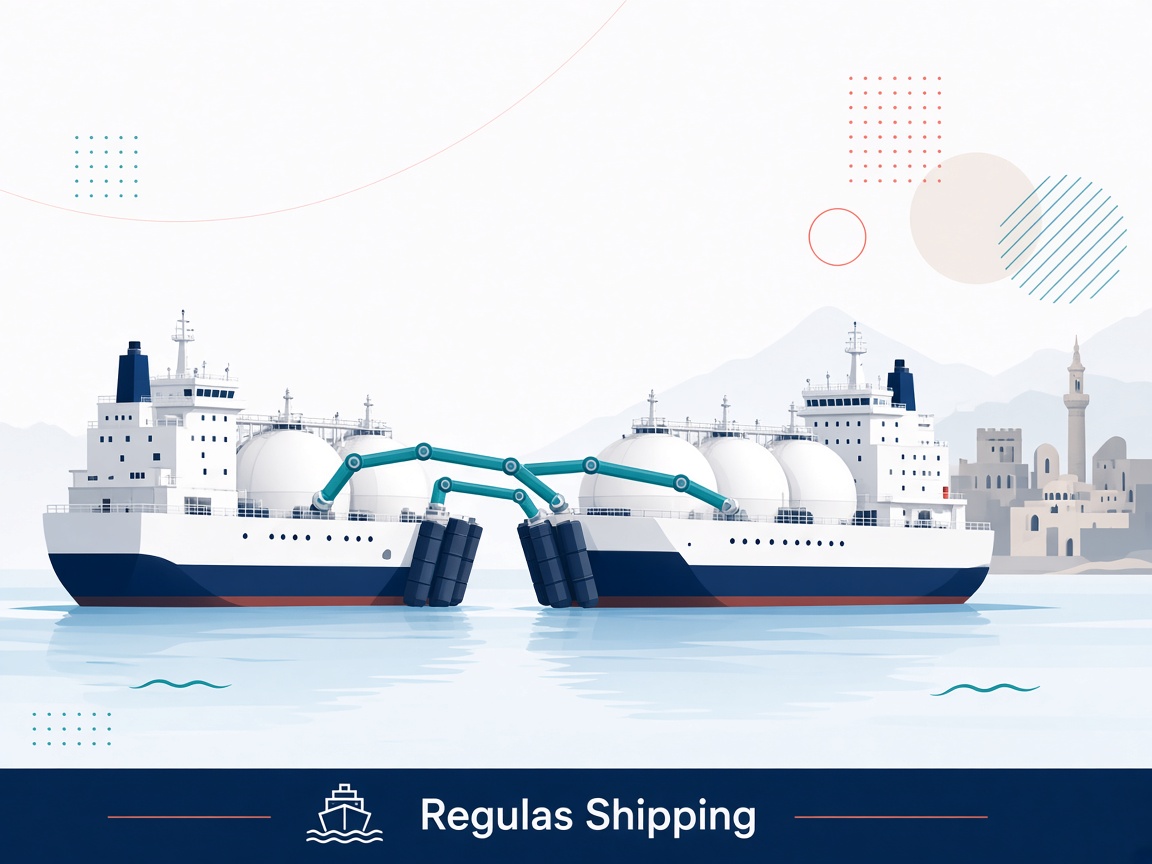
The first transfer was from the QatarEnergy-run Al Rekayyat, struck by a projectile near Hormuz in July, to the Qatari tanker Tembek off the UAE. Tembek then delivered the cargo to India. The second was from GasLog Shanghai, involved in an incident while leaving Hormuz in late July, to GasLog Savannah off Oman. The third was from the ADNOC-controlled Mraweh, which had loaded at Das Island, to LNG Enugu off Oman, with the cargo continuing toward Japan. Cryogenic ship-to-ship transfer is not the crude-oil operation most tanker operators already have in the SMS. LNG has to stay near minus 162 degrees Celsius. The transfer needs specialist arms, fenders, tugs and trained people on both ships, and it runs for about 30 to 35 hours. Industry estimates put the extra cost at more than US$1 million per operation, before boil-off, delay and the second hull’s positioning time.
The volumes behind those three cargoes explain why the workaround is being tried at all. Ras Laffan, the world’s largest LNG export complex, loaded on the order of 140 to 150 cargoes a month before the war. Every one of those ships had to leave through Hormuz. There is no east-coast LNG bypass. The International Energy Agency put the drop in Qatar and UAE LNG loadings between March and June at about 35 billion cubic metres versus a year earlier. Qatar itself exported 18 cargoes in the first six months of the Iran war, against 509 in the same period a year before — a fall of around 96 percent. Lost Qatari gas sales over that window have been estimated near US$24 billion. QatarEnergy remains under force majeure on some deliveries, with cancellations extending into early November. Fitch on 5 September removed Qatar from Rating Watch Negative and affirmed the AA sovereign rating, citing easier immediate risk to LNG plants, but kept a negative outlook because export uncertainty through the strait has not been closed.
Substitution has filled part of the hole, not the routing problem. Non-Gulf LNG production rose by almost 18 percent, or about 27 bcm, between March and June, offsetting roughly three-quarters of the Qatar-UAE shortfall. Global LNG production still fell about 4 percent. North America and Africa added cargoes. That is a supply story for charterers and importers. It does not put a Qatari molecule on a ship that can leave Ras Laffan under a normal bill of lading. The UAE can move some oil to Fujairah by pipeline and load outside Hormuz; LNG from Das Island and Ras Laffan cannot use that pipe. Qatar and Iran discussed a temporary Hormuz corridor and a mine-clearance project in Tehran in late August. That is diplomacy. It is not a sailing instruction, and it does not change the fact that two of the three August STS cargoes left damaged or incident-involved ships.
Operational implications sit in four files: safety, insurance, charter, and the receiving terminal. Safety is the first. An LNG STS is a simultaneous cargo, mooring and station-keeping operation in open water, often in the Gulf of Oman or off the UAE, in a theatre that still has UAV, mine and GNSS-interference risk. A 30-hour alongside window is a long time to be a static target with cargo arms connected. The SMS written for a Ras Laffan load-and-go does not automatically cover emergency cryogenic transfer, vapour handling, ESD, and a breakaway if the security picture changes mid-operation. Older steam ships without reliquefaction give boil-off back as fuel or as a loss; newer two-stroke ships can put some of it back into the tanks, but only if the plant is up and the transfer plan accounts for it. Neither class should be treated as a floating storage unit while the office waits for Hormuz to reopen.
Insurance and charters are the second and third files. Hull and cargo war-risk for the Gulf of Oman and off Fujairah is not the same wording as a Hormuz TSS transit, and an STS may sit outside the named-operation list in the policy. P&I and cargo underwriters will want to know which ship is transferring, which ship is receiving, where the fenders and tugs are contracted, and whether the damaged hull is still classed as seaworthy for cargo operations. On the charter side, QatarEnergy force majeure into November is already rewriting delivery windows. An STS that adds more than a day, a second ship and a seven-figure cost will not automatically sit inside a “reasonable endeavours to deliver” clause written for a direct Ras Laffan sailing. Offtakers in India and Japan who take a substituted hull need a clean chain of custody, a revised NOR, and a terminal that will accept the receiving ship’s size, manifold and cooldown state. The fourth file is commercial honesty: three cargoes do not reopen Qatar. They show that a damaged or trapped ship can, at a price, pass cargo to a clean hull west or south of the strait. Treating that as a scalable export programme will mis-price both the LNG and the ships.
What Operators Should Note
- Log these three August cargoes as emergency STS, not as a new Gulf loading pattern. Two of the three involved ships that had already been hit or incident-involved in Hormuz. Capacity at Ras Laffan is still gated by the strait, not by how many fenders are available off Oman.
- Budget more than US$1 million and 30–35 hours per cryogenic transfer, plus boil-off. Specialist arms, tugs, fenders and people are not optional. Older ships without reliquefaction will show the loss on the cargo outturn; newer ships still need a written vapour plan.
- Put the STS location on the same security plot as a Hormuz transit. A 30-hour alongside in the Gulf of Oman or off the UAE is a static, high-value target. UAV, mine and GNSS-spoofing controls belong in the transfer plan, not only in the strait passage plan.
- Do not assume hull, cargo and P&I war-risk automatically cover the second ship or the transfer itself. Ask whether the named area, the operation type and the damaged hull’s class status are all held covered before the arms go on. Silence in the policy is not permission.
- Re-open LNG sale, time-charter and force majeure files against a November cancellation horizon. QatarEnergy FM into early November is the commercial clock. An STS does not, by itself, defeat FM or restore a contractual delivery window unless the clause says so.
- Receiving terminals in India, Japan and elsewhere need a substituted-hull pack. Ship name, manifold, cooldown, Q88/Q88-equivalent, cargo documents and a revised NOR should move before the receiving vessel sails, not after she is on the pilot station.
- Keep Ras Laffan and Das Island on a closed-strait assumption until UKMTO/JMIC, not a ratings action, say otherwise. Fitch’s AA affirmation is a sovereign credit call. It is not a mine-danger, UAV or TSS clearance. The UAE oil pipeline to Fujairah is not an LNG route.
Regulas Shipping will keep lining Gulf LNG ship-to-ship transfers against Hormuz routing, force majeure and war-risk cover so operators can see which cargoes are actually moving and which remain stuck behind Ras Laffan.