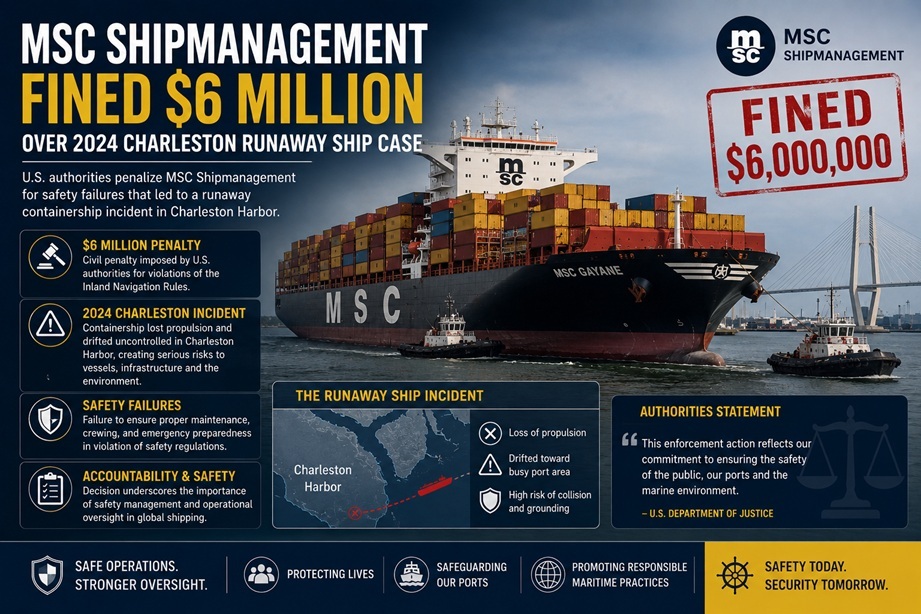
MSC Shipmanagement Limited was sentenced on Monday, 10 August 2026, to a $6 million criminal fine and four years of probation after pleading guilty to failing to report a hazardous condition aboard the containership MSC Michigan VII and obstructing a joint National Transportation Safety Board and U.S. Coast Guard investigation. The company’s chief engineer, Fernando San Diego San Juan, was sentenced to a $2,000 fine after previously pleading guilty on the same charges.
The case stems from a 5 June 2024 incident in Charleston Harbor, when a governor linkage-rod failure left the vessel unable to slow its main engine. The ship ran at roughly 16–17 knots — about four times the harbor speed limit — forcing evacuation of the Arthur Ravenel Jr. Bridge. The harbor pilot navigated the ship safely under the span and out to sea, but the vessel’s wake injured two people ashore and damaged ships and piers. Local beaches were cleared as a precaution.
A Hazardous Workaround That Was Never Reported
According to the U.S. Department of Justice, the engineering crew had been manually adjusting the length of the linkage rod between the governor and fuel rack during port maneuvering because telegraph-ordered revolutions could not otherwise be achieved. Locking washers designed to keep the nuts in place had been removed. Only trained technicians should make such adjustments; none of the ship’s engineering crew were qualified to do so.
Federal prosecutors said the chief engineer knew the practice was hazardous yet allowed it to continue, and later lied to investigators about whether the linkage rod had ever been adjusted. He also instructed other crew members to keep their accounts consistent with his false statements. Both the failure of the engine to match telegraph orders and the manual adjustments themselves were hazardous conditions that should have been reported to the Coast Guard — and were not.
What Operators Should Note
- Unreported mechanical workarounds are a criminal-exposure issue under U.S. ports and waterways safety law, not merely a class or flag-state deficiency.
- Engine-order telegraph response delays during maneuvering must be treated as reportable hazardous conditions, not informal engineering fixes.
- Obstruction of NTSB or Coast Guard interviews sharply escalates consequences for both company and individual officers.
- Post-Baltimore bridge-collapse scrutiny means near-miss harbor control failures will continue to draw aggressive U.S. enforcement attention.
As part of sentencing, MSC must also complete a root-cause analysis of the hazardous conditions aboard MSC Michigan VII. RegulAs Shipping will watch for any follow-on class, flag or commercial consequences tied to the judgment.