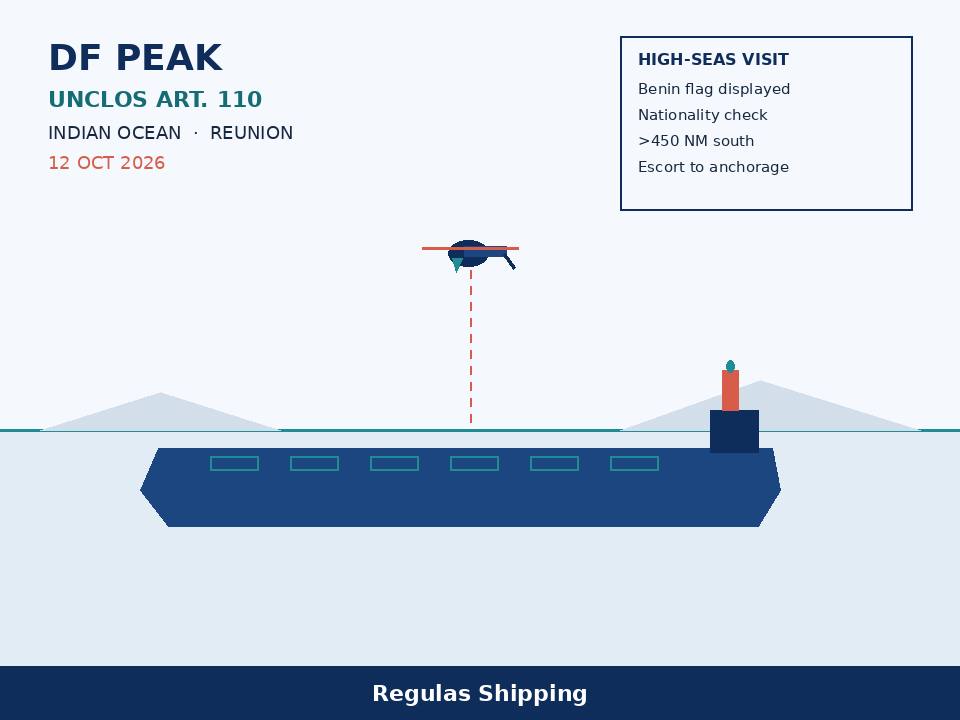
The French Navy boarded the sanctioned crude-oil tanker DF Peak on Monday, 12 October, more than 450 nautical miles south of Réunion in the Indian Ocean. The working primaries are the French Armed Forces General Staff communiqué that day, the prefecture of Réunion, and the public prosecutor in Saint-Denis. President Emmanuel Macron named the hull and said it was suspected of sailing under a false flag and of involvement in illicit fuel-transport activities. The boarding was carried out under Article 110 of the United Nations Convention on the Law of the Sea, to verify the nationality of a ship suspected of flying a false flag. After the visit party examined the ship’s documents, the prosecutor ordered the tanker diverted under naval escort to an anchorage off Réunion for judicial checks. French authorities have not established that the vessel was carrying an illegal cargo. This is a high-seas nationality inspection and a diversion, not a completed confiscation, not an OFAC boarding, and not a Hormuz kinetic file.
The French military said the ship was displaying a Benin flag. Document checks on board confirmed doubts about the regularity of that flag. A report went to the prosecutor in Saint-Denis, who is competent for the maritime court. The tanker is being escorted to an anchorage chosen for its administrative situation and for the needs of the inquiry. Maritime Executive, later on Monday, quoted Defence Minister Catherine Vautrin: the ship is under escort, the inspection continues, and command of the boarding sat with the regional prefect of Réunion even though the tanker was far outside French territorial seas. “International law is not optional,” she said. Macron’s own line was that France is determined to combat the shadow fleet wherever it may be. Le Marin called the interception the first of its kind outside Europe. Those are political and coverage lines. The legal instrument on the water is UNCLOS Article 110 plus a French transport-code offence for a master who cannot justify nationality, not a worldwide port ban.
What the boarding party and the prosecutor actually did
UNCLOS Article 110 is the right of visit. A warship on the high seas may board a foreign ship if there is reasonable ground for suspecting that the ship is without nationality, among other listed grounds. The French staff and the prefecture both printed that article as the basis for Monday’s control. They did not print a hot-pursuit from territorial waters, a port-state detention inside a French harbour, or a sanctions-enforcement boarding as such. The visit confirmed irregularity of the flag displayed. The prosecutor then ordered diversion. That sequence matters for operators: the high-seas step is a nationality check; the escort to Réunion is a judicial measure after that check, not a finding that a cargo is illegal.
The Saint-Denis prosecutor, via Linfo.re on Monday, opened a judicial inquiry for a master’s failure to justify the nationality of the ship during a control at sea. The offence is set out in Article L.5223-2, first paragraph, of the French transport code, and is punishable under the same article and Article 28 of the law of 17 December 1926 by up to two years’ imprisonment and a fine of €300,000. Confiscation of the vessel is also available. The tanker, still under naval escort, was making for an anchorage off Réunion while that inquiry continues. Do not brief Monday as a conviction, a completed forfeiture, or a cargo seizure. The file is an opened investigation on nationality papers.
Port News, drawing on the General Staff, said 21 crew of several nationalities were on board. French statements did not name the master. Macron’s range was “more than 450 nautical miles” south of Réunion; the prefecture and the prosecutor printed “nearly 500 nautical miles.” Stay with the official band. Do not invent a lat/long, a TSS, a cargo grade, or a destination as a French finding. Maritime Executive’s Equasis colour — that the record suggests a false Benin flag, and that Benin has moved to deregister non-compliant tonnage — is industry matching on the register, not the prosecutor’s charging document. Splash said French marines descended by helicopter onto the 110,119-dwt tanker after authorities questioned the claimed Benin registration. Helicopter insertion is Splash’s operational colour on the same Monday boarding; the staff communiqué is the visit, the documents, and the diversion.
The hull, the lists, and what this is not
Open-register colour only: IMO 9341067, MMSI 610000033, call sign TYAD5, about 244 × 42 metres, built 2006 at Hyundai Ulsan, about 110,119 deadweight tonnes on the Port News / Splash / Mer et Marine figures. AIS flag Benin. Former names NS Captain and Kaliningrad. VesselFinder also prints EU, UK OFSI and US OFAC listings against the same IMO. Those particulars are not a class survey and not a French naming beyond the hull already in Macron’s statement.
The history is a sanctions file, not Monday’s charging paper. The tanker traded as NS Captain for Russian state-controlled Sovcomflot. The US Treasury identified IMO 9341067 in February 2024, still as NS Captain, among 14 crude-oil tankers in which Sovcomflot had an interest. Mer et Marine’s flag chronology is Gabon in January 2024, then Kaliningrad under the Russian flag in April 2024, then DF Peak under Benin in June 2025. The EU added the vessel, then named Kaliningrad, to its sanctions list on 25 June 2024. Splash and Maritime Executive add UK, Swiss, Canadian and Ukrainian listings. Maritime Executive also says the hull moved into the SCF-linked, Dubai-based Sun Ship fleet in early 2022 and is now managed from Hong Kong. Port News lists Hong Kong Ding Feng Shipping as shipowner on records dated 19 June 2025. Ukrainian intelligence colour linking the ship to Russian crude exports is secondary. None of that converts Monday into a finding that the tanks held illicit cargo. The General Staff and Port News are explicit: French authorities have not established an illegal cargo.
Monday sits beside, and is not a substitute for, last Friday’s Dutch bill. Dossier 37038 would, if adopted, let Dutch authorities stop and divert false-flag shadow-fleet ships in the Dutch exclusive economic zone. It is not in force. This Indian Ocean boarding is an executed Article 110 visit on the high seas, ordered onward by a French prosecutor, hundreds of miles from Réunion. It is also distinct from earlier French European-waters files that Splash and Meduza recap: Grinch in January, Deyna in March, Tagor and Deliver in June, with Deliver intercepted off Sicily. Those are prior files. Do not collapse them into DF Peak. Do not recast Réunion as a new North Sea detention power, a Tokyo permit, or a Friday OFAC package.
Voyage colour only, and not a French position: VesselFinder last heard the tanker in the South Africa reporting area on the order of a week before the boarding, destination “FOR ORDER,” draught about 8.2 metres. Mer et Marine’s editorial note that the voyage had come from Puerto La Cruz, Venezuela, and was likely headed for an Indian port is the magazine’s read, not the staff communiqué. Do not put either line in the master’s folder as a confirmed load or discharge.
Operational implications
For any owner, manager or charterer with a hull on a Western sanctions list, Monday is a reminder that a displayed flag is now being tested on the high seas, not only at a European port-state berth. Article 110 is nationality, not a cargo inspection by default. If the papers do not support the flag, a coastal state’s warship can visit, a prosecutor can order a long diversion, and the master can face a nationality-documentation offence while the ship sits at an anchorage under escort. Twenty-one people were on board for that diversion. Crew change, stores, and P&I attendance at a Réunion anchorage are now live operational problems for this hull, even though no illegal-cargo finding has been published.
The Benin flag is the contested fact. Operators who still have counterparties claiming small, recently adopted registers should treat Equasis and flag-administration circulars as a pre-fixture check, not as colour. A high-seas visit that confirms irregularity of the flag can move a ship hundreds of miles off its voyage plan before any port-state inspector sees the tanks. Charterers who assumed that Indian Ocean ballast legs sat outside European enforcement should log that France has now done this south of Réunion, not only in the Channel, the Mediterranean or off Sicily.
Do not treat Macron’s “illicit fuel transportation” phrasing as a completed MARPOL or customs finding. The prosecutor’s published count is nationality. Keep the two clocks separate in the security clause file: (1) suspected false flag, visit, diversion, L.5223-2 inquiry; (2) suspected illicit fuel movement, which French authorities have not established. War-risk and sanctions-warranty language that triggers on “seizure” or “detention” should be read against a diversion-under-escort to an anchorage, which may or may not match the clause. Ask the club, in writing, before assuming cover or a deviation.
What Operators Should Note
- Log a named high-seas boarding, not a European port detention. DF Peak, IMO 9341067, 12 October, more than 450 nautical miles south of Réunion, Benin flag displayed, UNCLOS Article 110 nationality visit, documents confirmed doubts, prosecutor in Saint-Denis ordered diversion under French Navy escort to a Réunion anchorage. 21 crew. No published illegal-cargo finding. Force-majeure and deviation files should cite the staff communiqué and the prosecutor, not a social-media seizure clip.
- Keep the legal basis as Article 110 plus L.5223-2, not a sanctions boarding as such. The right of visit is for suspected lack of nationality. The opened offence is a master’s failure to justify nationality during a control at sea: up to two years and €300,000, confiscation available. It is an inquiry, not a conviction. Do not brief a completed forfeiture. Do not invent a cargo-smuggling count to fill the gap.
- Hold the lists as listing history, not Monday’s charging paper. US Treasury February 2024 as NS Captain / Sovcomflot interest. EU 25 June 2024 as Kaliningrad. UK OFSI, Switzerland, Canada and Ukraine also listed on industry reads. Hong Kong Ding Feng Shipping as owner on June 2025 records. Those screens still apply to fixtures, payments and port calls. They are not a French finding that the tanks were illegal on 12 October.
- Do not merge this with Dutch Bill 37038 or with Hormuz. The Hague’s Friday text is a proposed EEZ diversion power, not in force. DF Peak is an executed high-seas visit in the Indian Ocean. It is not Warning 166-26 through 169-26, not Update 104, and not a CENTCOM disablement. Keep the shadow-fleet enforcement file and the Gulf kinetic file in separate folders.
- Ask the club what “detention” and “seizure” mean for an escorted diversion to an overseas anchorage. The ship has not been reported alongside in a commercial berth. It is under escort to a holding anchorage while a nationality inquiry runs. Crew welfare, stores, and whether a P&I correspondent can attend at Réunion are immediate. A displayed small-register flag that Equasis already flags as doubtful is now a high-seas operational risk, not only a port-state remark.
- Do not treat prior French European boardings as this product. Grinch, Deyna, Tagor and Deliver remain earlier files. Monday’s new fact is geography: south of Réunion, first widely briefed French shadow-fleet interception outside European waters. Watch whether the anchorage inspection produces a confiscation order, a release, or a cargo finding. Until then, the published case is flag papers.
Regulas Shipping will keep lining DF Peak’s Article 110 diversion against the Saint-Denis nationality inquiry and the Réunion anchorage clock so operators can treat France’s Indian Ocean boarding as a live high-seas flag test, not as a completed cargo seizure or a Hormuz file.