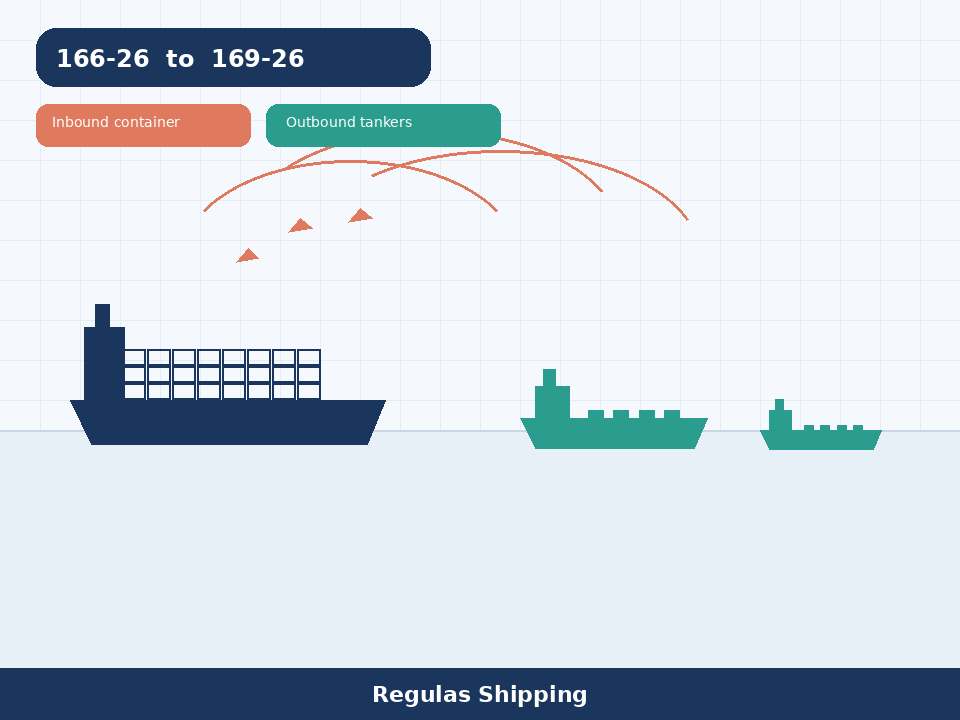
The United Kingdom Maritime Trade Operations centre issued four time-late Attack products on Monday, 12 October, for incidents inside the Strait of Hormuz. Warning 166-26 is an outbound tanker struck by an unknown projectile, crew confirmed safe, environmental impact unknown. Warning 167-26 is a container vessel struck by an unknown projectile while transiting inbound. Warning 168-26 is a products tanker struck by an unknown projectile on an outbound transit. Warning 169-26 is a crude-oil tanker struck by an unknown projectile on an outbound transit. All four are sourced as verified. All four name neither hull, flag, cargo grade, projectile type, position nor a responsible party. Three of the official PDFs print 11 October as the incident date, time to be confirmed. Circulated revisions of the 168-26 PDF print either 11 or 12 October; Seatrade, gCaptain and Maritime Executive treat the four time-late reports as Sunday, 11 October, hits.
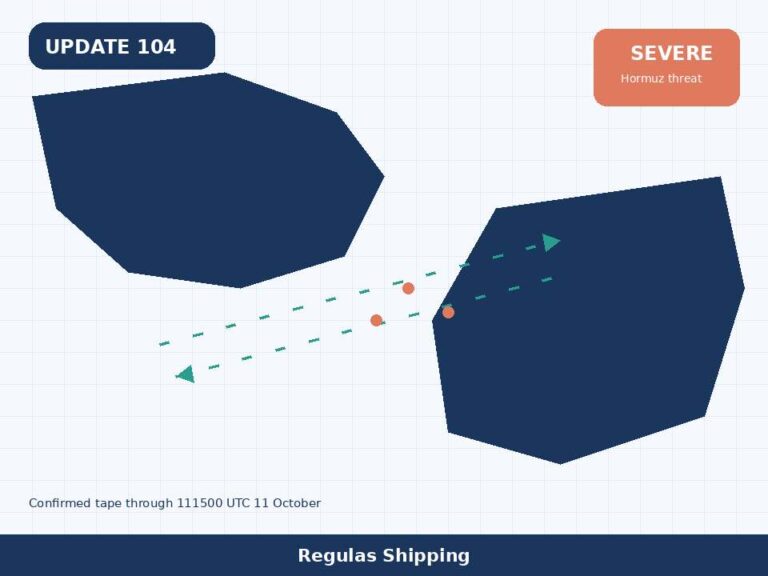
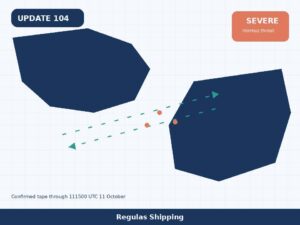
That is the working primary. Monday’s four warnings are a later UKMTO tape, not a rewrite of Sunday’s Joint Maritime Information Center Update 104 and not a rewrite of the dedicated Warning 164-26 and Warning 165-26 pieces. Update 104’s information cut-off was 111500 UTC on 11 October. It already had 164-26 on the table, still unnamed, and it did not print 165-26, 166-26, 167-26, 168-26 or 169-26. The useful facts for a DPA and a bridge team are the first official container-ship Attack product on this autumn’s Hormuz tape, the split between an outbound tanker with a crew-safe line and three products that still have no crew, damage or pollution line, and the fact that four of Sunday’s hits reached the warning board a day late. Do not treat Iran’s Al Maqam video as a UKMTO naming, and do not add Monday’s four files to Update 104’s printed list of five.
What the four warnings actually say
Warning 166-26, issued 12 October, incident date 11 October, time to be confirmed, source verified: UKMTO received a time-late report of an incident in the Strait of Hormuz. An outbound tanker has been struck by an unknown projectile. The crew have been confirmed as safe. The environmental impact is unknown. Authorities are investigating. Vessels are advised to transit with caution and report any suspicious activity to UKMTO. That is the only one of the four Monday products that prints a crew-safe line and an environmental-unknown line. Maritime Executive placed this outbound tanker northeast of the Musandam Peninsula. That range is not on the official PDF. Stay with Strait of Hormuz.
Warning 167-26, issued 12 October, incident date 11 October, time to be confirmed, source verified: a container vessel was struck by an unknown projectile while transiting inbound through the Strait of Hormuz. Authorities are investigating. The official PDF does not print a crew status, a damage line, a fire line or an environmental line. Seatrade called a box-ship hit in the Strait relatively rare, with major liner services still staying away and some smaller feeder traffic still operating. That is industry colour, not a UKMTO ship-type expansion beyond “container vessel.” Maritime Executive placed the container ship at the strait’s eastern entrance. That is not on the official PDF. Do not invent a service, a flag or a TEU count.
Warning 168-26, issued 12 October, source verified: a products tanker has been struck by an unknown projectile while conducting an outbound transit. Authorities are investigating. No crew, damage or environmental line. One circulated official PDF revision prints the incident date as 11 October; another prints 12 October. gCaptain’s wrap of Warnings 165-26 through 169-26 and Seatrade’s four-alert read both treat the products-tanker file as part of Sunday’s time-late cluster. Maritime Executive placed a product tanker northwest of the Musandam Peninsula. Hold the type. Do not force a single official clock onto 168-26 beyond “time-late, outbound, products tanker, unknown projectile.”
Warning 169-26, issued 12 October, incident date 11 October, time to be confirmed, source verified: a crude-oil tanker has been struck by an unknown projectile while conducting an outbound transit. Authorities are investigating. No crew, damage or environmental line. Do not collapse 169-26 into 166-26. One is a generic outbound tanker with a crew-safe line. The other is a crude-oil tanker without one.
UKMTO named neither hull on any of the four PDFs. It did not print a latitude, a traffic-separation-scheme lane, a cargo grade, a fire location or an attacker. The standing advice on all four is the same: transit with caution and report suspicious activity while authorities investigate.
What Monday does not name, and the Al Maqam colour
gCaptain, writing on 12 October, wrapped six commercial vessels reported struck in and around the Strait of Hormuz on 11 October: five tankers and a container ship. That six is 164-26, 165-26, 166-26, 167-26, 168-26 and 169-26. Four of those warnings were time-late. The dedicated 12 October 03:30 Warning 164-26 piece remains the Sunday 1200 UTC company-security-officer outbound: port-side unidentified projectile, damage, all crew safe, no environmental impact reported at the time of the attack. Update 104 later added steering-gear-room and port-water-tank damage and a Fujairah destination, still unnamed. The dedicated 12 October 03:30 Warning 165-26 piece remains the Sohar-anchorage UAV Attack, first issued as Suspicious Activity, then reclassified after confirmation of an uncrewed aerial vehicle, local authorities assisting evacuation, crew/damage/environment unknown on the first products. India’s Nicaragua-flagged MT Petro Dolphin naming stays on that dedicated file. Monday’s four warnings do not reprint 164-26 or 165-26, and they do not name Petro Dolphin or Valthera.
Seatrade, publishing early on 13 October, counted four more Hormuz attacks on 11 October — three tankers and a container ship — and said UKMTO had issued 18 reports of attacks on vessels in the Strait of Hormuz and the surrounding region during October. That 18 is Seatrade’s running tally, not an official UKMTO monthly instrument. Do not add it to Update 104’s 140 incidents since 1 March.
The same Seatrade piece, TradeWinds on 12 October and Maritime Executive carried Iran’s competing naming. Islamic Revolutionary Guard Corps-affiliated Tasnim published video of a tanker on fire that, on the IRGC account, had been making an unauthorised transit. Seatrade described an apparently laden Liberia-flag VLCC, Al Maqam, with a fire-blackened funnel and a tug attempting to extinguish a fire. TradeWinds identified the 298,800-dwt VLCC Al Maqam, built 2017, and said the UAE-based owner declined to comment on the footage and the statement. Maritime Executive said unverified stern footage displayed the name of the UAE-owned tanker Al Maqam, IMO 9732577, and that the timing — and whether the ship was the tanker in UKMTO’s Monday report — was not immediately clear. ADNOC Logistics & Services had not commented in those primaries. Open-register colour only: IMO 9732577, MMSI 636026818, call sign A8YN4, Liberia, 2017, about 333 × 60 metres, about 154,139 gt / 298,767 dwt, registered owner Al Maqam Inc, commercial and ISM manager listed as ADNOC Logistics & Services. VesselFinder’s AIS last heard on the order of 51 days before the video, and OSINT claims of AIS-off shuttle work, are voyage colour. They are not a class survey and not a UKMTO or JMIC naming. Al Arabiya, early on 13 October, carried an IRGC Navy statement via Sepah News that a supertanker was hit in the Strait of Hormuz and caught fire after disabling its transponders and ignoring warnings, against a weekend line from IRGC naval commander Ali Ozmaei that a vessel disabling its transponder to avoid detection would be considered hostile. Do not assign Al Maqam to 166-26, 168-26 or 169-26. Do not brief a confirmed IRGC naming of a UKMTO hull.
Al Jazeera’s 12 October shuttle-system read is context, not a fourth warning. Iran’s security chief Mohsen Rezaei said on Sunday night that an Arab-operated, U.S.-assisted oil shuttle was now an explicit target, claimed five or six participating vessels were being struck nightly, and described smaller vessels transferring oil to larger tankers with United Arab Emirates military assistance. Windward colour in that piece — 15 ships believed targeted in October, 87 percent of 45 third-quarter targets tankers, most strikes in the southern corridor with transponders off — is industry colour. It is not a UKMTO monthly count and not a naming of Monday’s four hulls. The IRGC weekend mine-contact claim against three unnamed tankers remains unused as a dedicated file unless UKMTO, JMIC or a flag prints mines against a named hull.
Operational implications
A cluster of time-late Attack products is a reporting and routing problem before it is a hull list. Four of Sunday’s Hormuz hits were not on the warning board when Update 104 cut off at 111500 UTC. gCaptain’s point stands for a CSO: security assessments and official incident counts may not reflect the most recent attacks while they are happening. Passage plans written against Update 104 alone are a day behind Monday’s tape. They are also a day behind 165-26, which Sunday’s numbered note did not print.
The container-ship file is the operational change of type. This autumn’s dedicated Hormuz tape on this desk has been tankers, LNG and LPG, plus one Gulf of Oman bulk-carrier blockade disablement. 167-26 is an inbound box ship. Seatrade’s feeder-traffic colour is the only industry read available. Feeder operators still offering a Gulf call should not brief a tanker-only threat inside the strait, and main-line operators who have stayed out should not treat one unnamed inbound hit as a liner-reopening signal. UKMTO did not print a service, a flag or a casualty line.
The outbound split matters for the shuttle watch already on the dedicated 160-26, 162-26 and 164-26 files. Three of Monday’s four products are outbound — a generic tanker, a products tanker and a crude-oil tanker. Update 104 had already called 164-26 the second outbound tanker struck within about 16 hours of the 10 October fire, and it had already warned that further projectile or drone incidents could affect outbound vessels in the southern Omani corridor and tankers at UAE anchorages. Monday does not name those corridors. It also does not clear them. AIS-off remains a detection problem, not a shield. Ozmaei’s hostile-transponder line is IRGC messaging. It is not a UKMTO routing order and not a licence to go dark.
CSOs should add 166-26 through 169-26 to the master’s folder beside Update 104, 164-26 and 165-26, and should not merge the four new PDFs into one unnamed Sunday “six-ship” event. 164-26 already has a CSO, a port-side hit, a crew-safe line and, on Update 104, a Fujairah destination. 165-26 is a Sohar UAV, not a Hormuz TSS projectile. 166-26 is the only Monday file with a crew-safe and environmental-unknown line. 167-26 is the container. 168-26 is products. 169-26 is crude. None of those edits is a flag circular, a class condition, or a completed MARPOL finding.
Do not merge Monday with the dedicated 12 October 11:30 IMO-board count of 104, with the dedicated Netherlands false-flag bill, or with the unused IRGC mine-contact claim. Monday’s four warnings are unnamed time-late Attack products. They are not Update 105, not a Hormuz reopen, and not a UKMTO naming of Al Maqam.
What Operators Should Note
- Log four new Attack products, issued 12 October, not a rewrite of Update 104. 166-26: 11 October, time to be confirmed, verified, outbound tanker, unknown projectile, crew safe, environmental impact unknown. 167-26: 11 October, time to be confirmed, verified, inbound container vessel, unknown projectile, no crew/damage/environment line. 168-26: verified, outbound products tanker, unknown projectile; official PDF revisions print 11 or 12 October as the incident date. 169-26: 11 October, time to be confirmed, verified, outbound crude-oil tanker, unknown projectile. Replace nothing in the Update 104 pack; add the four PDFs beside it.
- Do not name a hull against 166-26 through 169-26. UKMTO printed none. IRGC / Tasnim video of Liberia-flag VLCC Al Maqam, IMO 9732577, about 298,800 dwt, built 2017, ADNOC Logistics & Services on Seatrade and TradeWinds, fire-blackened funnel, tug alongside, owner no comment, is competing colour. Seatrade and Maritime Executive both said it was not clear whether that video is one of Monday’s four files. Open-register MMSI 636026818 / A8YN4 / about 154,139 gt is particulars colour, not a UKMTO or JMIC naming.
- Keep Sunday’s dedicated files on their own clocks. 164-26 remains the 1200 UTC CSO outbound, port-side damage, crew safe, no environmental impact at warning time; Update 104 added steering-gear room, port water tank and Fujairah, still unnamed. 165-26 remains the Sohar UAV Attack and the Petro Dolphin labour-state naming. gCaptain’s six-ship 11 October wrap is those two plus Monday’s four. Do not brief one event.
- Treat 167-26 as a type change, not as a liner reopening. Official wording is container vessel, inbound, unknown projectile. Seatrade: box-ship hits in the Strait are infrequent; main lines still staying away; some feeder traffic continues. Maritime Executive’s “eastern entrance” range is not on the PDF. Do not invent a flag, a service or a casualty tally.
- Do not add Monday to Update 104’s 140 or to Seatrade’s October 18. Update 104 cut off at 111500 UTC on 11 October and printed 159-26, 160-26, 162-26, 163-26 and 164-26. Seatrade’s 18 is a newspaper running tally of UKMTO attack reports in October. They are different series. Al Jazeera / Windward “15 ships in October” is a third series.
- Hold the outbound-shuttle watch without a published routing order. Three of the four new products are outbound. Update 104 already flagged further projectile or drone risk on the southern Omani corridor and at Ras Al Khaimah, Umm al Quwain, Sharjah and possibly Fujairah. AIS-off does not prevent detection. Ozmaei’s hostile-transponder line and Rezaei’s shuttle-target line are Iranian messaging, not UKMTO products. Report to UKMTO. Transit with caution. Do not brief a confirmed IRGC mine, a named ADNOC casualty, or a Hormuz closure.
Regulas Shipping will keep lining Warnings 166-26 through 169-26 against Update 104 and the dedicated 164-26 / 165-26 files so operators can treat Monday’s inbound container and three unnamed outbound tankers as a live time-late tape, not as a UKMTO naming of Al Maqam or a completed Hormuz reopen.