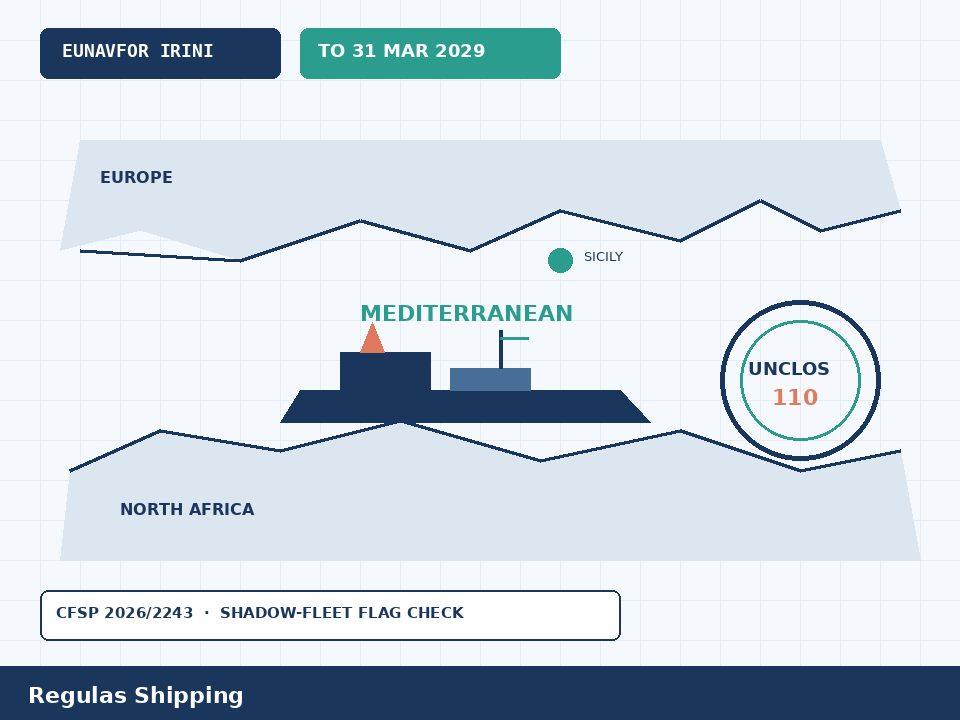
The Council of the European Union adopted Council Decision (CFSP) 2026/2243 on 9 October in Luxembourg, amending Decision (CFSP) 2020/472 on the European Union military operation in the Mediterranean, EUNAVFOR MED IRINI. The working primary is the Official Journal text, OJ L, 2026/2243, published 12 October. The decision entered into force on the date of adoption. Article 15(2) now reads that IRINI shall end on 31 March 2029. The previous extension, Decision (CFSP) 2025/488 of 11 March 2025, had run to 31 March 2027. Operation IRINI published its own mandate note on 13 October under the line “IRINI 2.0: Ready. Credible. Scalable.” World Ports carried the English operator read on 17 October. This is a Mediterranean legal instrument. It is not a new boarding of a named tanker, not a confiscation order, and not a Hormuz kinetic file.
The Council decision is the first dedicated mandate-renewal primary on this desk. The dedicated August boarding of the EU-sanctioned tanker Toa Payoh west of Pantelleria remains that boarding. Friday’s dedicated EUNAVFOR ATALANTA case-status note off northern Somalia is a different EU operation. The dedicated 13 October French UNCLOS 110 boarding of DF Peak south of Réunion is a national flag-verification in the Indian Ocean, not an IRINI act. The dedicated 12 October Dutch bill 37038 remains a submitted North Sea text that has not commenced. Do not collapse Sunday’s Council decision onto those files.
What the Official Journal actually changed
Three political objectives now sit in Article 2. IRINI shall, within its means and capabilities: safeguard Union interests in the Mediterranean through credible protection and deterrence; contribute to the implementation of United Nations Security Council resolutions in support of peace and stability in Libya; and foster Mediterranean partnerships through capacity building and training, and naval diplomacy, as part of the Union integrated approach. Article 1(1) is rewritten to match: a military crisis management operation with the political objectives of safeguarding Union interests in the Mediterranean Sea and contributing to peace and stability in Libya.
The new work is in Article 3. IRINI shall contribute to maritime situational awareness of illicit activities, expanded toward maritime domain awareness, and shall gather information useful for contingency planning. It shall contribute to constraining Russia’s “shadow fleet”, as defined in IMO Assembly Resolution A.1192(33) of 6 December 2023, in compliance with UNCLOS and international regulations, through a whole-of-route approach. It shall support the protection of critical maritime infrastructure, including through trials and pilot deployments of technological solutions. It shall contribute to disrupting the business model of human smuggling and trafficking networks by information gathering and aerial patrolling above the high seas in the agreed area of operation. Information from those tasks may be stored and released to member-state authorities, competent Union bodies, and, if applicable, NATO; trafficking information may also go to the UN Panel of Experts on Libya. IRINI shall report to the Political and Security Committee on actions such as inspections or visits to verify the flag. The PSC may consider any subsequent measure, as appropriate.
That last sentence is the operator line. A flag-verification visit is not, on the face of the decision, an automatic detention, diversion or confiscation. Subsequent measures sit with the PSC. The operation’s 13 October note is plainer on the method: the Mediterranean is a key transit and transfer area for Russia’s shadow fleet; IRINI’s ships can monitor those activities and, where applicable, contribute to constraining them through flag-verification boardings conducted in accordance with Article 110 of UNCLOS. Article 110 is a right of visit to verify nationality. It is not a cargo-seizure power. Do not brief 2026/2243 as a Mediterranean oil-confiscation mandate.
Libya work is restated, not dropped. Recital (3) records that UNSCR 2292 (2016) expired on 25 May 2026. That resolution had authorised high-seas inspections off Libya of vessels reasonably believed to be carrying arms in violation of the UN embargo. Article 4 now frames the Libya task as contributing to the implementation of the UN arms embargo under UNSCR 1970 (2011) and subsequent resolutions by reporting on and deterring illicit arms trafficking, using aerial, satellite, maritime and other assets, and as contributing to UN measures against illicit exports of petroleum from Libya under UNSCR 2146 (2014) and subsequent resolutions. IRINI shall again report flag-verification visits on those tasks to the PSC, which may consider subsequent measures. Capacity building and training for Libyan maritime law-enforcement and search-and-rescue institutions remain, with a platform for maritime-security cooperation that may include Egypt, Tunisia and Lebanon. Common costs for 1 April 2027 to 31 March 2029 are set at EUR 16,880,000. The Council President on the instrument is S. Harris.
Operational implications
For a DPA with tankers, products hulls or other tonnage on a Mediterranean passage — Gibraltar to the Sicilian Channel, the approaches to Pantelleria, Malta, Tunisia, the Gulf of Gabès, or a Libya-adjacent STS — 9 October is a mandate change, not a new intercept circular. The method IRINI has already used is a UNCLOS 110 flag check. Toa Payoh, boarded west of Pantelleria on 2 August by the Italian flagship ITS Thaon di Revel, was inspected and not detained. Russia’s Foreign Ministry called that inspection unlawful. That dispute is colour on the dedicated boarding piece. It is not a finding that 2026/2243 creates a detention power. A master who is hailed for a flag visit should expect document and identity checks, a report to the PSC, and no automatic diversion unless a subsequent measure is ordered. Keep the papers that prove the right to fly the flag in the same folder as the sanctions screen.
The shadow-fleet definition is IMO’s, not a new EU hull list. Resolution A.1192(33) is the 6 December 2023 Assembly text on illegal operations by the “dark fleet” or “shadow fleet”. 2026/2243 points at that resolution and at UNCLOS. It does not reprint an OFAC, OFSI or EU designated-vessel annex. A hull already on a sanctions list is not, on this decision, automatically boardable. The described trigger for a visit is the UNCLOS 110 nationality question, inside the agreed area of operation, within means and capabilities. AIS identity, flag documents, and the right to fly the flag on the transponder are the papers a Mediterranean master will be asked for. A Barbados, Cameroon, Comoros or other open-register hop in the week before a Sicily transit is the fact pattern already seen on Toa Payoh. It is still a visit, not a seizure, unless the PSC later says otherwise.
Critical maritime infrastructure is the third new task, not a cable-cut circular. On 4 August IRINI and the Italian Navy signed a technical arrangement on coordinated monitoring of undersea cables and pipelines in the Central Mediterranean. That arrangement predates 2026/2243 and sits as operation colour beside the new CMI paragraph. Do not brief a named cable incident, a named pipeline, or a named sabotage hull that the Official Journal does not carry. Do not merge this file with North Sea bill 37038, which is a submitted Dutch EEZ detention text, or with DF Peak, which is a French high-seas boarding 450 nautical miles south of Réunion.
Do not recast 9 October as an in-force Mediterranean detention regime, a rewrite of Toa Payoh, a substitute for the expired UNSCR 2292 boarding authorisation, a North Sea bill, an Indian Ocean seizure, or a Hormuz file. The confirmed facts are Council Decision (CFSP) 2026/2243, adopted 9 October, OJ 12 October, operation note 13 October, end date 31 March 2029, three new tasks including shadow-fleet constraint by UNCLOS 110 flag verification, PSC control of subsequent measures, Libya reporting retained, EUR 16.88 million common costs for 2027–2029.
What Operators Should Note
- Treat 2026/2243 as a live mandate, not a new intercept order. Council Decision (CFSP) 2026/2243, adopted 9 October in Luxembourg, OJ L 12 October, in force on adoption. IRINI now ends 31 March 2029, two years beyond the 2027 date in Decision (CFSP) 2025/488. Operation note 13 October. World Ports English read 17 October. No named hull is boarded by this instrument.
- Map UNCLOS 110 visits separately from detention. Article 3(2) points at IMO A.1192(33) and a whole-of-route approach to Russia’s shadow fleet, in compliance with UNCLOS. The operation’s own note names flag-verification boardings under Article 110. Article 3(6) sends inspections and flag visits to the Political and Security Committee, which may consider subsequent measures. That is not an automatic diversion, arrest or confiscation. Toa Payoh remains the dedicated August boarding that was inspected and not detained.
- Put flag papers on the same sheet as the sanctions screen. The decision does not reprint an OFAC, OFSI or EU hull annex. The visit trigger described is nationality. A transponder, a registry extract and the right to fly the flag are what a Mediterranean master will be asked to produce. A last-minute open-register hop is already the Toa Payoh fact pattern. It is still a visit unless the PSC later orders more.
- Do not brief a restored Libya high-seas embargo boarding power. Recital (3) records that UNSCR 2292 expired on 25 May 2026. Article 4 is reporting, deterring and information-sharing on the UN arms embargo and on illicit Libyan petroleum exports, with flag visits again reported to the PSC. Capacity building and a cooperation platform that may include Egypt, Tunisia and Lebanon remain. That is not a substitute for 2292.
- Keep CMI as a monitoring task, not a named sabotage circular. Article 3(3) supports protection of critical maritime infrastructure, including trials of technological solutions. The 4 August IRINI–Italian Navy cable and pipeline arrangement is operation colour. No 9 October casualty, wreck or cable cut is attached. Do not invent one.
- Leave DF Peak, Dutch bill 37038 and ATALANTA on their dedicated pieces. DF Peak remains the dedicated 13 October French UNCLOS 110 boarding south of Réunion. Bill 37038 remains a submitted North Sea detention text that has not commenced. ATALANTA remains Friday’s Horn of Africa piracy wrap. 2026/2243 is the Mediterranean mandate number. Watch a subsequent PSC measure, a named IRINI boarding, or a member-state implementing act — not a Hormuz rewrite.
Regulas Shipping will keep lining Council Decision (CFSP) 2026/2243 against UNCLOS 110 and the PSC subsequent-measure line so operators can treat IRINI’s 2029 mandate as a live flag-verification task in the Mediterranean, not as an already-in-force detention or confiscation regime.