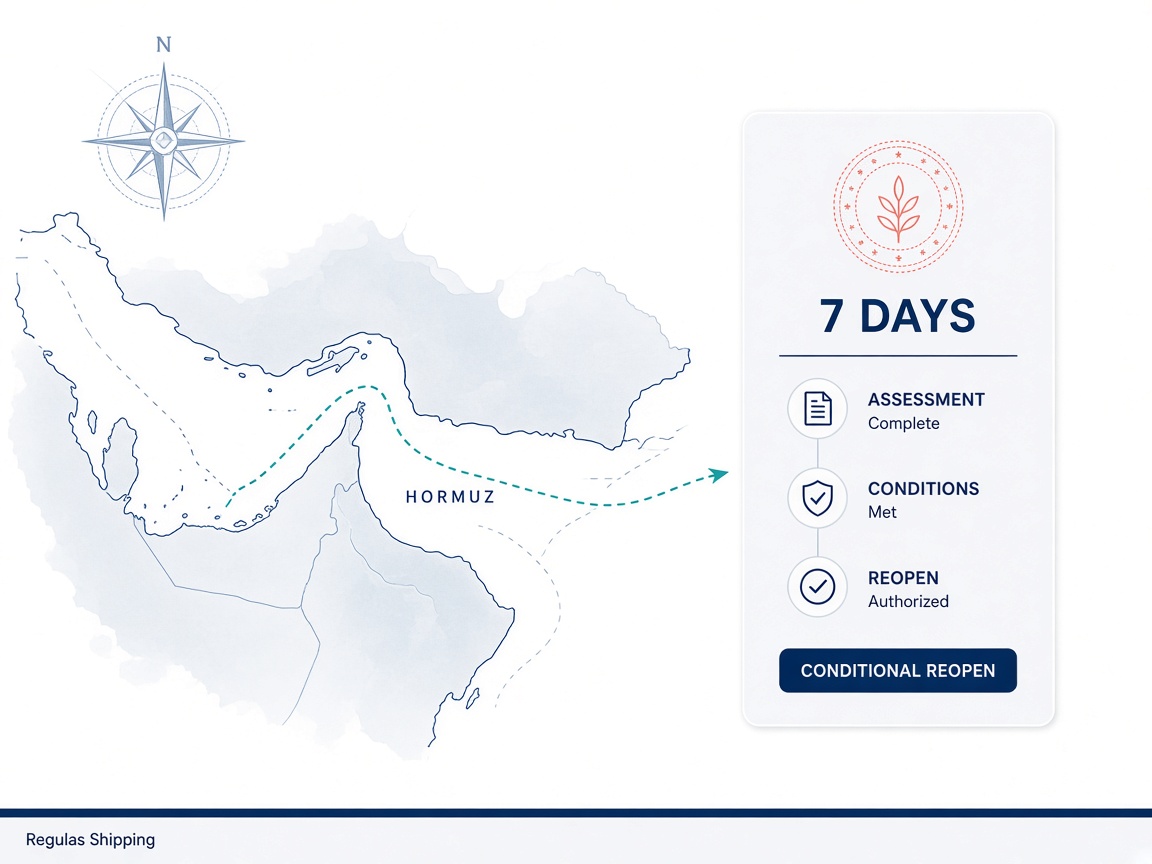
Iran can reopen the Strait of Hormuz within seven days if the United States eases military pressure and lifts its blockade of Iranian ports, a senior Iranian official told Reuters on Tuesday, 22 September, from New York. The same official said Tehran’s proposal had gone to Washington through mediators on 16 September, that the Iranian delegation to the United Nations General Assembly has full authority to revive diplomacy, and that President Masoud Pezeshkian — who left Tehran for New York on Tuesday morning — will not meet U.S. President Donald Trump at UN headquarters.
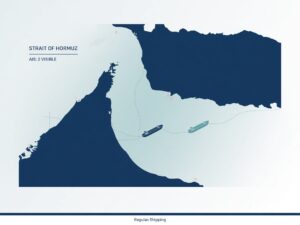
Kyodo News, also citing a senior Iranian government official on Tuesday, reported the same seven-day reopen offer if Washington takes initial steps toward easing military pressure, ending the port blockade and halting military operations related to the strait. Kyodo said the initiative had been approved by Supreme Leader Mojtaba Khamenei and the Supreme National Security Council. It was not immediately clear whether Reuters and Kyodo spoke to the same official. Neither report is a Notice to Mariners, a UKMTO product, or an IMO circular. It is a political condition attached to a waterway that, on AIS, handled two visible commodity ships on Monday.
For operators, the relevant question is not whether the quote is a breakthrough. It is whether a seven-day clock, if Washington took the named steps, would actually restore a normal TSS — and what happens if it does not. Sunday’s Iranian military central command warning that a U.S. restart of operations with regional support would bring retaliation “without limitations and considerations” remains on the table alongside the UNGA diplomacy.
Incident context
The seven-day formulation is narrower than the full political list Tehran has been circulating. Supreme National Security Council secretary Mohsen Rezaei told Al Jazeera on Saturday that Qatar had conveyed seven conditions to Washington. The items he named publicly were an end to the war on all fronts, including Lebanon; release of frozen Iranian funds; an end to the naval blockade on Iranian ports; an end to U.S. interference in Iran’s internal affairs; an end to U.S. cooperation with “the opponents of our revolution”; and an end to all U.S. attacks on Iranian territory. He did not publish a complete seven-item text. The Kyodo official did not say whether Tuesday’s seven-day Hormuz offer relaxed any of those conditions. Parliament Speaker Mohammad Bagher Ghalibaf said on Sunday that until the conditions are met and American commitments fulfilled, “there will be no opening for a return to the previous state of negotiations or for the reopening of the Strait of Hormuz.” Tuesday’s Reuters/Kyodo quotes and Ghalibaf’s Sunday line are both Iranian positions; they are not yet a aligned, written reopen order that a master can sail on.
Qatar is the public mediation channel. Foreign Ministry spokesperson Majed Al-Ansari said Qatari mediators have been exchanging proposals for nearly two weeks, travelling between capitals, and have received assurances from U.S. officials that Washington wants an agreement. Doha has framed restoring navigation through Hormuz and removing the threat of military action as necessary for meaningful talks. Rezaei said an Iran–Oman arrangement to manage the strait had come within “a short step” of announcement and may still require regional endorsement. That Oman track is the same file this desk has covered since mid-September: inbound traffic in Iranian waters, the southern route to close, a temporary TSS under Iranian traffic management, and no reopen until U.S. conditions are met. It is not a UNCLOS transit-passage restoration, and Bahrain has stayed outside any such deal absent non-discriminatory transit without fees or permits for all six GCC states.
The calendar around the offer is tight. Kyodo’s official said the council decided on 16 August that Iran would retain the option of another attack on U.S. forces if Washington failed to lift the port blockade within 45 days — a window that, counted from that date, is now in its final days. Pezeshkian is in New York. Foreign Minister Abbas Araghchi arrived and spoke by phone with UN Secretary-General António Guterres, Tasnim reported. The Reuters official said the UNGA is a “golden opportunity” for Washington to return to diplomacy, that details of an agreement to end hostilities can be discussed in New York via mediators, and that the United States needs to announce it wants a diplomatic resolution, make that official, and agree a timeline. U.S. Secretary of State Marco Rubio said Washington is open to meeting Iran at the UN, with no meeting scheduled yet, according to Reuters’ UNGA coverage on Tuesday. That is not an accepted reopen plan.
On the water, nothing in Tuesday’s quotes changes Monday’s facts. Visible Hormuz commodity traffic fell to two ships. UKMTO logged an inbound tanker projectile casualty and a delayed outbound LPG debris file. JMIC remains SEVERE. CENTCOM’s redirected count was 109 as of 20 September and was reported at 110 on Tuesday. Pre-war throughput was about 125 large commercial vessels a day. A June 60-day memorandum of understanding collapsed amid renewed hostilities; that MoU had included opening Hormuz for safe passage, an end to naval blockades by both sides, and other political items. Operators should treat Tuesday’s seven-day line as a successor talking point to a failed MoU, not as a schedule for the next fixture.
Markets moved on the headline. Reuters reported Brent near $100 a barrel on Tuesday as investors weighed the comments. Macron, after meeting Trump in New York, said France and the United States would work to protect critical Middle East energy infrastructure and freedom of navigation through the strait and would seek a moratorium on strikes against energy infrastructure, according to secondaries. Those statements, if they produce anything operational, would still have to show up as UKMTO, NAVAREA, NCAGS or flag guidance before they belong in a passage plan.
Operational implications
A conditional seven-day reopen is not a voyage order. Even if Washington eased pressure and lifted the Iranian-port blockade tomorrow, the official’s clock would run to late September at the earliest. In that interval the strait would still be a SEVERE-threat TSS with projectile, UAV, mine-claim and AIS-off traffic. Owners who pre-position hulls on the assumption that “Hormuz reopens next week” will have ships in the wrong place if the politics fail — and they will still need war-risk, crew consent and PGSA-list screening if it succeeds in a managed, Iranian-controlled form rather than as UNCLOS transit passage.
The distinction between lifting a blockade on Iranian ports and restoring third-country transit is operationally material. CENTCOM has described an “ironclad blockade” under which Iran has exported zero barrels, while also saying it has facilitated partner-country crude. Iranian officials want the blockade on their ports ended and military operations related to the strait halted. That is a different ask from “the TSS is open to all flags on UNCLOS terms.” An Iran–Oman managed route, if it ever appears as an IMO-notified TSS, would still be a traffic-management and possible-fee problem for Bahrain and for any owner whose flag, cargo or STS history sits on the PGSA non-compliance list (77 vessels as of 14 September). A political reopen that leaves the list, hailing, UAV overflight and unknown-projectile risk in place is not a return to February’s 125-ship day.
Charterparties written this week should not treat the Reuters quote as a laycan assumption. War-risk warranties, CONWARTIME/VOYWAR notices, and deviation clauses still turn on whether the named area is unsafe, not on whether a mediator is in New York. Joint War Committee listed-area treatment of the Gulf and the Black Sea is unchanged by Tuesday’s comments. P&I and hull underwriters will want to see an actual drop in UKMTO products and a sustained rise in AIS-visible, fully identified transits — including VLCCs and gas carriers, not only unknown-route bulkers — before they reprice as if the strait were open.
Crewing and flag policy should stay on the current threat picture. Liberia’s ISPS Level 3 for the Red Sea and Gulf of Aden is a separate theatre and is still in force. Hormuz does not have an equivalent public Level 3 circular in the same form, but JMIC SEVERE plus two Monday casualties is enough for most DPAs to keep additional security watches, citadel drills and restricted-access periods in the standing orders. A seven-day political clock is not a basis to stand those down.
If diplomacy does produce a short-term arrangement, the first operator-visible signs will not be a press quote. They will be: a UKMTO or JMIC downgrade; NAVAREA IX language on a new TSS or reporting regime; NCAGS or CENTCOM guidance on facilitation versus blockade; IMO or flag circulars; and AIS that again shows named tankers and gas carriers in daylight, transponder-on transits. Until those appear, the working strait is the one Kpler counted on Monday.
What Operators Should Note
- Log Tuesday’s seven-day offer as a political condition, not as a sailing window. Reuters and Kyodo both quote a senior Iranian official: Hormuz could reopen within seven days if the United States eases military pressure and lifts the blockade of Iranian ports. There is no UKMTO, NAVAREA or IMO product implementing that clock. Pezeshkian will not meet Trump at the UNGA; Rubio said a meeting was possible but not scheduled.
- Do not collapse the seven-day line into Rezaei’s seven conditions or into Ghalibaf’s Sunday refusal. Rezaei’s public list is broader (all fronts including Lebanon, frozen funds, non-interference, and more). Ghalibaf said there would be no Hormuz reopen until U.S. commitments are fulfilled. Treat them as concurrent Iranian messages. A fixture cannot assume they have been reconciled.
- Keep the Iran–Oman managed-route file separate from UNCLOS transit passage. Rezaei said a Muscat arrangement remains close but may need regional endorsement. Prior briefings described inbound traffic in Iranian waters and closure of the southern route. That is traffic management, not a return to pre-war freedom of navigation. Bahrain’s UNCLOS/no-fee/all-GCC conditions have not been withdrawn.
- Do not pre-position ships or relax war-risk on the quote. JMIC remains SEVERE. Monday’s AIS-visible flow was two dry-bulk ships. UKMTO logged an inbound projectile casualty and an outbound LPG debris file in the same 24 hours. Shuttle/STS off Fujairah and Sohar, PGSA-list screening and AIS-off liftings remain the working pattern.
- Watch for operator-grade signals, not UNGA colour. A real reopen would show up as UKMTO/JMIC language, NAVAREA IX, NCAGS/CENTCOM guidance, flag circulars, and AIS that again includes identified tankers and gas carriers. Mediator travel and “full authority to revive diplomacy” do not change a passage plan.
- Hold charterparty, crew-consent and insurance language on the current listed-area and threat picture until a reopen is actually notified. Dual-chokepoint exposure with Bab el-Mandeb still selective and Yanbu constrained is unchanged by a seven-day political offer. Brief masters that Sunday’s “retaliation without limitations” warning and Tuesday’s diplomacy are both live.
Regulas Shipping will keep monitoring Iranian, Qatari and U.S. statements against UKMTO, JMIC and NAVAREA products, and will update operators if a seven-day reopen is actually notified rather than quoted.