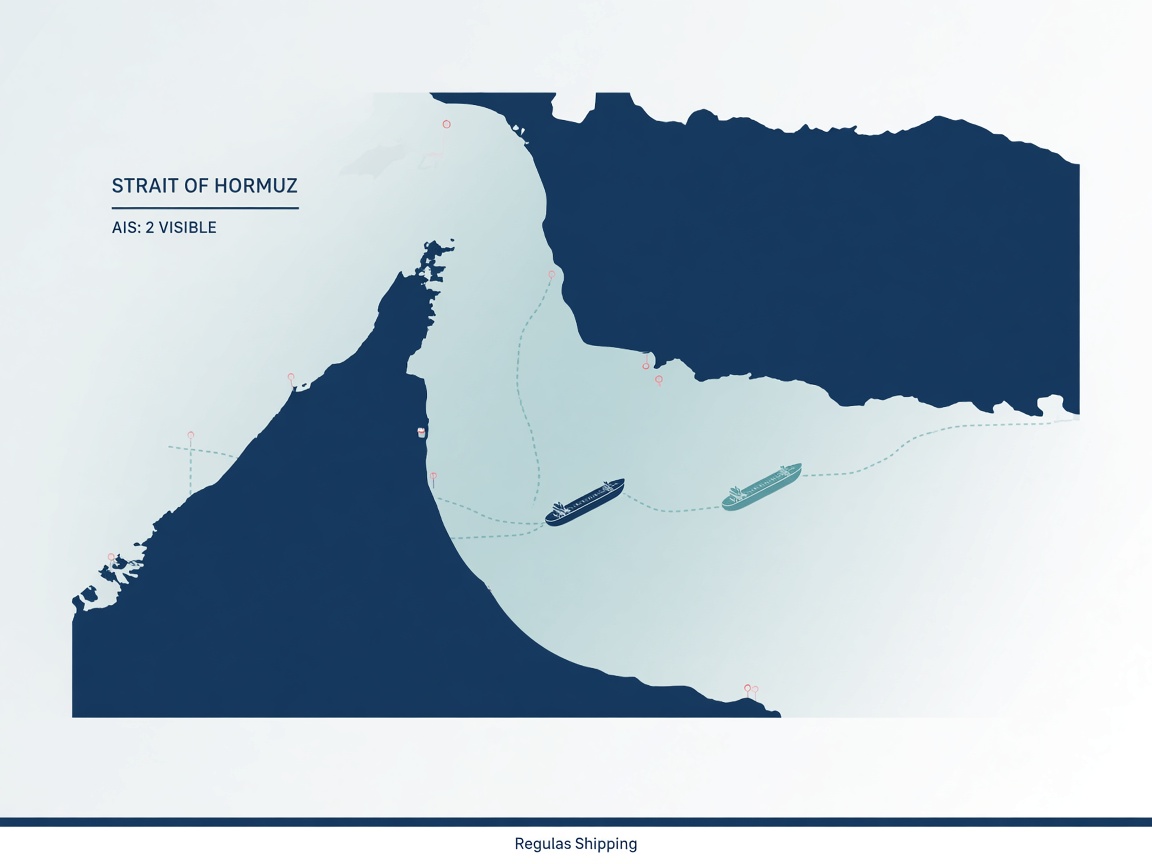
Commodity ships visible on Automatic Identification System (AIS) in the Strait of Hormuz fell to two on Monday, 21 September, from 10 a day earlier, preliminary Kpler data reported by Reuters on Tuesday showed. Both hulls were dry-bulk: a minerals-laden Panama-flagged Supramax and a Liberia-flagged bulk carrier. They entered via a route Kpler could not identify. The cut excludes ships that may have crossed with transponders off.
That is a two-ship day in a waterway that handled about 125 large commercial vessels a day before the Iran conflict began on 28 February, and that then carried some 20 percent of the world’s daily crude oil and liquefied natural gas. Neither of Monday’s AIS-visible ships was a tanker, a gas carrier or a boxship. The same 24-hour window produced two UK Maritime Trade Operations (UKMTO) security products on the strait — an inbound tanker hit by an unknown projectile with two crew injured, and a delayed outbound LPG report of debris from unknown projectiles — which this desk covered separately and does not treat as the traffic count.
At Bab el-Mandeb, 26 vessels crossed on Monday, unchanged from Sunday, according to the same Kpler/Reuters cut. Visible Hormuz traffic is therefore still a fraction of the pre-war baseline, while the southern Red Sea gate is holding a low but steadier number. Operators should not read either figure as a cleared TSS.
Incident context
Tuesday’s Kpler snapshot is a later cut than the weekend numbers Reuters published on Monday. Those earlier figures put trackable weekend commodity transits at 17, down from 37 the prior weekend. Sunday in that Monday-morning snapshot showed five exits — including the VLCC Pinios, two products tankers and two empty bulk or gas carriers — and two small oil tankers entering. Saturday’s mix, in the later weekend cut, included crude, agricultural products, petroleum products, LNG, LPG and fertiliser, plus a very large gas carrier and a VLCC entering. The Shandong Redwood LNG, loaded at Ras Laffan and bound for Pakistan, had already exited on 19 September. Tuesday’s “10 on Sunday, 2 on Monday” therefore revises a theatre where AIS counts move as dark tracks, late positions and unknown-route entries land. Do not force the weekend 17 and Tuesday’s Sunday-10 to add up; they are sequential snapshots, not a single ledger.
Gulf producers continue to lift cargo on hulls that go dark. Independent tracking has shown single-digit transits on some days, while U.S. Naval Cooperation and Guidance for Shipping (NCAGS) data indicated flows averaging more than 30 vessels a day in the 72 hours leading up to Sunday. That gap is now operational, not a footnote. A master who plans on “what AIS shows” will under-count traffic, under-count collision risk in the TSS, and over-count how empty the strait actually is for a war-risk underwriter.
Monday’s two UKMTO products sit on top of that thin visible flow. Warning 140-26 covered an inbound unnamed tanker struck by an unknown projectile, two crew with minor injuries, the ship under own power, no environmental impact reported. A later, delayed product described an outbound LPG tanker hit by debris from unknown projectiles, all crew safe, no pollution reported, proceeding to the next port. UKMTO did not name either hull. On Tuesday, shipping-intelligence firm Marisks Intelligence told Reuters the inbound crude was the Isle of Man-flagged LR Stephanie, managed by Universal Tanker Corp., and that the outbound LPG was the Liberia-flagged Al Maryah, managed by Abu Dhabi National Oil Company. Universal Tanker Corp. did not immediately comment. ADNOC Logistics and Services said it does not comment on specific operational matters, including voyage planning or vessel movements. Marisks said both ships continued without towing and that neither appears on publicly reported Persian Gulf Strait Authority (PGSA) non-compliance lists. Those identifications are not a UKMTO naming. Vanguard Tech had circulated “La Stephanie”; Pole Star’s closest match in secondaries is LR Stephanie, about 72,825 dwt, last AIS northbound from Khor Fakkan toward Hormuz. Greek secondaries dated Al Maryah’s UAV hit to 20 September “outside the Strait,” with 19 crew including nine Indian seafarers, later at Khor Fakkan — a different damage mode and location from UKMTO’s delayed Monday debris product. Treat Marisks, Vanguard and the Greek copy as unconfirmed identities until the flag, class or UKMTO puts a name on the product.
The traffic collapse also sits against a mid-September attack cluster that has not paused. A Joint Maritime Information Center advisory issued Sunday recorded three attacks in the strait between 16 and 18 September, including a hull-breach fire. Adding Monday’s two UKMTO files, that is at least five tanker attacks or security incidents since 16 September. JMIC still rates the threat SEVERE, with deliberate hostile action highly likely. IMO Secretary-General Arsenio Dominguez told CCC 12 on 16 September that the Secretariat had verified 80 Hormuz attacks since 28 February, with 22 seafarer deaths. CENTCOM’s redirected count was 109 commercial vessels as of 20 September, up from 105 on 18 September; Iran International, citing CENTCOM, put the figure at 110 on Tuesday. Admiral Brad Cooper has said U.S. forces assisted more than 2,000 commercial transits in recent months and that more than one billion barrels of Gulf-partner crude have moved through the strait under coordinated protection. Those facilitation claims and the two-ship AIS day can both be true if most barrels are moving dark, under escort, or on shuttle/STS chains that do not look like a normal TSS plot.
Volume that does leave the Gulf is increasingly a shuttle, not a laden VLCC steaming straight to Asia. Kpler data reported with the weekend cut said 22 tankers, mostly VLCCs, carrying about 42 million barrels of crude, exited in the week of 13 September, with Saudi Arabia and Iraq each about 43 percent of the volume. Pinios was transferring about two million barrels of Iraqi Basrah crude off Fujairah to the VLCC New Constant, expected to head to China. That is the working pattern: load or shuttle inside, cross, STS off Fujairah or Sohar, then a receiving hull continues. It is also why a Monday with no AIS-visible tankers does not mean no oil moved.
Operational implications
A two-ship AIS day after a 10-ship Sunday, and after a 17-versus-37 weekend, changes how owners should brief the next Gulf call. Visible traffic is not a safety all-clear. It is evidence that willing owners are still thin, that many remaining movements are off-AIS, and that the few hulls that do broadcast are easier to watch — including by whoever is firing projectiles and flying UAVs. Dry-bulk entries on an unknown route are not a template for a VLCC, an LNGC or an LPG carrier. Charterers who treat “two ships got through” as proof the TSS is open will mis-price war-risk, crew-nationality limits and deviation.
The unknown-route tag on both Monday ships matters for routing orders. Iranian-water, southern Omani and “dark” tracks have been used in different mixes since early September. Masters still need a written plan for which TSS, which reporting chain (UKMTO, NCAGS, flag, company DPA), and what to do if hailed on VHF or overflewn. JMIC has described IRGC UAV overflight, surveillance and VHF hailing as part of the current pattern. UKMTO has not attributed Monday’s two products and called the projectiles unknown. Passage plans should assume hostile action is highly likely, not that an unnamed bulk carrier’s unknown-route entry is a new commercial lane.
Bab el-Mandeb at 26 ships is not a Hormuz substitute for Gulf crude. It is a separate, still-impaired gate: 51 weekend transits versus 57 the prior weekend, with 33 exiting, including an Aframax with about 700,000 barrels of Saudi crude in the weekend cut. No visible Yanbu loadings have been reported since 16 September after the Petroline/East-West disruption. Owners who used Yanbu to avoid Hormuz do not get that bypass back because Hormuz AIS fell to two. Dual-chokepoint exposure remains the planning case: Hormuz constrained and dark, Bab el-Mandeb selective, Suez restorations still case-by-case.
For operations rooms, the practical split is three layers. AIS is what Kpler and Reuters can count. NCAGS is what navies are facilitating and reporting. Shuttle/STS is what actually keeps Gulf barrels moving at extraordinary freight. A two-ship Monday tells you the first layer collapsed. It does not tell you the third layer stopped. It also does not tell you the second layer is safe: Monday’s inbound casualty and outbound debris file happened on the same calendar day as the two visible bulk entries.
Class, P&I and cargo interests should keep the Marisks names on a watch list without treating them as closed identifications. If LR Stephanie or Al Maryah is later confirmed as a UKMTO hull, counterparties will want condition reports, crew-injury records, PGSA-list screening and next-port notifications. Until then, the official products remain unnamed. Do not brief the next charterer that “the ADNOC LPG” or “the Isle of Man LR” is the UKMTO ship.
What Operators Should Note
- Treat Tuesday’s Kpler cut as a two-ship Monday, not a reopening. Visible commodity traffic was two dry-bulk entries on an unknown route, down from 10 on Sunday in the later snapshot, against about 125 large commercial ships a day before 28 February. No VLCC, LNGC or products tanker appeared in Monday’s AIS-visible set.
- Keep AIS, NCAGS and shuttle/STS as three different counts. Weekend AIS of 17 versus 37 the prior weekend, NCAGS above 30 a day in the 72 hours to Sunday, and CENTCOM’s redirected tally at 109–110 are not contradictions. Dark transits and facilitated passages will not show as a normal TSS plot. Plan collision, reporting and war-risk on the higher military/facilitated flow, not on the two-ship AIS print.
- Do not use Monday’s bulk entries as a routing precedent for tankers or gas. Unknown-route dry-bulk does not validate a laden VLCC, an LNGC off Ras Laffan, or an LPG off Ruwais. JMIC remains SEVERE. At least five tanker attacks or security incidents have been reported in the strait since 16 September.
- Leave Monday’s UKMTO hulls unnamed in company reports unless the flag or UKMTO names them. Marisks identified LR Stephanie (inbound crude, two minor injuries) and Al Maryah (outbound LPG). Vanguard circulated “La Stephanie.” Greek secondaries dated Al Maryah to a 20 September UAV hit outside the strait. Those are not UKMTO namings. ADNOC declined operational comment.
- Do not read Bab el-Mandeb’s 26 Monday transits as a Hormuz workaround. The southern gate was unchanged from Sunday and still well below pre-crisis volumes. Yanbu remains constrained. Dual-chokepoint risk is the base case, not a residual.
- Brief masters that a quiet AIS overlay is not a quiet strait. UAV overflight, VHF hailing, projectile debris and inbound hull strikes all occurred in the same week as single-digit AIS days. Citadel, fire-party, reduced-power exit toward Omani or UAE waters, and parallel reporting to UKMTO, the flag and the DPA still belong in the passage plan.
Regulas Shipping will keep monitoring Kpler, UKMTO, JMIC and NCAGS counts on Hormuz visibility and will update operators if Tuesday’s two-ship cut is revised or if either Monday casualty is officially named.