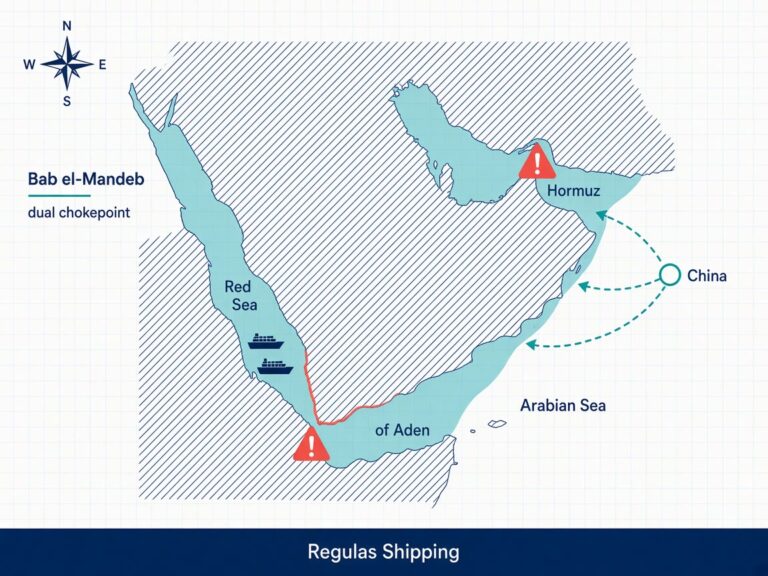
The UN Security Council held a second emergency meeting on Yemen in less than a week on Tuesday, 15 September 2026, after Houthi forces consolidated positions on Yemen’s Red Sea coast and around the Bab el-Mandeb Strait. Khaled Khiari, Assistant Secretary-General in the Departments of Political and Peacebuilding Affairs and Peace Operations, told the Council that the situation in and around the strait had become “increasingly volatile in recent days.” He said fighting had intensified along the west coast, that the Houthis had continued their advance toward the strait, and that they had reportedly captured several islands in the southern Red Sea. He then added the sentence that matters for commercial operations: according to maritime tracking sites, commercial shipping flows through the Red Sea “appear to remain unaffected for the time being.”
That combination — a Council warning on freedom of navigation, and an AIS picture that still shows ships — is the operational problem for this week. It is not a repeat of last Thursday’s Mokha capture note, when Kpler showed Bab el-Mandeb transits falling from 30 ships to six in an afternoon. Reuters put Tuesday’s Bab el-Mandeb commodity count at 22, little changed from 24 on Monday. Sea-Intelligence estimates that more than one-quarter of Asia–Europe liner capacity will transit the Red Sea in September, with the restoration most pronounced on Asia–Mediterranean services. Maersk, Hapag-Lloyd and MSC have already put named strings back toward Suez. The UN is telling members that navigational rights must be restored under resolution 2722 (2024). Tracking sites are telling operators that hulls are still moving. Company security officers have to hold both facts without treating the second as a clearance.
What the Council was told
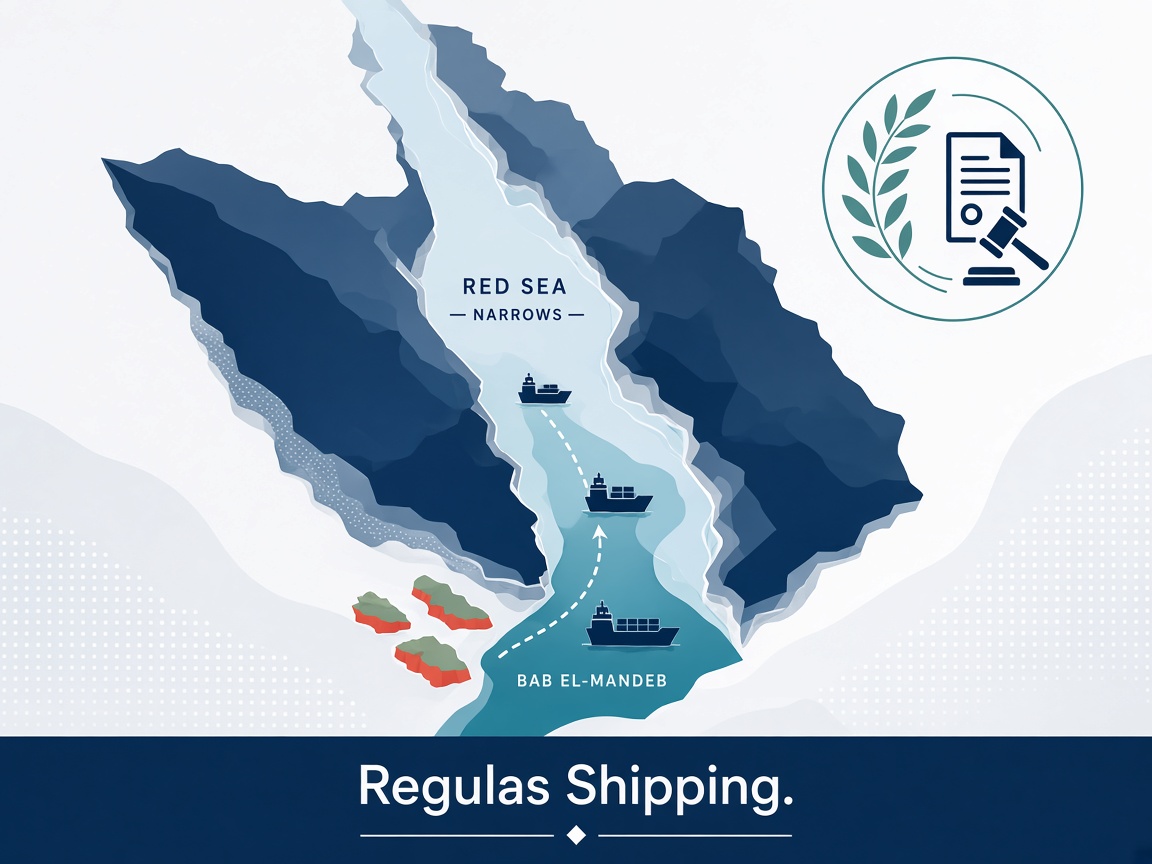
Tuesday’s meeting was requested after the Houthi advance along the Tihama and onto island positions in and around the strait. Public reporting of the request names Bahrain, the United Kingdom, Denmark, France, Greece and Latvia. It follows the 10 September emergency session, at which Special Envoy Hans Grundberg said the risk of a return to large-scale conflict had become a “harsh reality” and that Mokha’s fall put Ansar Allah on the approaches to the chokepoint. Five days later the geography has hardened. Greater and Lesser Hanish, about 160 kilometres north of the strait, are now being reported as seized, after last week’s capture of Mokha and Perim (Mayyun). Those island reports were not independently verified in the 10–11 September commercial file. They are now in the Council record as reported captures.
Khiari linked the strait to the other energy artery that had been carrying the Hormuz workaround. On 12 September Saudi Arabia condemned the targeting of the East–West pipeline by drones reportedly launched from inside Iraq. Iraq’s prime minister said Baghdad would investigate. “The strikes caused the pipeline to shut down for repairs, interrupting the crucial artery Saudi Arabia had been using as an alternative to the Strait of Hormuz,” Khiari told the Council. Rystad Energy said this week that 2.6 to 4 million barrels a day had recently moved through that line and out of Yanbu — a volume now at risk of “disappearing from the market.” Officials have estimated repairs in weeks, not days. Chevron chief executive Mike Wirth said on Friday that the stock buffers used earlier in the war, including releases from strategic reserves and the lifting of restrictions on some floating sanctioned barrels, have been “played out.”
The civilian file is not separate from the shipping file. Khiari put displacement across Yemen at at least 125,000 people since the start of September, with 40 civilian casualties in the same period, more than half of them women and children. About 2,300 people had arrived in Djibouti, 32 kilometres across the strait from the Houthi-held Yemeni shore, with further arrivals expected. The United Kingdom’s deputy permanent representative, Kate Foster, told the same meeting that overnight Houthi attacks on Saudi Arabia had reportedly injured a further 13 civilians, damaged homes and disrupted commercial aviation, and that more than 126,000 people were now displaced. She said the Houthis “bear full responsibility for this escalation,” that the impact of a threat to Bab el-Mandeb is felt first by developing countries, and that Council resolutions including 2140 and 2216 require members to prevent the transfer of arms to the group. Foster also restated the UK line that Iran’s support continues to enable attacks that threaten maritime security.
Khiari underscored that navigational rights and freedoms in the Red Sea and Bab el-Mandeb “must be fully restored and respected by all, consistent with resolution 2722 (2024).” That resolution is the 2024 Council product on Houthi attacks against merchant shipping. It is not a voyage clearance. It is the legal baseline against which a HOCC statement that navigation is “safe except for Saudi vessels” should be read. The Houthi leadership has repeated that it is not seeking to block all commercial shipping, only Saudi-linked ships. Tuesday’s Council meeting does not adopt that distinction. Neither should a company security officer writing a go/no-go for a southbound Suez-to-Aden run.
The AIS-normal trap
Khiari’s tracking-site sentence will be quoted in charter correspondence this week. It should be quoted with the next sentence of the commercial record attached. FreightWaves, citing Freightos, noted that carriers are restoring Suez and southern Red Sea capacity even as the Houthis consolidate a port and island position on the Bab el-Mandeb approaches. Sea-Intelligence’s September estimates put more than a quarter of Asia–Europe capacity back on the Red Sea route: roughly 35 percent of Asia–Mediterranean headhaul and 50 to 60 percent of that trade’s backhaul, against about 6 percent of Asia–North Europe headhaul and 30 percent of its backhaul. Asia–North Europe spot prices were reported this week around $4,300 per FEU, down 3 percent, and Asia–Mediterranean around $4,200 per FEU, down 12 percent, with daily prints near $3,800. Those rate moves describe effective capacity coming back onto a shorter routing. They do not describe a threat downgrade.
A multinational escort presence remains in the southern Red Sea. That is the same envelope in which the Houthis now hold Mokha, report island positions on Perim and Hanish, and retain missile, drone and small-boat reach. Coastal artillery and sensors on the Yemeni shore change the geometry that BMP Maritime Security was written against when the threat was standoff weapons from Hodeidah-range positions. A ship that transits because “AIS still shows 22 ships” is using other people’s risk appetite as its own. Liberia’s ISPS Level 3 posture for Red Sea and Gulf of Aden transits has not been lifted. JMIC has rated the Gulf of Aden threat substantial. The Council was not told that the threat had cleared. It was told that, for the moment, some commercial hulls are still going through.
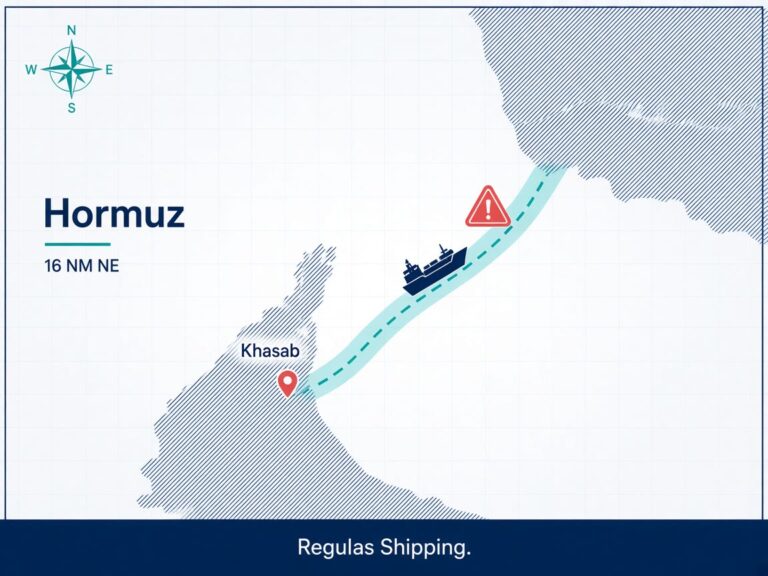
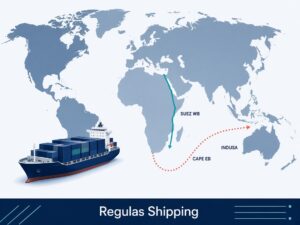
Al Jazeera has carried a contrary reading that Houthi control around Bab el-Mandeb has not in fact disrupted shipping movement, which would leave the Red Sea route serviceable even as political risk rises. That is consistent with Tuesday’s 22-ship Kpler print and with liner restorations. It is also consistent with a delayed casualty. Hormuz taught the same lesson in reverse: traffic can look residual under naval cover right up until the mix shifts away from VLCCs and the count drops into single digits. Bab el-Mandeb is not Hormuz. It is the remaining southern gate for Saudi barrels that can no longer use Hormuz and can no longer use Yanbu as a reliable bypass. Japanese shipowners put a dual-closure contingency at about 100 days round trip for Saudi crude to Asia via the Cape. Operators who are putting strings back through Suez this month are shortening the box voyage while the energy workaround sits inside the same strait the Council was briefed on.
What it changes for remaining transits
The practical instruction is to separate three questions that the HOCC line and the AIS plot collapse into one. First: is the ship Saudi-linked, or does the cargo, charterer, insurer or beneficial owner create a Saudi nexus the Houthis could read as a target? Second: even if it is not, does the company accept artillery, UAV and small-boat risk inside a strait whose Yemeni shore and islands are now held by a force the Council was asked to restrain? Third: if Hormuz remains a single-digit crude lane and Yanbu stays down, is this southern transit a box-network decision or an energy-workaround decision? Those are different war-risk files. A Mediterranean loop returning through Suez is not the same exposure as a Yanbu-loaded VLCC that has nowhere else to go.
Passage plans should assume the next UKMTO or MSCIO warning can arrive inside the strait, not only in the wider Gulf of Aden. Citadel, extra lookouts, firefighting and a prepared Cape diversion belong on the pre-entry checklist for any remaining Bab el-Mandeb transit, including ships that are not Saudi-flagged. Charterparties need a named dual-chokepoint trigger: if Petroline stays shut and a southern Red Sea warning product is issued, who orders the Cape, a hold, or cancellation, and on whose clock. Crew-welfare language should follow that trigger. Seafarers on a feeder or a grain hull are not parties to the Yemen war. They are the people who will be in the citadel if the AIS-normal assumption fails.
What Operators Should Note
- Treat Tuesday’s Council meeting as a threat-geometry update, not as a reissue of the 10 September Mokha note. Khiari recorded reported captures of southern Red Sea islands, a volatile Bab el-Mandeb, and a Petroline shutdown that cuts the Hormuz workaround. Resolution 2722 remains the navigation baseline. It is not a voyage permit.
- Do not convert “AIS unaffected for the time being” into a go. Reuters put Tuesday’s Bab el-Mandeb commodity transits at 22 against 24 on Monday. That is residual traffic, not a cleared lane. Write the Khiari sentence into the risk assessment with the 22-ship count and the HOCC “safe except Saudi” line beside it, then apply company policy.
- Re-check liner restorations against the southern gate, not only against Suez transit time. Sea-Intelligence’s September figures put more than a quarter of Asia–Europe capacity back on the Red Sea, led by Asia–Mediterranean. Gemini and MSC westbound restorations shorten the voyage only if Mokha, Perim and Hanish stay outside the ship’s engagement envelope. Cargo interests should be told that a shorter string is still a war-risk string.
- Name the Saudi nexus in writing before a southbound stem. Houthi targeting guidance remains Saudi-linked vessels. Beneficial ownership, charterer, cargo origin, previous Yanbu calls and AIS history are how that nexus is read from the shore. A non-Saudi flag is not a sufficient answer.
- Keep Yanbu and Petroline in the same file as Bab el-Mandeb. Rystad’s 2.6 to 4 million barrels a day through Yanbu is the volume that had been substituting for Hormuz. If that line stays down, remaining Saudi barrels to Asia compete for a southern Red Sea exit that the Council has just described as volatile. Japanese shipowners’ 100-day Cape contingency is the planning case, not a curiosity.
- Hold Liberia ISPS Level 3, BMP Maritime Security and UKMTO/MSCIO reporting for any remaining transit. Extra lookouts, citadel readiness and a prepared UKMTO report apply inside the strait. Preserve AIS, VDR and security communications. A later P&I file will ask whether the company had a written go/no-go after the 15 September Council briefing, not only after Mokha fell on 10 September.
Regulas Shipping will keep lining UN Security Council products, Kpler transit counts and liner restorations against the Mokha–Perim–Hanish geometry so operators can treat an AIS-normal southern Red Sea as a security decision, not as evidence that Bab el-Mandeb has cleared.