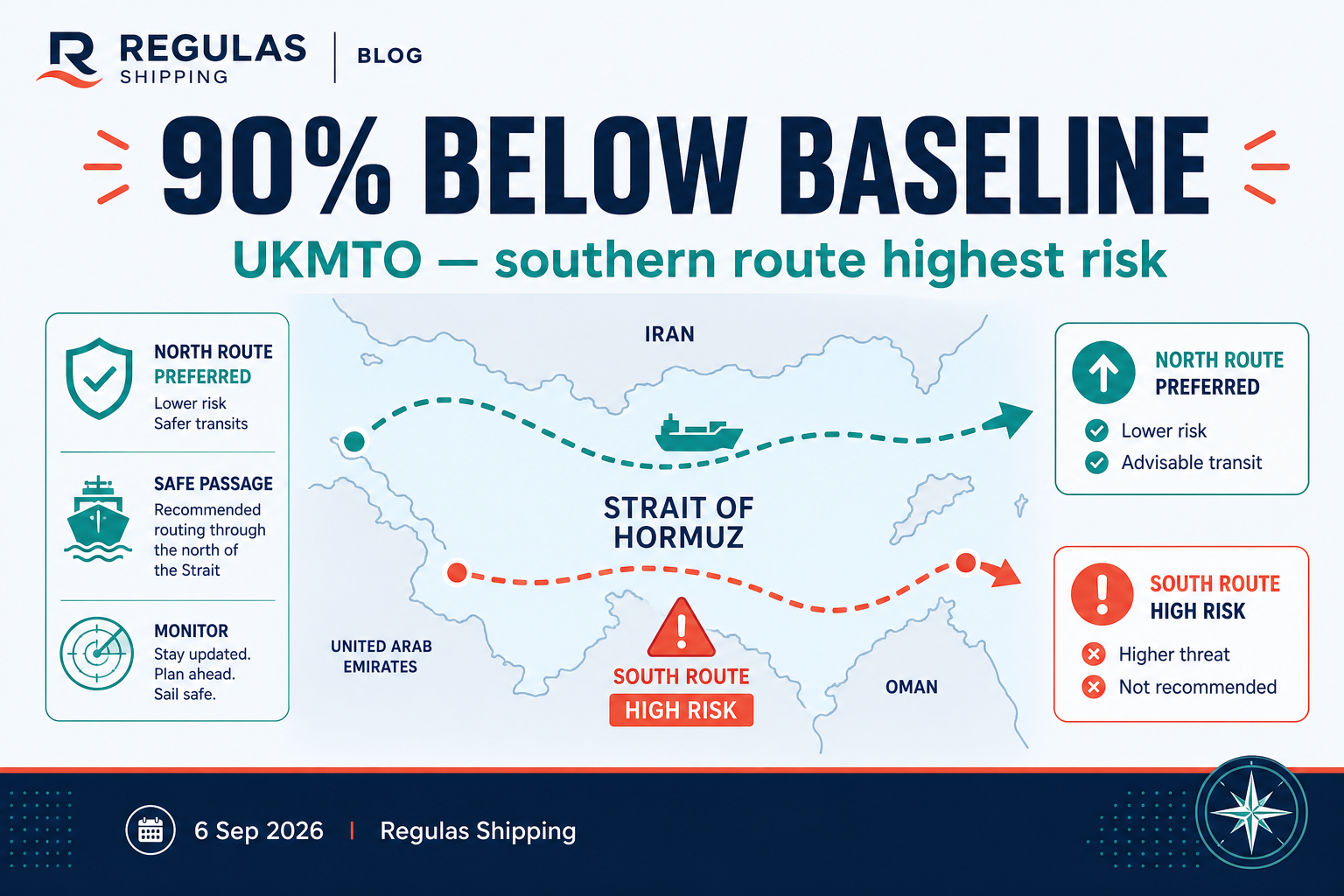
On 6 September 2026, operators continued to work from UK Maritime Trade Operations guidance that maritime traffic through the Strait of Hormuz remains significantly reduced. UKMTO reporting highlighted that AIS-detected transits have run approximately 90 percent below pre-conflict baseline levels since the late-June peak window, even as some political messaging claims recovery. On-the-water accounts from Bandar Abbas the same day likewise described visibly low shipping density while US–Iran tanker operations continued.
Route choice is now a core safety variable. UKMTO noted that vessel operators are favouring the northern route amid security concerns, while the southern Omani corridor remains the highest-risk path — accounting for 21 of 24 projectile-strike incidents reported by UKMTO since 6 July. Across the wider post-6 July period, about 27 projectile incidents have damaged bridges, engine rooms and structures. Tankers still make up a large share of remaining movements (around 46 percent in the UKMTO snapshot), but absolute volumes stay suppressed.
Threat posture is multi-theatre: JMIC continues to rate the Strait of Hormuz as SEVERE, with the Gulf of Oman, Gulf of Aden and Bab el-Mandeb at Substantial. That means a Hormuz diversion toward Red Sea/Aden options is not automatically a safety upgrade. Passage plans must compare northern versus southern Hormuz risk, US blockade enforcement, IRGC VHF hailing/diversion pressure, and Red Sea Houthi exposure in one brief.
What Operators Should Note
- Use the ~90 percent below-baseline figure in commercial and board risk packs, not reopen headlines alone.
- Treat the southern Omani corridor as the statistically hottest projectile zone since early July.
- Do not assume the northern route is “safe” — only relatively preferred under current operator behaviour.
- Keep Bab el-Mandeb/Aden Substantial risk in the same daily brief as Hormuz SEVERE.
- Require written route selection rationale (north vs south vs diversion) before any Gulf-related sailing.
Regulas Shipping will keep aligning UKMTO traffic and route-risk stats with JMIC severity levels for voyage decisions.