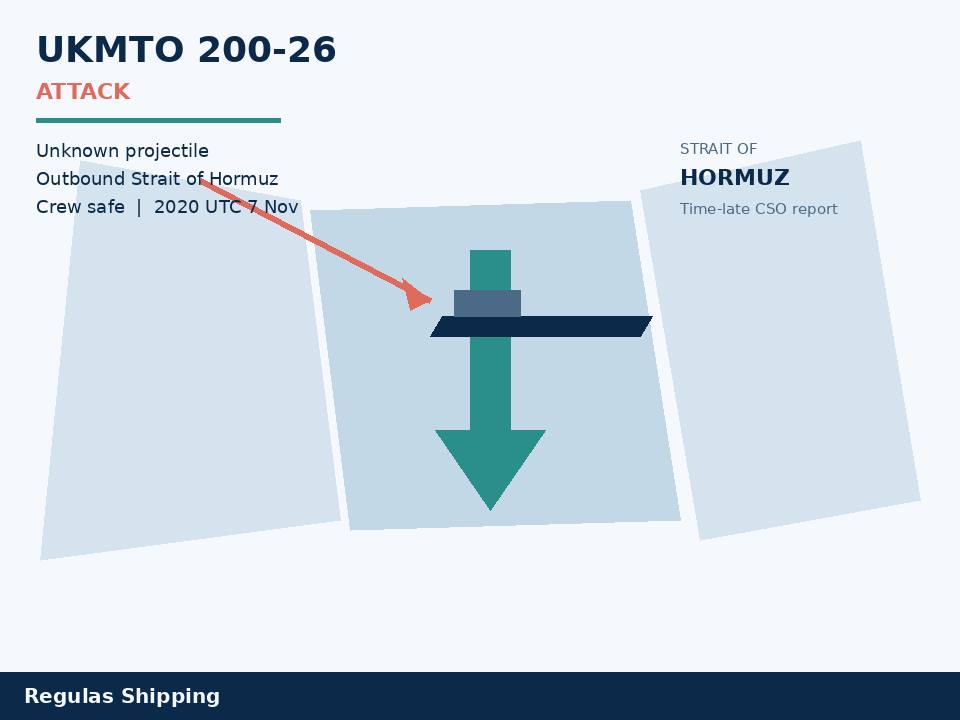
The United Kingdom Maritime Trade Operations centre published Warning 200-26 as a numbered PDF on its product board, filename 20261108-ukmto_warning-200-26.pdf. The face of the product is titled 200-26 — ATTACK. The incident date is 7 November 2026. The incident time is 2020 UTC. The source line is Company Security Officer. UKMTO states that it has received a time-late report of an incident in the Strait of Hormuz. The Company Security Officer of a tanker has reported that the vessel was struck by an unknown projectile while transiting outbound through the Strait of Hormuz. All crew are safe and accounted for and there is no reported environmental impact at this time. Vessels are advised to transit with caution and report any suspicious activity to UKMTO, whilst authorities investigate. The location footer printed on the product is Strait of Hormuz. Emergency contacts printed on the product remain [email protected], +44 (0) 2392 222060, +44 (0) 7779 966976 and +44 (0) 7585 795608.
That is the working primary. Sunday morning’s product is a Company Security Officer Attack on a 2020 UTC 7 November tanker clock, posted time-late on 8 November, unknown projectile, outbound through the Strait of Hormuz, crew safe, no environmental impact. It is not a rewrite of this morning’s dedicated Warning 199-26, not a rewrite of Saturday night’s dedicated Advisory 198-26, and not a conversion of Friday night’s dedicated Warning 197-26 onto a later outbound projectile. It names a tanker, an unknown projectile, an outbound Hormuz transit, a crew-safe line, and a no-environmental-impact line. It does not name a merchant hull, an IMO number, a flag, a cargo grade, an attacker, a fire, a NUC or tow line, a nautical-mile offset, a latitude/longitude, or a keep-clear radius. UKMTO posted the numbered PDF on the 8 November product board against a 2020 UTC 7 November clock. Masters who brief Sunday morning as 199-26’s unnamed northwest-of-Khasab fire now recast as a projectile, as 197-26’s east-of-Khasab waterline explosion, as 196-26’s Qatar tanker, or as 195-26’s Lima engine-room tanker will have merged four other series into a CSO Attack that still withholds the struck hull and still withholds a fire.
What the warning actually printed
The confirmed tape is the body of 200-26. UKMTO has received a time-late report of an incident in the Strait of Hormuz. The Company Security Officer of a tanker has reported that the vessel was struck by an unknown projectile while transiting outbound through the Strait of Hormuz. All crew are safe and accounted for and there is no reported environmental impact at this time. Vessels are advised to transit with caution and report any suspicious activity to UKMTO, whilst authorities investigate. That is the product. Stay with that wording. Do not invent a hull. Do not invent a flag. Do not invent a products, crude, LPG or LNG grade beyond the word tanker. Do not invent a UAV, a mine, a small-boat device or a boarding. 200-26 prints unknown projectile, not explosion, not fire, and not two projectiles. Do not invent a lat/long on the UKMTO PDF. 200-26 does not print one. Do not invent a keep-clear radius around Khasab, Lima, Musandam, Fujairah or the TSS. The PDF does not print one. Do not invent a fire-extinguished line, a lost-propulsion line, a sunk line, an evacuation line, or a next-port name. The product already prints crew safe and accounted for. It does not print that the crew left the ship. It does not print a destination. The crew line on this PDF is “all crew are safe and accounted for,” not “evacuated,” not “unconfirmed at present,” and not “one seafarer fatality.” Hold that wording. The environmental line is no reported environmental impact at this time. Hold that too.
The product type is the first briefing fact. 200-26 is Attack, the same family that ran dedicated 191-26 through 197-26, not the Suspicious Activity family that ran this morning’s dedicated 199-26, and not the Advisory family that ran dedicated 198-26. UKMTO says a tanker outbound through the Strait of Hormuz was struck by an unknown projectile. It does not say a small boat attached devices. It does not say a mine in the water. It does not say a UAV. It does not say the ship is on fire. It does not say the ship is at anchor, NUC, under tow, or sunk. A DPA who briefs Sunday morning as “another Hormuz fire, crew evacuated” has borrowed 199-26’s method and 199-26’s crew line and has dropped the Attack stamp, the unknown projectile, the outbound transit, the 2020 UTC clock and the CSO source that are the whole of this PDF. A DPA who briefs Sunday morning as a completed salvage because the crew are safe has under-read a numbered Attack that still withholds hull, damage volume and whether the ship is making way.
Time-late Company Security Officer source, an unknown projectile and a crew-safe line is the second briefing fact. The report sits on a Company Security Officer source, not on Master, not on Verified, and not on Military authorities. That is a different reporting path from this morning’s dedicated 199-26, whose source line is Military authorities, and from Friday night’s dedicated 197-26, whose source line was Master. Time-late is printed on the face of the product. The incident clock is 2020 UTC on 7 November. The numbered PDF appeared on the 8 November board. Do not treat the 8 November filename as an 8 November strike. Do not treat “time-late” as a completed investigation. Do not treat “unknown projectile” as a confirmed UAV, a confirmed mine, a confirmed small-boat pairing, or a confirmed two-projectile strike. Do not treat “all crew are safe and accounted for” as a class survey, and do not convert it into 199-26’s evacuation line or into Thursday morning’s unconfirmed crew line. The public PDF says there is no reported environmental impact at this time. It does not say whether a fire started, whether a hole was found, whether a tug was offered, or where the ship went after 2020 UTC.
The geography is the third briefing fact. 200-26 prints the Strait of Hormuz. The location footer is Strait of Hormuz. The transit line is outbound through the Strait of Hormuz. That is the named waterway, not this morning’s dedicated 199-26 8-nautical-mile northwest-of-Khasab offset, not Friday night’s 16-nautical-mile east-of-Khasab offset, and not Saturday night’s 18-nautical-mile east-of-Khor-Fakkan Gulf of Oman offset. 200-26 does not print a nautical-mile offset from Khasab, Lima, Musandam or any other coastal tag. A passage plan that only carried 199-26’s northwest-of-Khasab fire, or that treated Sunday as closed because 198-26 was the last UKMTO number at 03:30 UTC, has not budgeted a 2020 UTC unknown-projectile Attack on an outbound Hormuz tanker with no printed offset.
The numbering is the fourth briefing fact. 200-26 is numbered after 199-26 on the product board. It is a Warning, Attack, not Suspicious Activity. UKMTO’s Suspicious Activity series on this Sunday board is dedicated 199-26. Do not brief Sunday morning as “200 after 199 on the same hull.” Brief Sunday morning as a later-issued Attack on a later 7 November tanker clock, posted time-late, incident 2020 UTC. UKMTO now ends at 200-26 on the Attack line and at 199-26 on the Suspicious Activity line. There is no 201-26 this run.
Industry colour of the same clock, held separately: no numbered wire was retrieved this run that quoted 200-26’s projectile, 2020 UTC clock, CSO source and crew-safe line as a completed hull naming. Treat any later reprint of those public sentences as colour of the PDF, not as a naming. Do not collapse a later wire onto 200-26 as a completed identification, a TSS plot, a fire line, an Omani-port finding, or a conversion onto 199-26, 197-26, 196-26 or Velos Sapphire. Mapping accounts that labelled Sunday’s Khasab fire an IRGC attack are colour on 199-26, not a 200-26 naming. No numbered MSCIO wrap against the 2020 UTC Hormuz clock was retrieved this run.
What this is not
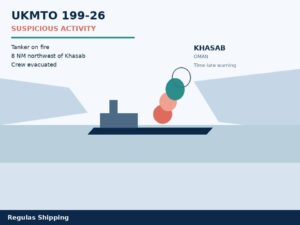
This is not Warning 199-26, and it is not this morning’s unnamed northwest-of-Khasab fire. This morning’s dedicated Warning 199-26 remains Suspicious Activity, posted about 0912 UTC on 8 November, source Military authorities, time-late: tanker on fire 8 nautical miles northwest of Khasab, Oman; crew evacuated; location Khasab, Oman. 200-26 is Attack, incident 7 November 2026, 2020 UTC, source Company Security Officer, time-late, tanker struck by an unknown projectile while transiting outbound through the Strait of Hormuz, crew safe and accounted for, no reported environmental impact, footer Strait of Hormuz. A Suspicious Activity fire with an evacuation is not a CSO Attack with a projectile and a crew-safe-onboard line. Do not convert Sunday’s projectile onto Sunday’s fire. Do not convert Sunday’s crew-safe line onto Sunday’s evacuation. Do not promote an 8-nautical-mile northwest-of-Khasab offset onto a PDF that prints Strait of Hormuz and does not print a nautical-mile offset.
This is not Warning 197-26, and it is not Friday night’s unnamed east-of-Khasab tanker. Friday night’s dedicated Warning 197-26 remains an Attack, incident 5 November 2026, 2200 UTC, source Master, time-late, filename 20261106-ukmto_warning-197-26.pdf: tanker transiting the Strait of Hormuz outbound, explosion at the waterline, port side, 16 nautical miles east of Khasab, Oman; crew safe and accounted for; tanker still under its own power and continuing on its voyage; location footer Khasab, Oman. 200-26 is 7 November, 2020 UTC, source Company Security Officer, time-late, unknown projectile, outbound Hormuz, crew safe, no environmental impact, footer Strait of Hormuz, no nautical-mile offset. Two days, a source change from Master to CSO, a method change from waterline explosion to unknown projectile, and a footer change from Khasab to Strait of Hormuz separate the two clocks. A Master Attack that prints an explosion at the waterline, port side, 16 nautical miles east of Khasab and a continuing voyage is not a CSO Attack that prints an unknown projectile and does not print own power. Do not convert Sunday’s tanker onto Friday’s Khasab tanker. Do not convert Friday’s port-side waterline explosion onto Sunday’s unnamed projectile.
This is not Advisory 198-26, and it is not Saturday night’s unnamed Khor Fakkan bulk carrier. Saturday night’s dedicated Advisory 198-26 remains an Advisory, report date 7 November 2026, incident time TBC, source Military authorities, filename 20261107-ukmto_advisory-198-26.pdf: bulk carrier and military forces in the Gulf of Oman, approximately 18 nautical miles east of Khor Fakkan, UAE; crew, damage and environment unknown; location footer Khor Fakkan, UAE. CENTCOM’s 7 November Huda statement remains wrap on that number, unused as a completed PDF naming. 200-26 is a Warning, Attack, tanker, unknown projectile, 2020 UTC, outbound Hormuz, crew safe. A Gulf of Oman bulk-carrier Advisory is not a Hormuz tanker Attack. Do not convert Sunday’s tanker onto Saturday’s bulk carrier. Do not promote Huda, St. Kitts and Nevis, or precision munitions onto 200-26.
This is not Warning 196-26 / Velos Sapphire, and it is not Thursday morning’s unnamed Qatar tanker. Thursday morning’s dedicated Warning 196-26 remains an Attack, incident 4 November 2026, 2320 UTC, source Verified, filename 20261105-ukmto_warning-196-26.pdf: tanker struck by two unidentified projectiles, 50 nautical miles north of Madinat ash Shamal, Qatar; status of the crew, damage assessment and environmental impact unconfirmed at present; location footer Madinat ash Shamal, Qatar. Friday afternoon’s dedicated IMO 129-count, as at 6 November, converted Velos Sapphire’s missing line to one seafarer fatality on that Qatar sheet — wrap on dedicated 196-26, unused as a 200-26 naming. 200-26 is 7 November, 2020 UTC, source Company Security Officer, time-late, one unknown projectile, outbound Hormuz, crew safe, no environmental impact. Three days, a sea change and a confirmation-state change separate the two clocks. A Verified Attack that prints two unidentified projectiles and an unconfirmed crew line is not a CSO Attack that prints one unknown projectile, a crew-safe line and no environmental impact. Do not convert Sunday’s tanker onto Thursday’s Qatar tanker. Do not promote Velos Sapphire, IMO 9321201, or the 25th fatality onto a PDF that withholds the hull.
This is not Warning 195-26, not 194-26, not 193-26, not 191-26, and not a Selat Storm naming. Tuesday night’s dedicated Warning 195-26 remains a CSO Attack, incident 3 November 2026, 1900 UTC: tanker struck by two unknown projectiles into the engine room, 14 nautical miles northeast of Lima, Oman; no casualties or environmental impact reported as this time; location footer Lima, Oman. Tuesday night’s dedicated Warning 194-26 remains a Verified Attack on an Indian crewed dhow outbound through Hormuz, 1105 UTC 2 November, vessel status unknown. Last week’s dedicated Warning 193-26 remains a Master Attack, 2020 UTC 1 November, hole on the starboard side, 9 nautical miles northeast of Lima, vessel and crew safe. Sunday night’s dedicated Warning 191-26 remains a Channel 16 Mayday-relay Attack in the Strait of Hormuz. Dedicated NAVAREA IX 425/26 remains tug boat Selat Storm sunk in 26-22.55N 056-20.47E, 0.6 nautical miles west of Jazirat Um Al Ghanam. 200-26 prints tanker, unknown projectile, outbound Hormuz, 2020 UTC 7 November, crew safe, no environmental impact, footer Strait of Hormuz. It does not print engine room, Lima, dhow, starboard hole, Mayday, tug, Selat Storm, or Um Al Ghanam. Do not collapse those files onto this number because they share outbound, Hormuz, CSO or Attack family. 193-26’s 2020 UTC stamp is 1 November, not 7 November.
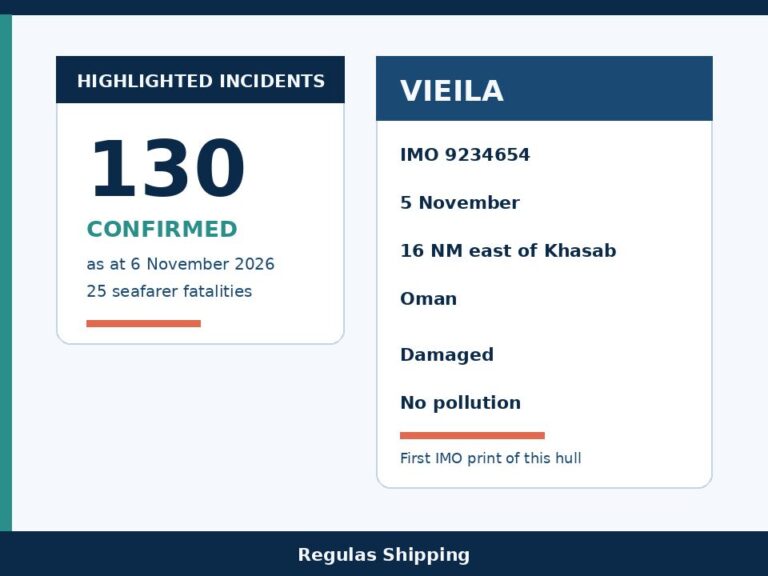
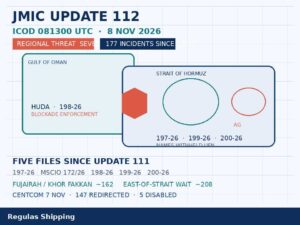
This is not Update 112, not a 130th IMO row, and not NAVAREA IX 434/26. Last week’s dedicated Update 111, ICOD 051300 UTC 5 November, remains the last numbered public periodic note. Its confirmed-incidents table closed at 191-26 through 196-26. 197-26, 198-26, 199-26 and 200-26 all sit after that cut-off. IMO’s highlighted-incidents board still prints 129 confirmed incidents and 25 confirmed seafarer fatalities as at 6 November, with VELOS SAPPHIRE as the named top row. IMO has not named 200-26, 199-26, 198-26, 197-26, 195-26, 194-26, 193-26, 191-26, Al Jusufi, Quba, AZINI or Huda. The fatality line is still 25, on Velos Sapphire, not on this PDF. NAVAREA IX still lists 433/26 as the 070300 UTC 7 November self-cancelling in-force list atop dedicated 432/26 and dedicated 431/26. Dedicated 432/26 remains the Southern Gulf drifting container through 082359 UTC 8 November. No 201-26, no Update 112, no IMO 130, no ARN 169, no 434/26 and no official NAVWARN 813 this run. Official MSCIO alerts index showed no numbered wrap against the 2020 UTC Hormuz clock.
Operational implications
For a master already shaping a Hormuz outbound, Musandam, Khasab, Lima, Fujairah, Khor Fakkan, Sohar or Gulf of Oman coastal transit, or holding in the Southern Gulf this morning, Sunday is a same-morning Attack on a 2020 UTC 7 November CSO tanker clock, posted time-late, on top of this morning’s dedicated 199-26 northwest-of-Khasab fire, on top of Saturday night’s dedicated 198-26 Khor Fakkan bulk-carrier Advisory, and on top of Friday night’s dedicated 197-26 east-of-Khasab waterline explosion. Update 111 remains the last numbered JMIC note and still prints Hormuz SEVERE and Arabian Gulf SUBSTANTIAL, with an ICOD that closed before this clock. 016-26 remains the working blockade document pack for hulls that still need the Strait. 200-26 adds a tanker that had already reported an unknown-projectile strike while outbound through Hormuz at 2020 UTC on 7 November, with crew safe and no environmental impact reported when the time-late PDF was posted. A passage plan that only carried 198-26’s TBC Khor Fakkan Advisory, or that treated Sunday as closed because 198-26 was the last UKMTO number at 03:30 UTC, has not budgeted a 2020 UTC projectile on the outbound Hormuz transit and has not budgeted 199-26’s northwest fire either.
An unknown projectile, learned time-late from the Company Security Officer, with crew accounted for and no environmental impact reported, is a standoff watchkeeping problem and a delayed-reporting problem before it is a war-risk rewrite. 200-26 is not 199-26’s fire-and-evacuation problem. It is not 197-26’s waterline-explosion, own-power problem. It is not 187-26’s alongside, slow-speed, above-waterline device problem. It is a lookout, CPA, AIS-on/AIS-off, citadel and damage-watch problem at the same time as it is a late-report problem. BMP MS projectile and citadel guidance remains the working industry pack; 200-26 does not reprint it and does not order an armed team. It also does not authorise a master to treat every radar contact in the Strait of Hormuz as a confirmed Attack, or to treat every AIS-on tanker as 199-26, 197-26, Velos Sapphire or Louise 1 after the fact. Log the Warning number, the 7 November date, the 2020 UTC clock, the time-late stamp, the Company Security Officer source line, the tanker type, the outbound Hormuz transit, the unknown-projectile method, the crew-safe line, and the no-environmental-impact line. Do not log a hull, 199-26’s fire, 199-26’s evacuation, 197-26’s port-side waterline explosion, a nautical-mile offset, a NUC, a sunk line, or an Omani-port finding that the PDF does not print.
The missing hull, fire and damage-volume lines are the practical damage watch, not a completed all-clear. The public PDF says all crew are safe and accounted for and there is no reported environmental impact at this time. Those are status sentences. They are not a class survey, and they are not a finding that the hull is undamaged. 200-26 does not print own power, continuing on its voyage, fire out, or NUC. Next-port authorities will want a written account that 200-26 does not contain. Charterers and war-risk underwriters will now ask whether the ship was outbound through Hormuz after 2020 UTC on 7 November, whether it reported on time or time-late, and whether it was following Update 111 and 016-26. They will not be answered by this morning’s 199-26 fire, by Friday night’s 197-26 Attack, by IMO’s Velos Sapphire row, or by a NAVAREA that names a different hull on a different plot.
For a DPA and an operator with any merchant hull still using Hormuz, Musandam, Khasab, Fujairah, Khor Fakkan or the Gulf of Oman, the reporting split is the operational content. Sightings of explosions, fire, smoke, a disabled tanker, a Mayday on Channel 16 or pollution go to UKMTO on the 200-26 action line and to the company security officer. NAVCENT NCAGS remains the 016-26 blockade mailbox for hulls that still need the Strait. MSCIO remains the EU ATALANTA registration and alert desk; no numbered MSCIO wrap against the 2020 UTC Hormuz clock was retrieved this run. Registering with one mailbox is not a substitute for the others. 200-26 does not order a daylight-only transit, a deviation around a published circle, or a halt to visit-and-search compliance. Keep Update 111 Hormuz SEVERE / Arabian Gulf SUBSTANTIAL and 016-26 visit-and-search in the master’s pack. Watch a PDF revision that names a hull, prints a type beyond tanker, a lat/long, a NUC, a tow, a fire, a flooding line, a casualty line or a next-port line; a NAVAREA that plots this tanker rather than Selat Storm, RITI, Quba or Louise 1; a flag or class note; a JMIC Update 112; or an IMO-board row — not a headline that 199-26 closed Sunday’s Attack or completed a salvage.
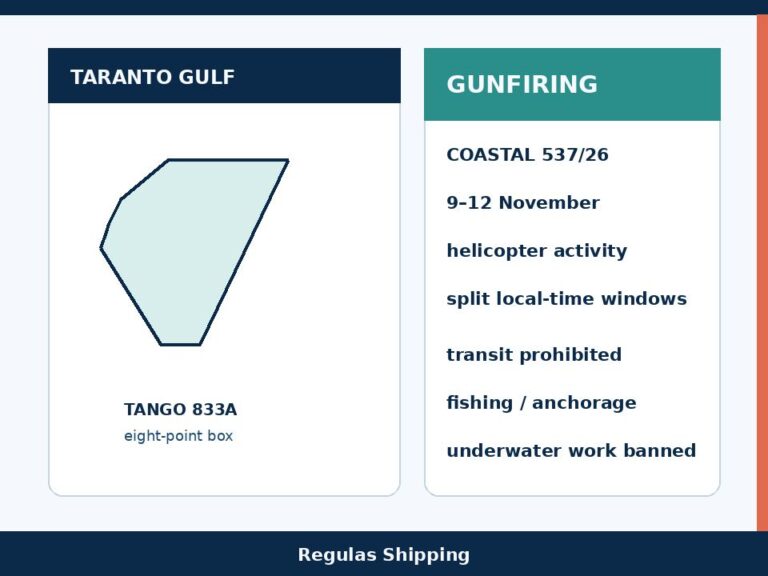
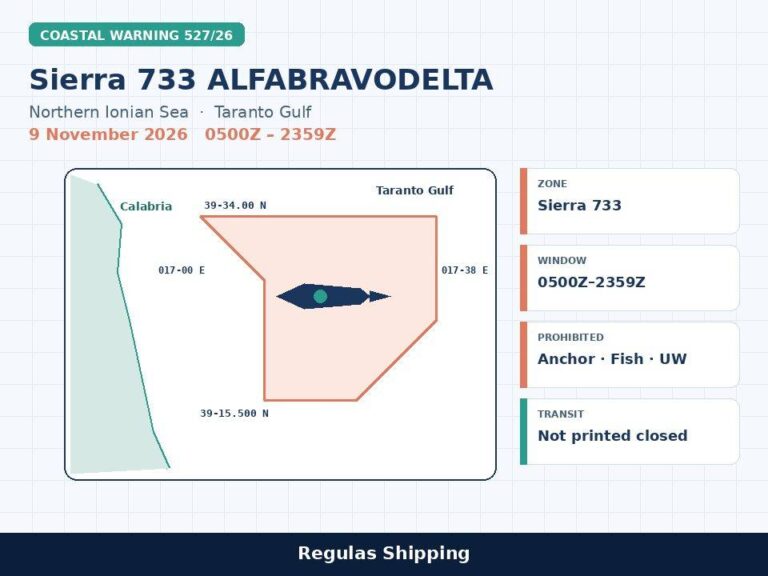
Keep the dedicated files on their own lines. 199-26 remains this morning’s dedicated Suspicious Activity warning on a tanker fire 8 nautical miles northwest of Khasab, crew evacuated, military authorities, time-late. 198-26 remains Saturday night’s dedicated Advisory on a bulk carrier and military forces 18 nautical miles east of Khor Fakkan, incident time TBC; CENTCOM’s Huda statement remains wrap. 197-26 remains Friday night’s dedicated Master Attack on a tanker 16 nautical miles east of Khasab, explosion at the waterline port side, crew safe, under own power. 196-26 remains Thursday morning’s dedicated Verified Attack on a tanker 50 nautical miles north of Madinat ash Shamal, two unidentified projectiles, crew unconfirmed; Friday afternoon’s dedicated IMO 129-count remains the Velos Sapphire fatality conversion on that Qatar sheet, wrap, not a 200-26 hull. 195-26 remains Tuesday night’s dedicated CSO Attack on a tanker 14 nautical miles northeast of Lima, two unknown projectiles into the engine room, no casualties. 193-26 remains last week’s dedicated unnamed Lima hole, 2020 UTC 1 November, 9 nautical miles northeast, vessel and crew safe — same clock-of-day, different date. Update 111 remains ICOD 051300 UTC, 172 incidents, six counted since the last report through 196-26. 016-26 remains the blockade document pack. This morning’s dedicated Kerkyra 201/26 remains the Zakynthos firing box 9–13 November. This morning’s dedicated Irakleio 1409/26 remains the Plateia firing windows on 9 and 16 November. Do not recast 8 November morning as a named Hormuz tanker, as 199-26 recast, as 197-26 filed twice, as Update 112, or as IMO moving the fatality line off Velos Sapphire.
What Operators Should Note
- Log 200-26 as a 7 November outbound Hormuz tanker Attack on a time-late CSO clock, not as a 199-26 rewrite and not as a 197-26 rewrite. UKMTO Warning 200-26, incident 7 November 2026, 2020 UTC, source Company Security Officer, time-late. Filename
20261108-ukmto_warning-200-26.pdf. Tanker struck by an unknown projectile while transiting outbound through the Strait of Hormuz. All crew safe and accounted for. No reported environmental impact at this time. Transit with caution. Report suspicious activity to UKMTO, [email protected] / +44 (0) 2392 222060. Authorities are investigating. Location footer Strait of Hormuz. UKMTO printed neither hull, IMO, flag, cargo, attacker, fire, nautical-mile offset, lat/long, anchorage, NUC, tow, next port, nor a keep-clear radius. This is not 199-26, not 197-26, not 198-26 / Huda, not 196-26 / Velos Sapphire, and not 195-26. - Hold the clock, the water and the time-late stamp. 200-26 is Attack, not Suspicious Activity. The working date is 7 November. The working time is 2020 UTC. The working source is Company Security Officer, not Military authorities and not Master. The working type is tanker. The working transit is Strait of Hormuz outbound. The working water is the Strait of Hormuz footer, with no nautical-mile offset printed. The working method is an unknown projectile — not a fire and not a waterline explosion. The crew line is all crew safe and accounted for, not evacuated. The environmental line is no reported environmental impact at this time. The product number is 200. The incident clock sits after 197-26’s 2200 UTC 5 November Khasab tanker and after 196-26’s 2320 UTC 4 November Qatar tanker. Do not brief Sunday morning as “199-26’s Khasab fire, now a projectile.” Do not treat the 8 November filename as an 8 November strike.
- Hold 199-26 on its own line, one product earlier on the same Sunday board. Dedicated 199-26 remains Suspicious Activity, posted about 0912 UTC on 8 November, source Military authorities, time-late: tanker on fire 8 nautical miles northwest of Khasab, Oman; crew evacuated. 200-26 is Attack, unknown projectile, 2020 UTC 7 November, crew safe onboard, no environmental impact, footer Strait of Hormuz. Two Sunday warnings are two Sunday warnings. Do not merge the projectile into the fire. Do not merge the crew-safe line into the evacuation. Do not treat 8 nautical miles northwest of Khasab as 200-26’s plot.
- Do not collapse 197-26, 198-26, 196-26 / Velos Sapphire or 195-26 onto this number. 197-26 remains Friday night’s dedicated Master Attack on a tanker 16 nautical miles east of Khasab, explosion at the waterline port side, crew safe, under own power. 198-26 remains Saturday night’s dedicated Advisory on a bulk carrier and military forces 18 nautical miles east of Khor Fakkan, TBC; CENTCOM’s Huda statement remains wrap. 196-26 remains Thursday morning’s dedicated Verified Attack on a tanker 50 nautical miles north of Madinat ash Shamal, two unidentified projectiles, crew unconfirmed; Friday afternoon’s dedicated IMO 129-count remains the Velos Sapphire fatality conversion on that Qatar sheet. 195-26 remains Tuesday night’s dedicated CSO Attack on a tanker 14 nautical miles northeast of Lima, two unknown projectiles into the engine room, no casualties. An outbound Hormuz unknown-projectile Attack with no printed offset is not an 8-nautical-mile northwest-of-Khasab fire, and it is not a 16-nautical-mile east-of-Khasab waterline explosion. Five products are five products. An outbound Hormuz tanker is a sixth overnight file. Do not make them one hull.
- Do not merge this watch onto 194-26, Al Jusufi, 193-26, 191-26 or IMO’s 129-count as a completed 200-26 naming. 194-26 remains Tuesday night’s dedicated Verified Attack on an Indian crewed dhow, 1105 UTC 2 November, vessel status unknown; Monday afternoon’s dedicated Al Jusufi file remains wrap on that number, not on 200-26. 193-26 remains last week’s dedicated unnamed Lima hole, 2020 UTC 1 November, 9 nautical miles northeast, vessel and crew safe — same clock-of-day, 1 November, not 7 November. 191-26 remains Sunday night’s dedicated Channel 16 Mayday-relay Attack. IMO still prints 129 confirmed / 25 dead as at 6 November, with VELOS SAPPHIRE as the named top row. IMO has not named 200-26. Fatality still 25, on Velos Sapphire. Update 111 remains ICOD 051300 UTC; this 2020 UTC 7 November clock sits after that cut-off. 016-26 remains the blockade document pack. No Update 112, no 201-26, no IMO 130 this run.
- Treat the missing hull, fire and damage-volume lines as open damage lines. The public tape prints tanker, outbound Hormuz, unknown projectile, 2020 UTC 7 November, crew safe, no environmental impact at this time. It does not print a hull, a cargo grade, a fire, a survey, a hole size, a NUC interval, a tug, own power, a next-port name or a class note. Keep Update 111 Hormuz SEVERE / Arabian Gulf SUBSTANTIAL and 016-26 visit-and-search in the master’s pack. Sightings go to UKMTO, MSCIO, the Omani authorities and the CSO. Watch a PDF revision that names a hull or prints a lat/long; a NAVAREA that plots this tanker rather than Louise 1 or Selat Storm; a flag or class note; a JMIC Update 112; or an IMO-board row — not a headline that 199-26 closed Sunday’s Attack or completed a salvage.
Regulas Shipping will keep lining Warning 200-26 against this morning’s dedicated Warning 199-26 and against Friday night’s dedicated Warning 197-26 so operators can treat Sunday morning’s tape as a numbered time-late CSO Attack on an outbound Hormuz tanker, not as a northwest-of-Khasab fire rewrite, an east-of-Khasab explosion reprint, or a completed class survey.