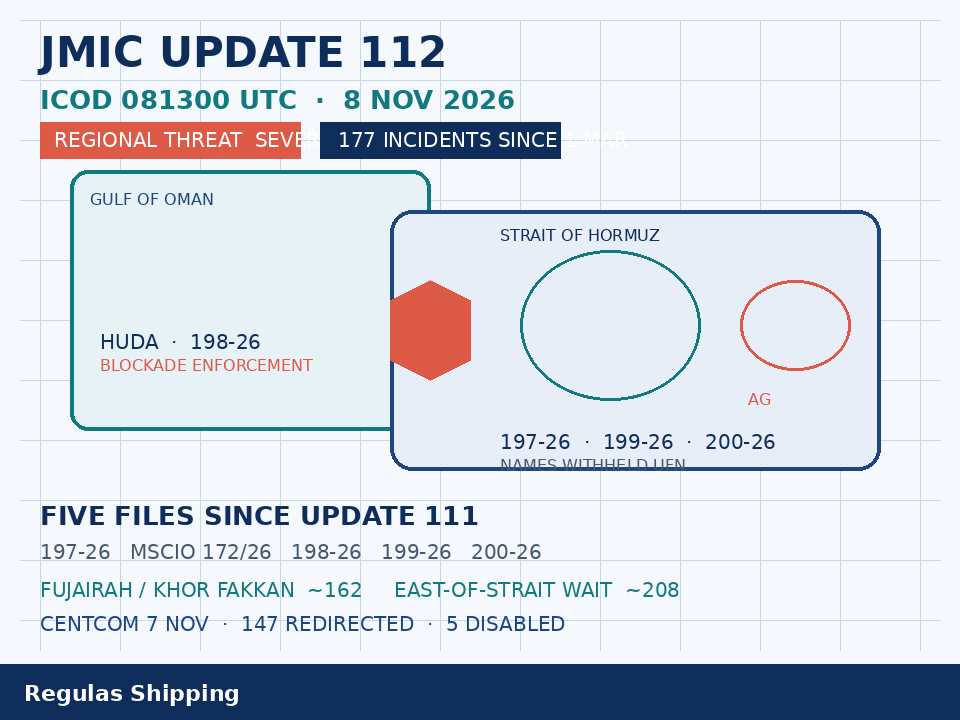
The U.S. Navy-led Joint Maritime Information Center published Update 112 to its regional advisory note with an information cut-off of 081300 UTC on 8 November. The working primary retrieved this run is the numbered PDF posted on the UKMTO product board as jmic_advisory_update_112_08-nov.pdf. The face of the note is titled Update 112 to JMIC Advisory Note, 01 March – 08 November 2026. The information cut-off is printed as ICOD 081300 UTC. The note is printed as JMIC# 001 26. The regional threat level remains SEVERE. The Strait of Hormuz remains SEVERE. The Arabian Gulf remains SUBSTANTIAL. The Gulf of Oman stays MODERATE. The Arabian Sea stays MODERATE. The Gulf of Aden stays SUBSTANTIAL. Bab el-Mandeb / the southern Red Sea stay SUBSTANTIAL. The Somali Coast / Somali Basin stay MODERATE. The Northern Red Sea / Suez Canal stay MODERATE. The Eastern Mediterranean stays LOW. Confirmed vessel incidents since 1 March are now printed as 177. Five incidents are counted since the last report: UKMTO 197-26, MSCIO 172/26, UKMTO 198-26, UKMTO 199-26 and UKMTO 200-26. A correction line reprints that the total in Update 110 should have read 166, not 167; the error was a double count, and totals from Update 111 are corrected.
That is the working primary. Sunday night’s product is a numbered regional instrument, not a Hormuz reopen, not Update 113, and not a rewrite of Thursday night’s dedicated Update 111, Friday night’s dedicated Warning 197-26, Saturday night’s dedicated Advisory 198-26, or this morning’s dedicated Warning 199-26 and Warning 200-26. The useful facts for a DPA and a bridge team are the first JMIC conversion of dedicated 198-26 onto HUDA as Blockade Enforcement; the still-withheld 197-26, 199-26 and 200-26 rows; the first numbered JMIC print of MSCIO 172/26 as Suspicious Activity in the Bab el-Mandeb; the 177-incident tally after five counted files; the 8 November congestion print of about 162 hulls at Fujairah / Khor Fakkan and about 208 stationary east of the Strait; the 5–7 November U.S.-facilitated Hormuz count of 91; CENTCOM’s 7 November print of 147 redirected and five disabled; and the outlook that still treats further Hormuz attacks as highly likely, particularly off Musandam. Do not treat Friday afternoon’s dedicated IMO 129-count / 25-fatality sheet as a substitute for this numbered note, and do not treat Update 111 as still the current public instrument. Update 112 still withholds 197-26, 199-26 and 200-26. It still withholds Velos Sapphire against dedicated 196-26.
What Update 112 actually added
The confirmed tape is the body of Update 112. ICOD 081300 UTC 8 November. JMIC# 001 26. Regional threat SEVERE. Five incidents since Update 111, counted as 197-26, 172/26, 198-26, 199-26 and 200-26. Total 177 since 1 March. That is the product. Stay with that wording. Do not invent a sixth counted row for a UKMTO 201-26 this desk has not retrieved. Do not invent a Hormuz downgrade. Do not invent a completed Update 113. Do not invent a UKMTO PDF revision of 197-26, 198-26, 199-26 or 200-26. Do not invent a 130th IMO board row on this note.
On 197-26, Update 112 withholds the name. Vessel: Name withheld UFN. Vessel type: Tanker. Event type: Attack. Location: Strait of Hormuz. The narrative says UKMTO reported that on 05 Nov the Master of a tanker transiting the Strait of Hormuz outbound reported an explosion at the waterline, port side, approx. 16 NM east of Khasab, Oman. The crew reported safe, and the vessel continued its voyage. Also reported by MSCIO in 171/26. Friday night’s dedicated Warning 197-26 remains an unnamed Master Attack, 2200 UTC 5 November, tanker, explosion at the waterline, port side, 16 nautical miles east of Khasab, crew safe and accounted for, still under its own power and continuing on its voyage. Update 112 reprints that clock and still withholds the hull. Official MSCIO 171/26 is wrap on dedicated 197-26, unused as a second Khasab piece. Do not invent a name. Do not convert the waterline explosion into a projectile count. Do not collapse this morning’s dedicated 199-26 fire or 200-26 projectile onto this 16 NM offset.
On MSCIO 172/26, Update 112 withholds the name. Vessel: Unidentified. Vessel type: Unknown. Event type: Suspicious Activity. Location: Bab el-Mandeb. The narrative says MSCIO reported suspicious activity on 06 Nov 2026, in position 12°46.4’N 043°18.0’E, in the Bab el-Mandeb Strait. A merchant vessel observed a small radar target heading northbound towards Yemen, outside the Traffic Separation Scheme. The target could not be visually identified and appeared to be operating without navigation lights. At approx. 22:45 UTC, a large explosion was observed at the target’s position, followed by a fire on the sea surface lasting more than 30 minutes. No distress calls or radio communications were reported. The identity of the target, the cause of the explosion and the circumstances remain unknown. That file is unused as a dedicated piece this run. It is wrap on Update 112. It is in the five-incident tally. Do not convert Suspicious Activity into Attack. Do not invent a hull, a Houthi claim, a merchant casualty or a TSS closure against this radar target. Do not collapse Thursday night’s wrap MSCIO 168/26 smoke object onto this 12°46.4’N clock.
On 198-26, Update 112 names the hull. Vessel: HUDA. Vessel type: Bulk Carrier. Event type: Blockade Enforcement. Location: Gulf of Oman. The narrative says UKMTO reported that on 07 Nov, a vessel identified by US CENTCOM as the HUDA, was disabled by military forces in the Gulf of Oman, approx. 18 NM east of Khor Fakkan, UAE. CENTCOM stated that U.S. forces disabled the vessel after its crew ignored repeated warnings and attempted to violate the naval blockade; a U.S. military aircraft fired precision munitions at the stern after directing the crew to abandon targeted spaces. Status of the crew, damage assessment and environmental impact were unknown at the time of the UKMTO report. Saturday night’s dedicated Advisory 198-26 remains an unnamed bulk-carrier Advisory, incident time TBC, source Military authorities, bulk carrier and military forces, approximately 18 NM east of Khor Fakkan, crew / damage / environment unknown. CENTCOM’s 7 November Huda statement was already wrap on that dedicated file, unused as a completed PDF naming. Update 112 is the first numbered JMIC print of HUDA against 198-26. The “identified by US CENTCOM” clause is a JMIC sourcing line. It is not a revision of the public 198-26 PDF, which still withholds the name and still prints Advisory, not Attack. Do not invent a flag on this note. Do not invent an IMO number on this note. Do not convert Blockade Enforcement onto 198-26 as a completed PDF Attack. Do not collapse 199-26 or 200-26 onto this 18 NM offset.
On 199-26, Update 112 withholds the name. Vessel: Name withheld UFN. Vessel type: Tanker. Event type: Incident. Location: Strait of Hormuz. The narrative says UKMTO received a time-late report that on 07 Nov military authorities reported that a tanker approx. 8 NM northwest of Khasab, Oman, was on fire, which resulted in the evacuation of the crew. This morning’s dedicated Warning 199-26 remains an unnamed Suspicious Activity, tanker on fire 8 NM northwest of Khasab, crew evacuated. The numbered PDF 20261108-ukmto_warning_199-26.pdf is now retrieved and prints Incident Date 07 Nov 2026, Incident Time 1920UTC, source Military authorities; that clock is wrap on this morning’s dedicated file, not a second Khasab fire piece. Update 112 reprints the fire and the evacuation and still withholds the hull. It types the row as Incident, not Attack. Do not invent a name. Do not invent a projectile, a mine, a small-boat, a NUC, a tow, a casualty count or a pollution volume. Do not collapse 200-26 onto this 8 NM offset. Do not collapse 197-26 onto it as an east-of-Khasab reprint.
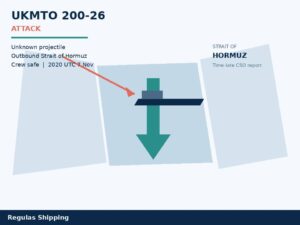
On 200-26, Update 112 withholds the name. Vessel: Name withheld UFN. Vessel type: Tanker. Event type: Attack. Location: Strait of Hormuz. The narrative says UKMTO received a time-late report that on 07 Nov the Company Security Officer of a tanker reported that the vessel was struck by an unknown projectile while transiting outbound through the Strait of Hormuz. All crew are safe and accounted for and there is no reported environmental impact. This morning’s dedicated Warning 200-26 remains an unnamed CSO Attack, 2020 UTC 7 November, tanker, unknown projectile, outbound Hormuz, all crew safe, no reported environmental impact, location footer Strait of Hormuz. Update 112 reprints that clock and still withholds the hull. Do not invent a name. Do not invent a nautical-mile offset. Do not collapse 199-26’s fire onto this projectile. Do not collapse 197-26’s waterline explosion onto it.
The Arabian Gulf operational summary is marked no confirmed attacks or disruptions in this period. Traffic flows continued, with anchorage congestion high across the region. The 24–48-hour outlook is unchanged in kind: eight attacks inside the Gulf since 07 Oct, including the 01 November attack on a tanker approx. 72 NM east of Ras Al Khafji (UKMTO 192-26) and the 04 November attack on a tanker approx. 50 NM north of Madinat ash Shamal, Qatar (UKMTO 196-26), show that attacks remain a strong possibility throughout the Arabian Gulf, including the northern and central Gulf, anchorages and STS areas. Electronic interference remains a credible concern in the central and southern Arabian Gulf. Vessels stationary for extended periods, or maintaining AIS-on while static, may face elevated targeting risk. Do not invent a ninth Arabian Gulf Attack on this cut-off. Dedicated 196-26 remains Thursday morning’s unnamed Qatar tanker; Friday afternoon’s dedicated IMO 129-count remains the Velos Sapphire fatality conversion. Update 112 does not print Velos Sapphire against 196-26.
The Strait of Hormuz summary carries two Attacks in the period (UKMTO 197-26 and 200-26), against four in the previous period. On 05 November an outbound tanker reported an explosion at the waterline; this was the fifth attack off the Musandam coast of Oman since 01 November (UKMTO 191-26, 193-26, 194-26, 195-26 and 197-26). IRGC attacks, attempted attacks and/or harassment activity persisted, including UAV overflight, targeted surveillance of merchant shipping, and occasional VHF hailing. Commercial traffic through the Strait remained at reduced levels compared to the 2025 baseline. Independent tracking data indicated single to low double digit transits per day, while U.S. NCAGS data indicated an average of approx. 30 U.S. assisted transits per day on 05–07 November. The 07 November attack on an outbound tanker (UKMTO 200-26) is cited in the outlook as a further indication that the threat to transiting vessels persists. Further attacks on transiting vessels, including tankers, tugs and dhows, are highly likely, particularly off Musandam. AIS-on vessels can expect elevated targeting risk and directed hails instructing them to divert toward the northern Iranian-controlled route. A 30-nautical-mile standoff from U.S. units remains advised. JMIC Advisory Note 016-26 remains the clearance-request tool.
What sits off the list, and the traffic that moved
Sunday’s cut-off is 081300 UTC on 8 November. Update 112 does print this morning’s dedicated Warning 199-26 and Warning 200-26, as an unnamed tanker Incident 8 NM northwest of Khasab and an unnamed tanker Attack outbound through the Strait. It does not print a hull against either clock. It does not print Velos Sapphire against dedicated 196-26. Friday afternoon’s dedicated IMO 129-count / 25-fatality sheet is a different instrument, still as at 6 November, still 129 confirmed / 25 dead. Do not back-fit an IMO hull onto an 081300 UTC JMIC sheet that still reads Name withheld UFN on 197-26, 199-26 and 200-26.
The Gulf of Oman summary is the paragraph that should replace Update 111’s version in the master’s pack. On 07 Nov UKMTO reported an incident / blockade enforcement involving a bulk carrier and military forces in the Gulf of Oman, approx. 18 NM east of Khor Fakkan, UAE (UKMTO 198-26). Naval presence remained elevated due to blockade enforcement activity. According to official CENTCOM figures issued on 07 Nov, 147 commercial vessels have been redirected and five merchant ships have been disabled as a result of blockade enforcement. Two vessels had previously been reported boarded for blockade compliance (CENTCOM, 01 Nov). Update 111’s CENTCOM line was still dated 01 Nov: 144 redirected, four disabled, two boarded. Sunday night is the conversion of that 7 November print. Neutral vessels between non-Iranian ports may be questioned, visited and searched under the blockade and should be prepared to provide the documentation noted in JMIC Advisory Note 016-26. A 30-nautical-mile standoff from U.S. units remains advised, as well as continuous monitoring of VHF Channel 16. Unauthorized entry or departure may result in interception or force. Do not treat the 147 / five figures as a 198-26 PDF revision.
The Arabian Sea paragraph is marked no change. The Gulf of Aden paragraph is marked no change. No confirmed attacks or disruptions were reported in this period. Further small-boat approaches are likely in the western Gulf of Aden and the IRTC. MSCIO continues to advise strict adherence to BMP-MS. The southwest monsoon subsided on 15 Oct. Sea state across the Gulf of Aden is forecast to remain slight, with wave heights of approx. 0.8–1.5 m and winds of 13–18 kt through the reporting period.
Southern Red Sea and Bab el-Mandeb carry MSCIO 172/26 as the one Suspicious Activity in the period. No confirmed attack on merchant shipping was reported. Traffic remains below the 20 July Houthi selective embargo. Commercial traffic in the Bab el Mandeb averaged approx. 28 transits per day on S&P tracking on 05–07 Nov, against approx. 35 per day in the previous week. The 72-hour BAM total is printed as 85 cargo-carrying vessels above 1,000 deadweight tons against a 2023 baseline of about 61 per day. Bab el-Mandeb remains open to commercial traffic but is considered as volatile. Houthi statements continue to assert that non-Saudi commercial shipping may transit safely. The Houthi-run Humanitarian Operations Coordination Center (HOCC) advertises a voluntary, free ‘safe transit’ request service for vessels outside its declared ban; recent reporting that merchant vessels have used this service remains independently unconfirmed. Disclosure of voyage information in response to Houthi communications may increase targeting risk. U.S. MARAD Advisory 2026-013 remains the U.S.-flag instruction to disregard Houthi orders to activate AIS or submit voyage information. MT ASANA, the Tanzanian-flagged product/chemical tanker hijacked on 17 July approximately 65 NM southwest of Mukalla, is still the one merchant vessel remaining hijacked.
The Somali Coast and Somali Basin paragraph is marked no change. AZINI’s 2 November liberation remains on Update 111; Update 112 reprints that Pirate Action Group range is likely to extend across the northern Somali Basin towards the shipping routes east and south of Socotra. Sea state in the Somali Basin is forecast to remain slight, with wave heights of approx. 0.8–1.3 m and winds of 10–16 kt, with no storm warning until next report.
Infrastructure colour is unchanged in kind. No attack on ports, terminals, offshore platforms, oil and gas loading facilities or subsea infrastructure was reported in this period. The overall infrastructure risk remains MODERATE.
Port and anchorage congestion is printed as of 08 Nov. About 162 vessels were at anchor in the vicinity of Fujairah / Khor Fakkan, eased from about 179 on 5 November. About 144 were off Dubai / Jebel Ali to Ras Al Khaimah, mainly off Sharjah / Ajman / Umm Al Quwain, broadly unchanged from about 141. About 46 were in the vicinity of Musandam / Sohar, down from about 50 on a small base. About 32 were off Bandar Abbas / Qeshm, up from about 17 on a small, low-confidence base because Iranian AIS coverage is thin. There was no mass departure, new cluster or gap near an attack area, including off Musandam where one attack was reported. JMIC internal tracking counted approximately 208 commercial vessels stationary at the main anchorages east of the Strait of Hormuz (Fujairah, Khor Fakkan, Sohar and Musandam), against single-digit to low double-digit AIS-visible transits per day; the backlog is expected to persist. Data limits: internal AIS estimates; AIS-dark vessels excluded. Stationary AIS-on hulls may face elevated targeting risk. Do not restore Update 111’s 229-vessel wait as a figure on this note. That sentence sat on Update 111. It is not reprinted here.
GNSS / AIS interference in the Arabian Gulf was broadly stable on 7 November, at or below its weekly level; the most consistent indications were on the Ras al-Khaimah coast at the Hormuz approaches. Windward recorded 154 jammed vessels of 7,100 transmitting in the Gulf and Gulf of Oman on 5 November, about 62 percent below its seven-day average. Update 111’s Windward print was 362 jammed of 5,921 transmitting on 3 November. UKMTO’s weekly VRA report for the week ending 06 November recorded three vessel GNSS reports and listed the Red Sea, Gulf of Oman and Arabian Gulf as unchanged hotspots. In the Strait of Hormuz and the Gulf of Oman, aircraft indications remained low. In the Red Sea and Bab el-Mandeb, no significant GNSS interference was observed at sea. No new specific UKMTO, MARAD, NAVCENT or NAVAREA IX GNSS/EMI notices were issued 05–08 November. Baseline advisories remain in force. Cross-check with radar and visual navigation.
The annex is the independent traffic colour Update 111 closed at 4 November. Independent cargo-vessel transits through the Strait, S&P Maritime / SeaVision, excluding Iranian-port callers, are printed as 0, 0, 1, 4, 4, 4 and 1 for 1–7 November. Independent tanker transits for the same week are 1, 2, 2, 1, 2, 3 and 1. Bab el-Mandeb cargo totals for those seven days are 19, 25, 22, 17, 18, 24 and 18. Bab el-Mandeb tanker totals are 19, 12, 13, 9, 7, 12 and 6. U.S.-facilitated Strait of Hormuz transits for 05–07 November, the past 72 hours, are printed as 91. Do not add those independent figures to the 91 U.S.-facilitated count. UKMTO’s own transit, latest-incidents and AIS-anomaly boards are printed as annex headings, marked not updated since 05 November.
What this is not
This is not Update 113, and it is not a rewrite of dedicated Update 111. Update 111, ICOD 051300 UTC 5 November, remains the previous numbered public periodic note. Update 112 replaces it. The 172-incident print on Update 111 is now 177 after five counted files. Masters who still brief the region as Update 111 will have the wrong instrument in the folder. Masters who brief Sunday night as Update 113 will have invented a later cut-off this desk has not retrieved.
This is not a rewrite of 198-26, and it is not a UKMTO PDF naming of Huda. Dedicated Advisory 198-26 remains an unnamed bulk-carrier Advisory, incident time TBC, 18 NM east of Khor Fakkan, crew / damage / environment unknown. CENTCOM’s 7 November Huda statement remains wrap on that PDF. Update 112 is the first numbered JMIC print that types 198-26 as Blockade Enforcement, names HUDA, and attributes the identification to US CENTCOM. Two instruments. Do not collapse them into one “UKMTO named Huda on 198-26” sentence. Do not convert JMIC’s Blockade Enforcement onto 198-26 as a completed PDF Attack. Do not invent a flag or an IMO number on this note.
This is not a rewrite of 197-26, 199-26 or 200-26. Those three files remain Name withheld UFN on this note. Dedicated 197-26 remains Friday night’s unnamed Khasab waterline explosion. Dedicated 199-26 remains this morning’s unnamed 8 NM northwest-of-Khasab fire; the 1920 UTC clock now on the numbered PDF is wrap, not a second fire piece. Dedicated 200-26 remains this morning’s unnamed outbound Hormuz projectile. MSCIO 171/26 remains wrap on 197-26. MSCIO 172/26 remains wrap on tonight’s Update 112, unused as dedicated. Do not promote a later IMO hull onto this 081300 UTC table.
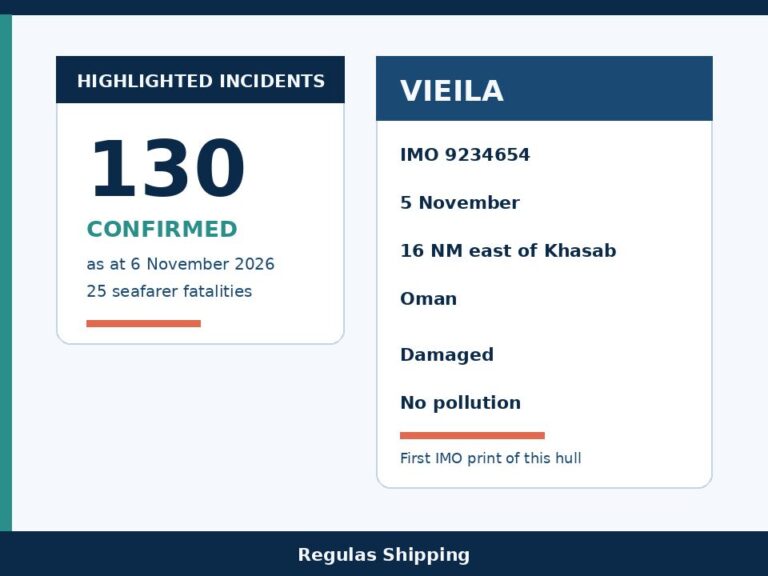
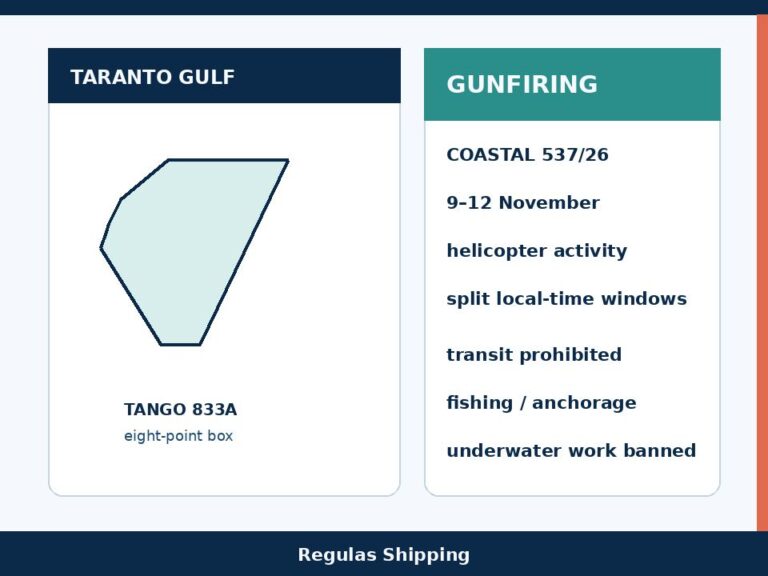
This is not an International Maritime Organization 130-count. Friday afternoon’s dedicated IMO highlighted-incidents board remains 129 confirmed / 25 seafarer fatalities as at 6 November. JMIC’s 177 and IMO’s board are different datasets. Wednesday afternoon’s dedicated JMIC Advisory Note 016-26 remains the blockade visit-and-search document pack; Update 112 reprints the pack, it does not replace it. This is not tonight’s companion NAVWARN 813/26, and it is not Saturday afternoon’s dedicated 799/26, Thursday morning’s dedicated 797/26 MENTOR, or Friday night’s dedicated 432/26 southern-Gulf container (now past 082359 UTC 8 November). Official HNHS 1338/26, 1339/26 and 1351/26 remain unused unlit lights. Official Cyprus 345/26 remains unused as dedicated. NAVAREA IX 433/26 remains the unused self-cancelling in-force list. Official English 814/26 remains wrap on tonight’s companion 813/26.
Operational implications
A numbered JMIC update is a routing and manning problem before it is a count of who was hit. Hormuz is still SEVERE, with deliberate attacks called highly likely, AIS-on targeting risk, directed hails toward the northern Iranian-controlled route, and a specific watch for attempted mining within and adjacent to the traffic-separation scheme. That guidance did not move because five more files cleared the table. The Arabian Gulf column did not move either. It stays SUBSTANTIAL. What moved is the one Blockade Enforcement naming — Huda against dedicated 198-26 — the still-withheld 197-26, 199-26 and 200-26 rows, the first numbered print of MSCIO 172/26, the incident tally from 172 to 177, the congestion print from Update 111’s 5 November figure of about 179 hulls at Fujairah / Khor Fakkan down to about 162 on 8 November, the east-of-strait wait from about 229 to about 208, the facilitated count from 126 over 1–4 November to 91 over 5–7 November, CENTCOM from 144 redirected / four disabled as at 1 November to 147 redirected / five disabled as at 7 November, and the GNSS colour from Windward’s 3 November 362 jammed print to a 5 November 154 jammed / 7,100 transmitting print. Masters who still brief the region as Update 111 will have the wrong instrument in the folder. Masters who brief Sunday night as a Hormuz downgrade will have the wrong scale on the chart.
The Huda paragraph is a briefing-discipline problem, not a new casualty on the 198-26 PDF. Saturday night’s dedicated 198-26 left a bulk carrier unnamed against a TBC clock 18 NM east of Khor Fakkan. CENTCOM’s 7 November statement named M/V Huda, precision munitions at the stern, blockade-violation / disablement, and stayed wrap. Update 112 is the first numbered JMIC note that prints HUDA against 198-26, types the row as Blockade Enforcement, and attributes the identification to US CENTCOM. A master’s pack that briefs “UKMTO named Huda” has over-read a JMIC sourcing line. A pack that briefs 199-26 as Attack because 200-26 is Attack will have ignored Update 112’s Incident type on the fire row. Hold the PDFs, the CENTCOM wrap, this note, and Friday afternoon’s IMO 129-count as separate sheets.
The Fujairah density and the 208-vessel east-of-strait wait are the other operator facts. Update 112 parks that density against a Strait that printed independent cargo transits of 4, 4 and 1 on 5–7 November and independent tanker transits of 2, 3 and 1. Two Hormuz Attacks in the period sit on this note, with no mass departure from the east-of-strait anchorages. Fujairah / Khor Fakkan eased gradually. Vessels stationary for extended periods, or maintaining AIS-on while static, may face elevated targeting risk. Harbour assists, wreck response and disabled-hull tows operating in that density are in the same watch as shuttle tankers. AIS-off is not a detection shield and is not an order on this note. Do not merge Huda’s 18 NM east-of-Khor-Fakkan offset onto the Fujairah line, and do not merge 199-26’s 8 NM northwest-of-Khasab fire onto it.
CSOs should replace the 5 November Update 111 pack with Update 112 in the master’s folder and in the charterer’s security clause file. The new named line is 198-26 HUDA, bulk carrier, Blockade Enforcement, 18 NM east of Khor Fakkan, identified by US CENTCOM, disabled after ignored warnings and an attempted blockade violation, precision munitions at the stern after the crew was directed to abandon targeted spaces, crew / damage / environment unknown at the UKMTO report. The still-withheld lines are 197-26, 199-26 and 200-26. The new Suspicious Activity line is MSCIO 172/26, unidentified radar target 12°46.4’N 043°18.0’E, explosion about 2245 UTC 6 November, fire on the sea surface more than 30 minutes, no distress. The new tally is 177 since 1 March. The new congestion line is about 162 hulls in the vicinity of Fujairah / Khor Fakkan as of 8 November and about 208 stationary at the main east-of-strait anchorages. The new facilitated count is 91 U.S.-assisted Hormuz transits over 5–7 November. The new CENTCOM line is 147 redirected and five disabled as at 7 November. The new GNSS colour is Windward’s 5 November print of 154 jammed vessels of 7,100 transmitting. None of those edits is a flag circular, a class condition, or a completed MARPOL finding. Do not replace Friday night’s dedicated 197-26 PDF, Saturday night’s dedicated 198-26, this morning’s dedicated 199-26 or 200-26, Wednesday’s dedicated 016-26 pack, or Friday afternoon’s dedicated IMO 129-count. They are different instruments. Update 112 is the numbered regional threat note that now sits on top of Update 111.
For a master already shaping Musandam, holding off Fujairah or Khor Fakkan, or still needing a blockade clearance, Sunday night is a document-pack and lookout problem before it is a policy problem. 016-26 remains the working visit-and-search list. Update 112 reprints it; it does not shorten it. Channel 16, the UKMTO emergency line, the MSCIO emergency line and the company duty officer still have to be on the night orders. Registering with one mailbox is not a substitute for the other. Update 112 does not order a daylight-only transit or a halt to visit-and-search compliance. It also does not authorise a master to treat every AIS-on bulk carrier east of Khor Fakkan as Huda, or every tanker fire off Khasab as 200-26, after the fact. This morning’s dedicated 199-26 remains a separate unnamed fire on this table. This morning’s dedicated 200-26 remains a separate unnamed projectile.
Charterers, P&I and war-risk underwriters will now ask whether the ship was in the Voluntary Reporting Area after 081300 UTC 8 November, whether it was off Musandam after the fifth attack since 1 November, whether it was 18 NM east of Khor Fakkan after the Huda row, whether it held the 016-26 pack, and whether it was following BMP-MS. They will not be answered by this morning’s 199-26 unnamed fire, by this morning’s 200-26 unnamed projectile, by Friday’s 129-count, or by a headline that one JMIC naming closed the 198-26 PDF. Off-hire and deviation conversations that treat Update 112 as a completed Hormuz reopen, or as a UKMTO PDF naming of Huda, have misread the cut-off.
Keep the dedicated files on their own lines. 197-26 remains Friday night’s dedicated unnamed waterline explosion 16 NM east of Khasab; MSCIO 171/26 is wrap. 198-26 remains Saturday night’s dedicated unnamed bulk-carrier Advisory; Huda on this note and on CENTCOM’s 7 November statement is wrap on that PDF, not a UKMTO naming. 199-26 remains this morning’s dedicated unnamed fire 8 NM northwest of Khasab; the 1920 UTC PDF clock is wrap. 200-26 remains this morning’s dedicated unnamed outbound Hormuz projectile. 196-26 remains Thursday morning’s unnamed Qatar tanker; Friday afternoon’s dedicated IMO 129-count remains the Velos Sapphire fatality conversion and is not a 196-26 PDF naming. 172/26 remains wrap, unused as dedicated. 016-26 remains Wednesday afternoon’s blockade document pack. Saturday afternoon’s dedicated 799/26 remains the Varna port-and-road closure on 10 and 13 November. Tonight’s companion 813/26 is a different Black Sea boarding box. Do not recast 8 November night as a Hormuz reopen, as a UKMTO PDF naming of Huda, as Update 113, as an IMO 130-count, or as a corridor closure.
What Operators Should Note
- Log Update 112, ICOD 081300 UTC 8 November, not a Hormuz downgrade. JMIC# 001 26. Filename
jmic_advisory_update_112_08-nov.pdf. Regional threat SEVERE. Hormuz SEVERE. Arabian Gulf SUBSTANTIAL. Gulf of Oman MODERATE. Arabian Sea MODERATE. Gulf of Aden SUBSTANTIAL. Bab el-Mandeb / southern Red Sea SUBSTANTIAL. Somali Coast / Somali Basin MODERATE. Northern Red Sea / Suez MODERATE. Eastern Mediterranean LOW. 177 incidents since 1 March. Five counted files since Update 111 (197-26, 172/26, 198-26, 199-26 and 200-26). Replace Update 111 in the master’s pack. Do not confuse this numbered note with Friday afternoon’s dedicated IMO 129-count, and do not stretch it to an IMO 130-count this desk has not retrieved. - Type the Huda row as JMIC typed it, and hold the dedicated 198-26 PDF beside it. HUDA, bulk carrier, Blockade Enforcement, 18 NM east of Khor Fakkan; identified by US CENTCOM; disabled after ignored warnings and an attempted blockade violation; precision munitions at the stern after the crew was directed to abandon targeted spaces; crew / damage / environment unknown at the UKMTO report. Dedicated 198-26 remains unnamed Advisory, incident time TBC. CENTCOM’s 7 November statement remains wrap. “Identified by US CENTCOM” is a JMIC sourcing line, not a 198-26 PDF revision. Do not invent a flag or an IMO number on this note. Do not brief Huda as a UKMTO PDF naming. Do not convert Blockade Enforcement into Attack on the public Advisory.
- Leave 197-26, 199-26 and 200-26 as Name withheld UFN on this table. Dedicated 197-26 remains the 16 NM east-of-Khasab waterline explosion, crew safe, own power; MSCIO 171/26 is wrap. Dedicated 199-26 remains the 8 NM northwest-of-Khasab fire, crew evacuated; JMIC types it Incident, not Attack; the retrieved PDF’s 1920 UTC clock is wrap. Dedicated 200-26 remains the outbound Hormuz unknown projectile, 2020 UTC 7 November, crew safe, no environmental impact. Do not promote a later IMO hull onto this 081300 UTC sheet. Do not collapse the fire onto the projectile.
- Carry MSCIO 172/26 as wrap, not as a dedicated Bab el-Mandeb Attack. Unidentified radar target, 12°46.4’N 043°18.0’E, 6 November, northbound towards Yemen outside the TSS, no navigation lights, large explosion about 2245 UTC, fire on the sea surface more than 30 minutes, no distress. Identity, cause and circumstances unknown. Unused as dedicated. Do not convert Suspicious Activity into Attack. Do not invent a merchant hull or a Houthi claim. Do not collapse wrap 168/26 onto this clock.
- Treat the Fujairah density and the 208-vessel east-of-strait wait as live routing, not as a published closure. About 162 vessels were at anchor IVO Fujairah / Khor Fakkan as of 8 November; about 144 Dubai / Jebel Ali to Ras Al Khaimah; about 46 Musandam / Sohar; about 32 Bandar Abbas / Qeshm. About 208 stationary at Fujairah, Khor Fakkan, Sohar and Musandam against single-digit to low-double-digit AIS-visible transits. U.S.-facilitated Hormuz transits 5–7 November: 91. Independent Strait cargo series 1–7 November: 0, 0, 1, 4, 4, 4, 1. Independent tanker series: 1, 2, 2, 1, 2, 3, 1. CENTCOM as at 7 November: 147 redirected, five disabled, two boarded still from 1 November. Do not add those series into one throughput figure. Do not restore Update 111’s 229-vessel wait. Stationary AIS-on hulls may face elevated targeting risk.
- Keep the 016-26 pack, the mining watch and the reduced-but-live GNSS baseline. Update 112 reprints Advisory Note 016-26: last-port clearance, bill of lading, registry, agent letter, receipts or contracts, berth booking, VHF 16, 30-nautical-mile standoff from U.S. units, NAVCENT NCAGS mailbox. AIS-on targeting risk and directed hails toward the northern Iranian-controlled route remain. Attempted mining within and adjacent to the TSS remains on the outlook. Windward’s 5 November print is 154 jammed vessels of 7,100 transmitting in the Gulf and Gulf of Oman, about 62 percent below its seven-day average. UKMTO’s week-ending 6 November VRA report recorded three GNSS reports. No new UKMTO, MARAD, NAVCENT or NAVAREA IX GNSS/EMI notice was issued 5–8 November. Cross-check with radar and visual navigation.
- Do not recast Sunday night as Update 113 or as a completed early-November tape. 197-26 through 200-26 and 172/26 now sit on this table. Three of the UKMTO files remain unnamed on the note. Asana is still hijacked. Watch a later JMIC cut-off, a UKMTO PDF that prints Huda, a 198-26 revision of the TBC clock, an IMO 130-count, or tonight’s companion 813/26 as a separate sheet — not a headline that Sunday night reopened Hormuz or completed a UKMTO naming.
Regulas Shipping will keep lining Update 112’s 081300 UTC cut-off against dedicated Warnings 197-26 through 200-26, dedicated Advisory 198-26, and Friday afternoon’s IMO 129-count so operators can treat Sunday night’s Huda naming, the 177-incident tally and the 208-vessel east-of-strait wait as a live routing pack, not as a Hormuz reopen or a completed Update 113.