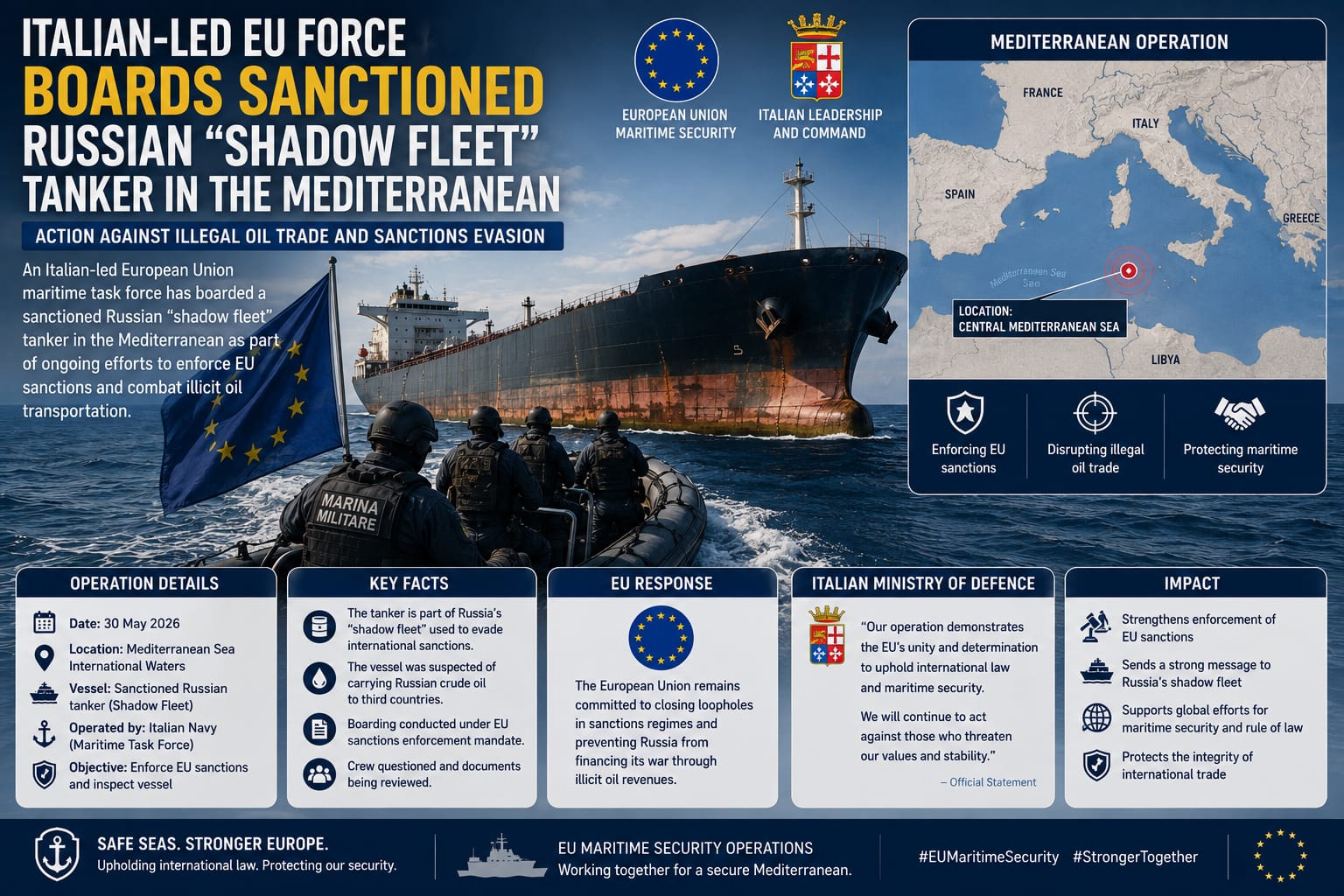
Italian-Led EU Force Boards Sanctioned Russian “Shadow Fleet” Tanker in the Mediterranean
August 2026 | Maritime Security Desk
An EU naval mission led by Italy has boarded and inspected a tanker linked to Russia’s so-called shadow fleet in the Mediterranean, the second such operation in less than two weeks as Europe sharpens its enforcement against vessels suspected of helping Moscow evade oil sanctions. The tanker, sailing under a flag it had only registered days earlier, was intercepted and inspected without incident, though it was not detained.
What Happened
Italy’s Defence Ministry confirmed that the tanker Toa Payoh, a vessel already under EU sanctions, was intercepted west of Sicily’s Pantelleria island while sailing from Benin toward Istanbul. The ship had switched to a Cameroon registry only the week before the boarding, a detail that immediately drew scrutiny from inspecting authorities looking to verify whether the new flag registration was legitimate.
- Tanker intercepted in international waters west of Pantelleria, between Sicily and Tunisia
- Vessel had re-flagged to Cameroon registry only days before the inspection
- Boarding conducted by Italian naval personnel, supported by a Greek vessel and a Polish maritime patrol aircraft
- Inspection lasted approximately two hours and concluded without incident
Under Operation IRINI’s Expanded Mandate
The boarding was carried out under Operation EUNAVFOR MED Irini, the EU naval mission originally launched in 2020 to help enforce the UN arms embargo on Libya. EU member states have since broadened Irini’s mandate to include verification boardings of vessels suspected of flying false flags, a capability now being actively used against Russia’s tanker network. Notably, the mission does not have authority to seize vessels during these inspections, so despite the irregularities noted, the tanker was not detained, though the documentation gathered could support future action by national authorities.
Part of a Broader Enforcement Push
This was the second Irini boarding of a suspected shadow fleet vessel in under two weeks, following a similar inspection of the tanker MV South Star. The pace of these operations reflects a deliberate escalation in EU scrutiny, reinforced by a newly approved mechanism allowing member states to confiscate and sell Russian oil and grain cargoes found aboard shadow fleet vessels, with proceeds barred from reaching Russian individuals or entities.
Implications for Owners and Flag Registries
- Recent flag changes are now a clear trigger for EU boarding and verification scrutiny, particularly in the Mediterranean
- Vessels with any historical or ownership links to sanctioned Russian trade should expect increased inspection frequency
- Flag states may face growing pressure to tighten registration verification processes to avoid association with shadow fleet activity
- Owners and charterers should factor rising boarding risk into route planning and documentation readiness for Mediterranean transits
The Bottom Line
The Toa Payoh boarding is another clear signal that the EU is treating shadow fleet enforcement as an active, ongoing operational priority rather than a one-off gesture. With two inspections in under two weeks and a legal mechanism now in place to seize sanctioned cargoes, vessels attempting to obscure their ownership or flag status in EU-patrolled waters should expect the scrutiny to keep intensifying.
This article is based on publicly reported statements from Italy’s Defence Ministry and wire reporting on the Operation IRINI boarding. Details may be updated as Italian authorities complete their review of the documentation gathered.