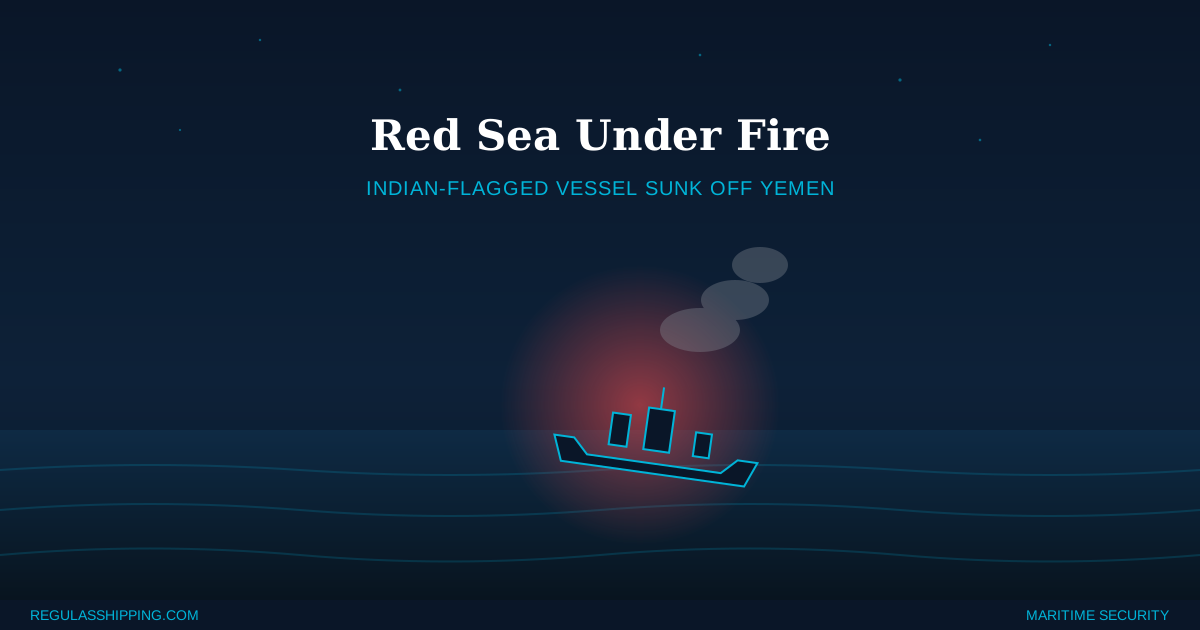
A commercial vessel flying the Indian flag was struck by a projectile and sank in the Red Sea off the coast of Yemen on 4 August, in what appears to be the first confirmed attack on a non-Saudi ship since Houthi forces declared a maritime blockade against Saudi Arabia and Saudi-linked shipping in July.
The vessel, identified as MSV Faize Noore Oliya, was hit near Hodeidah, a Red Sea port under Houthi control. The strike caused the ship to capsize and go down, but all 14 seafarers aboard, including 13 Indian nationals, were pulled to safety by the Yemeni Coast Guard and brought ashore at the Port of Mokha. No injuries were reported among the rescued crew.
India’s Ministry of External Affairs formally condemned the attack, calling the continuing targeting of commercial shipping in the region deeply worrying and renewing its call for unimpeded navigation through international waterways. Union Minister for Ports, Shipping and Waterways Sarbananda Sonowal confirmed the rescue operation and described the incident as an unprovoked attack on a merchant vessel, adding that the government would continue working to protect Indian seafarers operating in high-risk waters.
Responsibility for the strike has not been officially claimed. Yemen’s internationally recognised government has pointed to the Iran-aligned Houthi movement, reportedly citing the use of an explosive-laden unmanned boat, a tactic the group has employed in several previous attacks on shipping in the Bab el-Mandeb corridor. The Houthis had not issued a public statement on the incident at the time of writing.
A Widening Front
The sinking lands squarely inside an already deteriorating security picture for the southern Red Sea. Since declaring a blockade aimed at Saudi exports on 20 July, Houthi forces have struck at least two Saudi-linked tankers, prompting Saudi Arabia to reroute a portion of its export cargoes north through the Suez Canal while other operators increasingly transit the Bab el-Mandeb Strait in dark mode, with AIS transponders switched off to reduce the risk of being targeted.
Until now, the blockade’s stated focus had been Saudi and Israeli-linked tonnage. An Indian-flagged vessel with no apparent connection to either falling victim marks a meaningful widening of the threat envelope, and it comes against a backdrop of parallel disruption at the Strait of Hormuz, where Iranian enforcement action has already pushed a large share of tanker traffic into dark-mode transits or outright avoidance.
What Operators Should Note
- Threat scope has broadened. Flag state and cargo affiliation may no longer be a reliable basis for risk assessment in the southern Red Sea and Bab el-Mandeb corridor.
- UKMTO and Ambrey advisories remain the primary real-time source for transit risk in the region and should be checked immediately before routing decisions.
- Crew welfare and emergency response protocols were validated in this incident — rapid coordination between the vessel, Yemeni Coast Guard and Indian authorities resulted in a full rescue with no casualties, underscoring the value of well-rehearsed abandon-ship and coastal state liaison procedures.
- War-risk insurance and routing decisions for Red Sea transits will likely face renewed scrutiny across the tanker and bulk carrier segments in the coming days.
RegulAsShipping will continue to track developments in the Red Sea security situation, including any formal claim of responsibility, IMO or flag-state response, and updated maritime security advisories for the region.