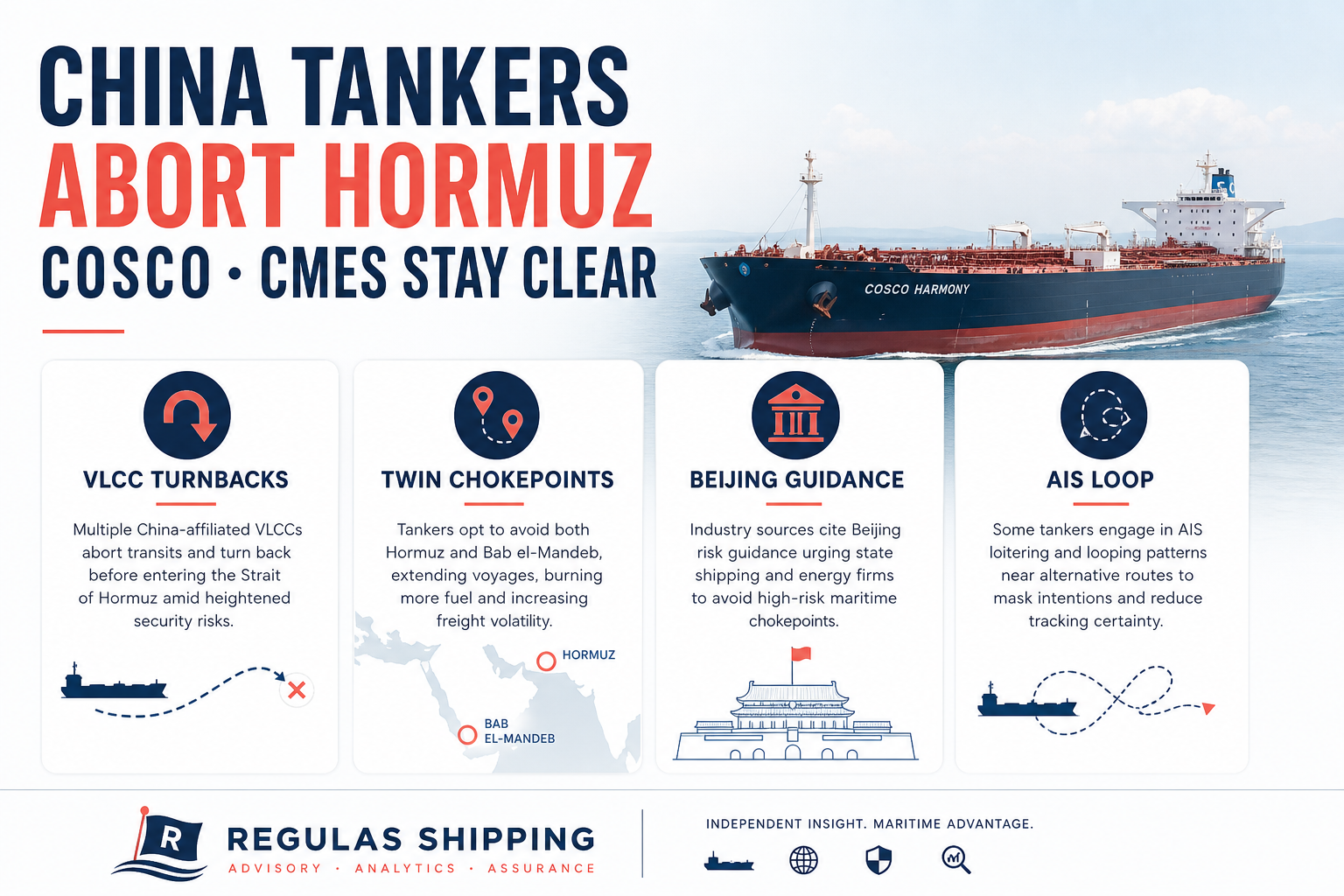
Tracking through mid-August shows several China-linked tankers aborting Strait of Hormuz transits, including Hong Kong-flagged VLCCs that approached then looped back, and at least one ballast tanker that turned mid-passage on the southern route on 19 August. The pattern aligns with industry reporting that China’s two largest state tanker operators — COSCO Shipping Energy Transportation and China Merchants Energy Shipping — are keeping fleets out of both Hormuz and Bab el-Mandeb on Beijing guidance.
Together those operators control more than 100 VLCCs and previously accounted for roughly half of China’s Middle East crude imports. AIS fields advertising “Chinese crew/owner” have appeared on turnbacks, underscoring how political guidance and crew-nationality signalling now sit alongside kinetic risk in routing decisions. Iran’s public assurances to friendly fleets are not matching observed commercial behaviour.
What Operators Should Note
- Do not assume nationality-based exemptions through Hormuz without verified corridor guarantees.
- Chinese charter coverage gaps will tighten Gulf–Asia tonnage and support Cape diversion demand.
- Monitor AIS destination text and mid-strait U-turns as leading indicators of fleet policy.
- Reprice long-haul Middle East crude to China against sustained twin-chokepoint avoidance.
RegulAs Shipping will watch for any official Chinese maritime advisory changing the stand-off posture.