Yemen’s Iran-aligned Houthi movement seized the Red Sea port city of Mokha on Thursday, 10 September 2026, after days of fighting on the Tihama coastal plain. Internationally recognised government forces withdrew south. Three Yemeni government sources confirmed the city and its port had fallen; social-media video later showed Houthi troops on the airfield on the western edge of the city. Mokha last changed hands in February 2017, when government-aligned forces took it back. It sits about 80 kilometres from the Bab el-Mandeb Strait, the southern gate of the Red Sea between Yemen and the African coast, a waterway that in peacetime carries on the order of 12 percent of world trade and the crude and products that feed Suez and the SUMED pipeline.
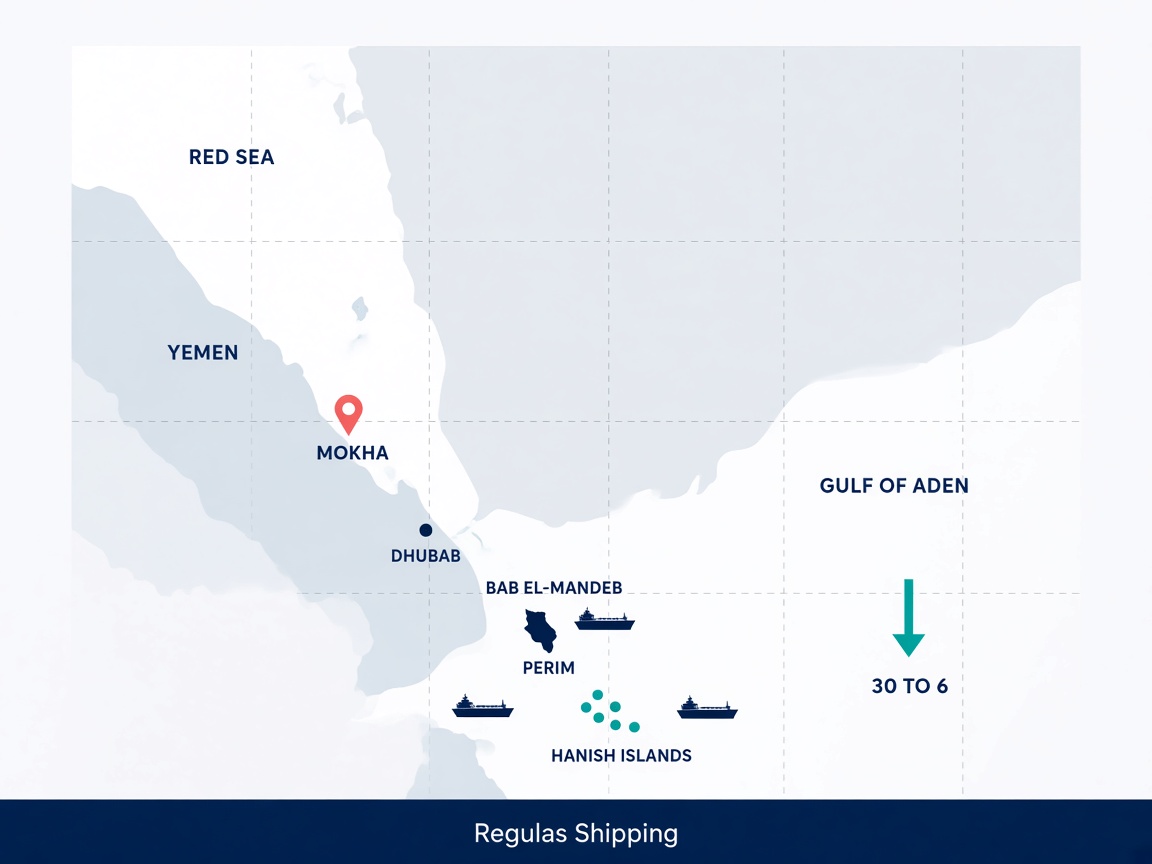
The advance did not stop at the coffee port. Yemeni government military sources told Reuters that Houthi forces had pushed on toward Dhubab, which sits on the strait across from Perim Island, and that the group had reached the Hanish Islands farther offshore. Maritime Executive, drawing on ground reporting, placed Houthi troops past Al Khawkhah and Al Hays, at Zibian, around the Emirati-built airfield at Dhubab, and close to the Murad Peninsula and Ras Menhali, the point that dominates the narrow sea channel opposite Perim. Reports of footholds on Zuqar and on Greater and Lesser Hanish were not independently verified at the time of writing. Presidential Leadership Council member Tariq Saleh called the pull-back a “tactical withdrawal” to regroup. Council head Rashad al-Alimi told the international community that Mocha and Bab el-Mandeb “are not a purely Yemeni affair,” warning that the strait “cannot become another Strait of Hormuz.” Yemen’s foreign minister separately wrote to the UN Security Council. Defence analyst Wolfgang Pusztai told Al Jazeera that control of the Yemeni Red Sea coast would let the Houthis threaten shipping with artillery, not only with missiles and drones.
Traffic collapsed the same afternoon. Preliminary Kpler data showed only six vessels crossing Bab el-Mandeb as of 15:14 UAE time on Thursday, against 30 on Wednesday, 26 on Tuesday and 29 on Monday. Of those six, five exited the Red Sea with grain, crude, coal and fertiliser; one entered. Houthi spokesman Mohammed Abdul Salam said navigation in the Red Sea and the strait “remain safe and uninterrupted” and that operations are limited to specific targets, while the Houthi-run Humanitarian Operations Coordination Center repeated that Red Sea navigation is safe for all shipping companies except Saudi vessels, which remain under a previously announced ban. Operators did not wait for that assurance. Saudi crude that can no longer use Hormuz has been loading at Yanbu, further north on the Red Sea, for the run to Asia via Suez or around the Cape. Houthi control of the southern gate puts that workaround, and any remaining Bab el-Mandeb crude and products, back inside a coastal-artillery and small-boat envelope. Brent held above $100 a barrel on Thursday, with The National printing $103.80 in late UAE trade.
The UN Security Council held an emergency session on Yemen the same day, called by Bahrain and the United Kingdom after Houthi strikes wounded 73 civilians at energy and utility sites in southern Saudi Arabia earlier in the week. Special Envoy Hans Grundberg said Yemen faces its gravest risk of full-scale war since the 2022 truce and called on the Houthis to stop attacks in Yemen, across the Saudi border, and on commercial vessels in the Red Sea. The United States accused the group of acting as an Iranian proxy. Russia cautioned against pinning the crisis solely on the Houthis. Pakistan had already carried a Saudi warning to Tehran to restrain the group. A senior Iranian official replied that “Iran does not control the Houthis”; other Iranian sources told Reuters that Tehran had last week directed attacks on Saudi Arabia and sent IRGC commanders to Yemen. Dryad Global’s Corey Ranslem told Middle East Eye the capture put the Houthis “one step closer to be in full control of the Bab el-Mandeb.” Ibrahim Jalal, a Yemeni researcher, said the group now holds high ground overlooking the strait, which makes targeting and surveillance easier into the Gulf of Aden as well as the Red Sea lane.
The operational implication is that Bab el-Mandeb is no longer only a missile-and-drone problem managed with BMP Maritime Security, a southern Red Sea transit corridor, and a Houthi HOCC notice that Saudi-linked hulls are banned. A force on Mokha, on the approaches to Dhubab, and potentially on the Hanish Islands changes the geometry: the lane narrows, the coast is closer, and artillery, uncrewed boats and coastal radar can cover traffic that used to stand off from Hodeidah-range weapons. Company security officers who still treat a non-Saudi flag, a dark AIS picture, or a HOCC “navigation is safe” line as sufficient for a southbound Suez-to-Aden run need a fresh, voyage-specific assessment against the 10 September positions, not last week’s Saudi-energy-strike note. Passage plans should assume the next UKMTO or MSCIO warning can arrive inside the strait, not only in the wider southern Red Sea. Citadel, extra lookouts, firefighting and a prepared diversion around the Cape belong on the pre-entry checklist for any remaining Bab el-Mandeb transit, including ships that loaded at Yanbu to avoid Hormuz.
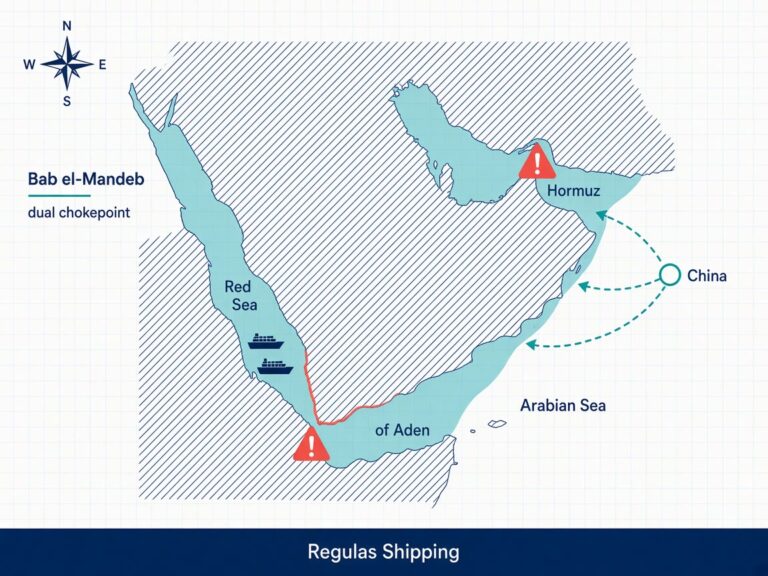
Charterparties, war-risk notices and crew-change plans have to name the dual-chokepoint case in writing. If Hormuz is effectively closed and Bab el-Mandeb is under coastal pressure, the remaining options are Suez-plus-Cape, Mediterranean load ports, or not sailing. That is a routing and a seafarer-welfare decision, not only a freight one. VLCC earnings on the Middle East-to-China benchmark were already near $800,000 a day this week, with a new Baltic Gulf-of-Oman-to-East-Asia index around $386,000 a day, as shuttle and STS patterns stretch fleets. A further collapse at Bab el-Mandeb will extend voyage times for Saudi and Red Sea barrels headed to Asia by more than three weeks on a Cape routing. Masters should keep UKMTO, MSCIO and the Houthi HOCC channel live, but they should not treat a HOCC “safe except Saudi” message as a clearance. Flag, P&I and underwriters will ask whether the company had a written go/no-go for Mokha-range waters after 10 September, whether AIS and lookouts matched the Ship Security Plan, and who authorised remaining in the lane after transits fell from 30 ships to six in a single afternoon.
What Operators Should Note
- Treat Mokha as a coastal-control event, not a repeat of the 8 September Saudi energy strikes. The port and city fell on 10 September. The threat is now artillery, boats and sensors on the Yemeni shore and islands, in addition to missiles and drones. Update the voyage risk assessment against that geometry.
- Read the Kpler count into the go/no-go. Six Bab el-Mandeb crossings by mid-afternoon Thursday, against 30 the day before. Five of those six were southbound with grain, crude, coal or fertiliser. A thin traffic picture is itself a targeting and a SAR problem: fewer merchant witnesses, fewer assisting hulls.
- Do not take the HOCC “safe except Saudi” line as a transit clearance. Houthi spokesmen said navigation remains uninterrupted and that only Saudi vessels are banned. The same week the group struck Saudi energy sites and seized a port 80 kilometres from the strait. Company policy, not a HOCC notice, decides whether the ship enters.
- Re-check Yanbu and other Red Sea load ports against the southern gate. Saudi barrels that bypass Hormuz still have to leave via Suez, SUMED or Bab el-Mandeb. If the fixture assumes a southbound Aden exit, name the alternative (Cape, Mediterranean outturn, or cancellation) in the war-risk and diversion clause before the ship loads.
- Watch Dhubab, Perim and the Hanish Islands as the next control points. Government sources put Houthi forces on the road to Dhubab and on Hanish. Perim still sits on the Yemeni side of the narrows. A further move onto those positions would put the traffic-separation scheme inside direct coastal range. Build that trigger into the master’s standing orders.
- Keep BMP MS, UKMTO, MSCIO and IFC-IOR live for any remaining southern Red Sea transit, including ships that are not Saudi-linked. Extra lookouts, citadel readiness and a prepared UKMTO report apply inside the strait, not only in the wider Gulf of Aden. Liberia’s ISPS Level 3 posture for Red Sea and Gulf of Aden transits remains the flag-state baseline for Liberian hulls.
- Write crew-welfare and routing authority for a dual-chokepoint closure. If both Hormuz and Bab el-Mandeb are effectively closed to the ship’s flag, cargo or insurer, the master needs a named person who can order Cape routing or a hold, and a next-of-kin and P&I clock that does not wait for a press line. Seafarers on a grain or fertiliser hull are not parties to the Yemen war.
Regulas Shipping will keep lining the Mokha–Dhubab–Hanish positions against Bab el-Mandeb transit counts so operators can treat a southern Red Sea passage as a security decision, not a default alternative to Hormuz.