A fuel-oil squeeze is now a voyage-cost problem, not a refinery-desk story. Reporting on 7 September 2026, based on Reuters-compiled inventory data, put fuel-oil stocks at Singapore, the Amsterdam–Rotterdam–Antwerp hub and Fujairah around 30 percent below their three-year seasonal averages. In Singapore, the world’s largest bunker hub, very low sulphur fuel oil was just under $825 per metric tonne on 1 September, up 76 percent since the Iran conflict began, according to ZeroNorth. Brent crude rose about 40 percent over the same period. Marine fuel has therefore moved faster than the underlying crude benchmark, which is the line that should be in the next bunker estimate, not last quarter’s stem price.
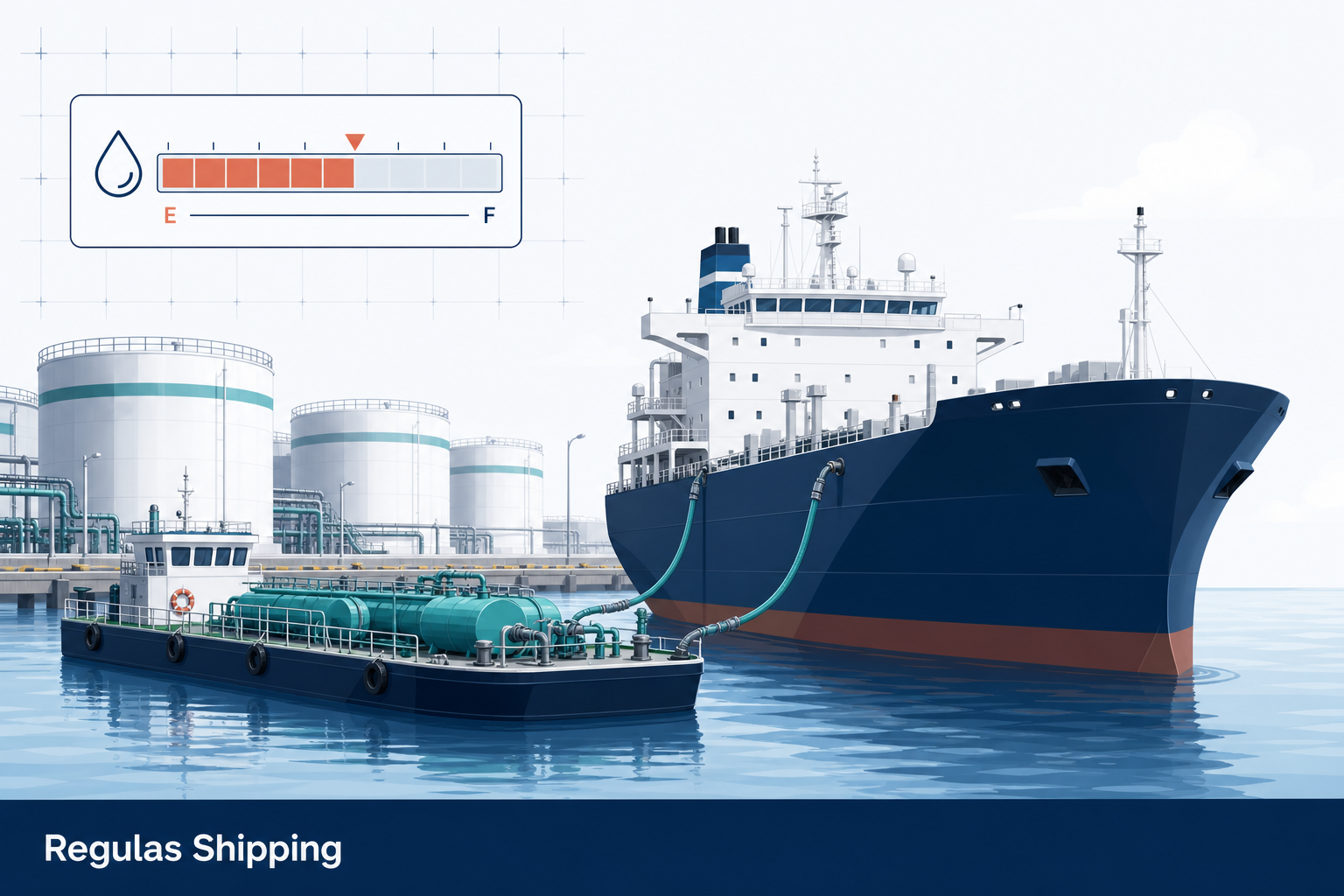
The physical market is already rationing time. Singapore suppliers were quoting VLSFO lead times of around nine to 16 days in early September, with reduced supplier availability and shortages of blending components limiting prompt barrels. At Fujairah, heavy-distillate inventories fell 15 percent in the week ended 31 August to 3.122 million barrels, their lowest in two months, after a 32 percent drop the previous week, according to Fujairah Oil Industry Zone data. Ex-wharf offers there have thinned as spot bunker demand strengthened, market participants told S&P Global. Northwest Europe is less empty on paper — independently held fuel-oil stocks in ARA averaged 5.30 million barrels in early September, 15 percent above the August average, per Insights Global — but those stocks were still 18 percent below February, and suppliers were recommending five- to seven-day lead times for prompt stems. A ship that can “always bunker in Singapore on arrival” is working off a pre-war assumption.
The supply maths behind those lead times is a war-and-yield story. Energy Aspects expects a global fuel-oil deficit of 218,000 barrels per day in the third quarter of 2026, the first quarterly shortfall it has estimated since a 6,000-bpd gap in the third quarter of 2025. Middle East fuel-oil exports averaged about 447,000 bpd from March to August, down 45 percent year on year, Kpler data show. Kuwait’s Al-Zour refinery, a major fuel-oil exporter earlier in the year, shipped only one 26,000-bpd cargo between March and early September against around 191,000 bpd in January and February. Russian fuel-oil exports fell to a record-low 591,000 bpd in August from an average of more than 860,000 bpd in 2025. Energy Aspects’ Royston Huan has separately put the drop in ship-fuel sales since April at about 400,000 bpd versus year-ago levels of 6.9 million bpd — on the order of China’s entire bunker-sales volume, and the scale operators should use when they hear “tight.”
Refinery damage and product yields are reinforcing the hole. The International Energy Agency has said as much as a fifth of Middle East refining capacity, some 9.6 million bpd, has been knocked out by hostilities. Ukrainian strikes have cut Russian refinery runs and diesel output; Russia imposed a diesel-export ban that tightened middle-distillate markets further. Refiners with barrels to run are sending heavy residue through secondary units into diesel, gasoline and jet rather than leaving it as bunker. Nigeria’s 650,000-bpd Dangote refinery, Kpler notes, has ramped diesel, petrol and jet exports while cutting fuel-oil exports. Huan’s line to Reuters is the operating assumption until diesel inventories rebuild: record-low gasoline and diesel stocks will keep refiners maximising secondary-unit runs on fuel-oil feedstock, tightening bunker balances further. Rystad Energy’s Valerie Panopio told Reuters she expects fuel-oil supply to remain critically tight in the third quarter because of the protracted Middle East disruption.
For operators the cost path is already visible on long-haul trades that were already burning more miles. Cape of Good Hope diversions, suppressed Hormuz transits and Red Sea targeting of Saudi-linked hulls have stretched tonne-miles. A 76 percent jump in Singapore VLSFO on top of extra steaming is a second chokepoint: even a ship that avoids the Strait still has to stem, and Singapore imports more than half of the nearly one million bpd of fuel oil it consumes. Asia is the tightest consumer of Gulf-origin fuel-oil blending components. Europe can still find barrels with notice. A vessel arriving Singapore with a two-day fuel remaining and a 12-day barge queue is a commercial off-hire and a safety case.
Grade and compliance effects sit beside price. Short blending components raise off-spec and availability risk on VLSFO; some owners will be offered HSFO-plus-scrubber stems, MGO, or delayed barges rather than the contracted grade. FuelEU Maritime and EU ETS do not pause because Singapore is tight. A higher VLSFO flat price changes the spread versus bio-blends and versus paying the FuelEU penalty, and it changes the bunker line that voyage estimators still copy from Q2. Charter-party silence on extra steaming for a stem, on waiting time for a barge, and on who pays a forced grade change will leave the owner holding both the cash and the delay. Slow-steaming can cut tonnes lifted; it cannot create a barge that is 16 days out.
What Operators Should Note
- Book Singapore stems 9 to 16 days out; do not assume prompt VLSFO on arrival. Lead times are the rationing tool. Arrive with a conservative ROB and a confirmed nomination, not a call to the broker after dropping the hook.
- Budget around $825/t VLSFO in Singapore, not the pre-conflict print. ZeroNorth had the grade just under that level on 1 September, up 76 percent since the Iran war began, while Brent was up about 40 percent. Voyage files frozen at Q2 bunker will miss the cash.
- Treat Fujairah as tight and exposed, ARA as better stocked but not walk-up. Fujairah heavy distillates are at a two-month low after back-to-back weekly draws. ARA has more inventory than in August but still wants five to seven days’ notice.
- Watch blending-component availability, not only price. Short cutter stock is how on-spec VLSFO disappears even when a tank farm looks full. Spec, density and sulphur on the BDN need a harder check this month.
- Re-open bunker and deviation clauses before the next long-haul fixture. Name who pays extra steaming to a stem, waiting time for a barge, and a forced grade or port change. Silence is an owner cost.
- Do not net FuelEU or EU ETS against a hoped-for cheaper stem later. Higher VLSFO changes the bio-blend spread and the penalty arithmetic. The 30 September EU ETS surrender and FuelEU DoC remain separate clocks.
- Cape and other long-haul routings now have two chokepoints: miles and fuel. Extra steaming was already in the model. A 218,000-bpd Q3 fuel-oil deficit and 16-day Singapore queues are the second constraint. Slow-steam where the schedule allows; do not plan to “catch up” the bunker in Singapore.
Regulas Shipping will keep lining Singapore, Fujairah and ARA bunker availability against war-driven fuel-oil yields so operators can see which stems are still prompt and which voyages now need a 16-day fuel plan rather than a port-call afterthought.