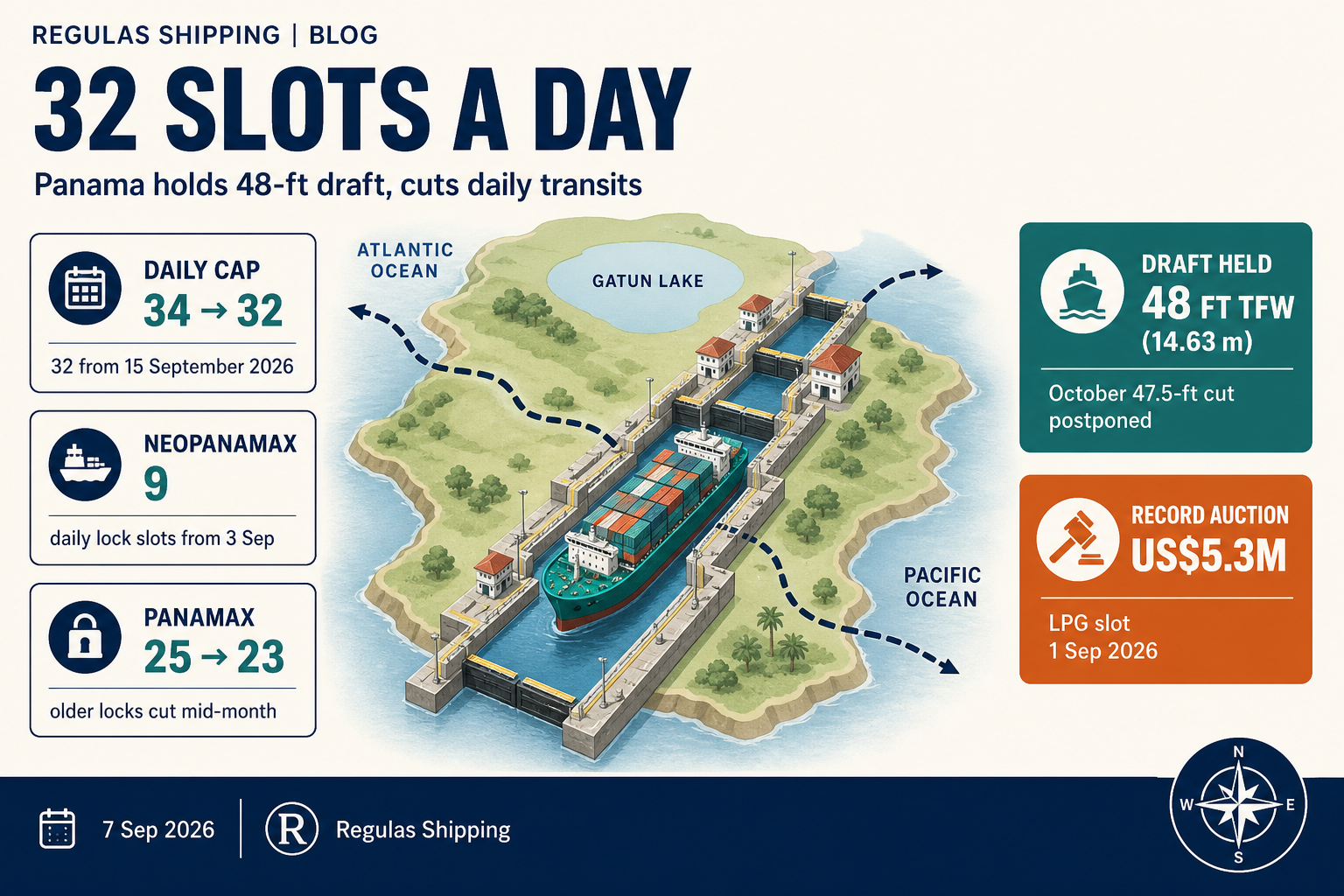
On 5 September 2026 the Panama Canal Authority said it will keep the current 48-foot (14.63-metre) Tropical Fresh Water draft for Neopanamax vessels and postpone the 47.5-foot (14.48-metre) cut that had been slated for 1 October. That is useful voyage-planning news. It is not a return to a normal canal. Daily transit capacity is already down, and it tightens again on 15 September 2026, when the overall cap falls from 34 ships a day to 32. Neopanamax locks have been limited to nine daily slots since 3 September. Panamax locks, now at 25, are due to drop to 23 on the same mid-month date.
The draft hold follows a summer of stepped cuts — 49.5 feet, then 49, then 48.5 — as Gatun Lake ran lower than hoped. The 48-foot limit itself slipped from late August to 2 September before being left in place. Administrator Ricaurte Vásquez has warned that a developing El Niño could mean a long stretch of weak rainfall, on the order of eight months. Water-saving basins, paired lockages, interior gates and reduced generation at Gatun Dam are already in use. The authority is still advancing the proposed US$1.6 billion Río Indio reservoir as longer-term cover. None of that restores the slots the lock chambers will not offer in the second half of September.
Demand is the other half of the squeeze. Before the Iran war the canal was handling about 34 transits a day, including roughly seven tankers. Conflict-driven rerouting pushed peaks to 40–41 ships a day. That extra Pacific–Atlantic traffic is now competing for a smaller book. Vessels that arrive without a reservation have recently faced waits of about 8.5 days — shorter than the 21-day, 154-ship queues of the 2023–24 drought, but long enough to break an LPG laycan or an Asia–U.S. East Coast proforma. The authority has told the market to book ahead rather than roll the dice on a walk-up.
Auction prices show how expensive that dice roll has become. On 1 September, South Korea’s SK Gas paid a reported record US$5.3 million for a northbound slot for the LPG carrier G. Spirit, beating an earlier US$4.6 million gas-carrier record and sitting nearly 100 times the roughly US$55,000 median auction print from October 2025 to February 2026. Ordinary tolls, tugs, freshwater and reservation fees sit on top of that bid. From September the canal is also splitting auction slots into four vessel groups — LNG/LPG; dry bulk and general cargo; container, vehicle and reefer; and chemical, crude and product tankers — so a box ship is no longer bidding directly against a gas carrier that cannot miss a Houston or Far East window.
Operationally, the split between a held draft and a cut slot count matters more than either number alone. A 48-foot TFW limit still trims intake on the largest Neopanamax containerships and some gas carriers, but it is a known number planners can load to. A drop from 34 to 32 daily transits, with only nine Neopanamax chambers, is a queue and auction problem. Asia–U.S. East Coast strings, U.S. Gulf LPG to Asia, and west-coast South America box cargo are the trades most exposed. Some carriers had already signalled low-water surcharges and then slipped them; the commercial question for October is whether those fees return once the 15 September cap is in force, even if the 47.5-foot draft cut stays on hold. Cape of Good Hope remains the long-way alternative, at roughly a 30 percent time penalty and a tied-up ship. It is a last resort, not a free option, while Hormuz disruption is already stretching the same fleet.
What Operators Should Note
- Diary 15 September 2026 as a hard capacity date — plan for 32 total transits, nine Neopanamax and 23 Panamax, not for the 34/25 mix that opened the month.
- Load and bunker to 48 feet TFW (14.63 m) as the working Neopanamax limit until the authority reinstates a deeper draft in writing. Do not assume the postponed 47.5-foot cut is cancelled for the season.
- Book through the reservation system or LoTSA; do not arrive dirty. An 8.5-day walk-up wait will wreck gas and liner windows faster than a held draft will.
- Budget auction exposure by vessel group. Gas carriers have set the US$4.6–5.3 million ceiling; container and tanker desks should use their own group prints, not the LPG headline, when quoting all-in canal cost.
- Rebuild September–October Asia–USEC and USG–Asia LPG cost models with a scarce-slot premium and a possible October low-water surcharge, even while the 48-foot draft holds.
- Decide Cape diversion on a voyage, not a slogan. Extra steaming only pays if the slot, the wait and the auction together exceed the time-charter and bunker cost of the longer route.
- Watch Gatun Lake bulletins weekly. El Niño comments from the administrator point to a multi-month water story; draft and slot settings can move again with little commercial notice.
Regulas Shipping will keep lining Panama draft notices against daily slot counts, auction prints and actual waiting times so operators can see whether a held draft is still being paid for in queues and surcharges.