On 4–6 September 2026, operators assessing Black Sea risk were no longer dealing with a single-coast problem. A summer of reciprocal strikes on ships and port infrastructure has left both Ukrainian and Russian deep-water grain outlets impaired, pushed seafarer casualties to wartime highs, and put unmanned or damaged merchant ships into the approaches of the Bosphorus. The International Maritime Organization’s leadership has already condemned a wider “deterioration of maritime security around the globe.” For commercial managers, the working question is no longer whether the Black Sea is open. It is whether a given hull, crew and cargo can still be insured, manned and delivered without becoming a casualty or a navigational hazard.
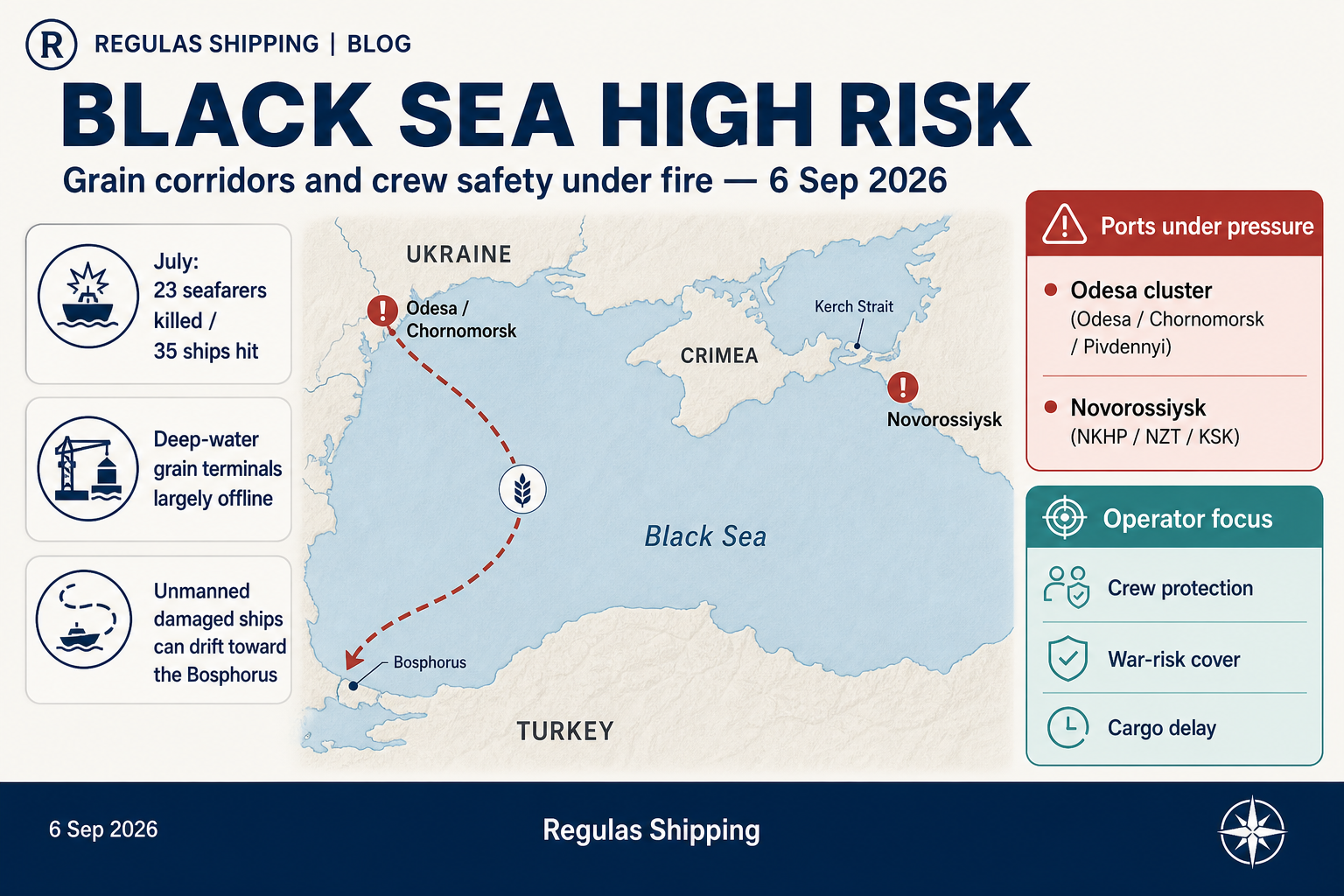
Casualty numbers are now material to crewing decisions. The Turkish seafarers’ union Türkiye Denizciler Sendikası estimated that as many as 23 people died in July from attacks on 35 ships in the Black Sea — more crew killed in that month than in the entire war to that point, according to the same reporting. That is the context for masters, CSOs and manning agents facing refusals, extra war bonuses and P&I questions on Ukrainian and Russian calls. Kinetic risk is no longer confined to berth or anchorage. Analysts at Vanguard have noted that merchant ships are being selected by port, trade and cargo, and that attacks have spread beyond port approaches into a wider area of the sea.
The export machine on both shores is damaged at the same time. Russia struck Ukraine’s main grain hubs at Odesa and Chornomorsk again in July; the greater Odesa cluster has seen deep-water loading effectively freeze for stretches of July and August, with Ukraine’s food ministry indicating only about 1.4 million tonnes actually moved — roughly a third of what could have been exported by sea, rail, river and road. On the Russian side, Ukrainian drone and missile attacks in mid-August hit the Novorossiysk complex. Market reports said the three main terminals — NKHP, the Novorossiysk Grain Terminal and KSK, together on the order of 26 million tonnes of annual capacity — suspended operations, after Taman and Azov/Kerch traffic had already been crippled. Tuapse was left as the residual deep-water grain outlet. Oxford Economics has put more than 70 percent of Russia’s seaborne grain exports on Black Sea ports and a further 20 percent on the Sea of Azov, and has cited August Russian grain exports falling toward 40 percent of normal capacity.
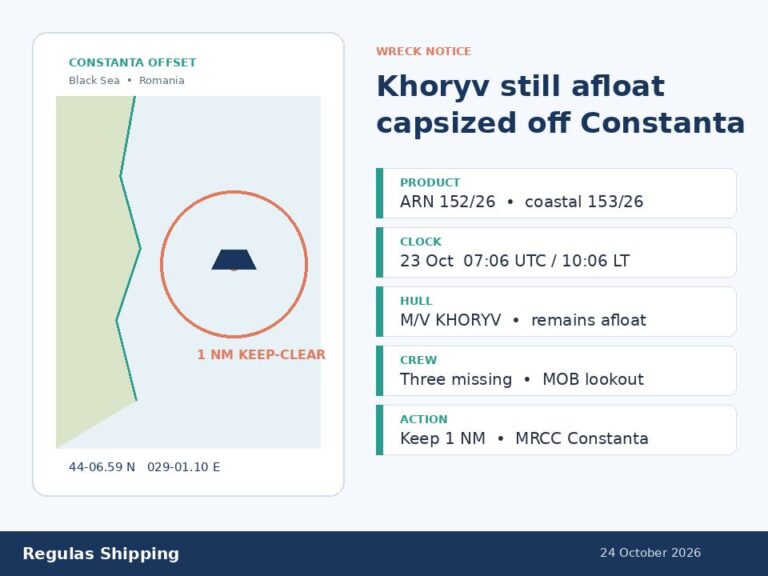
The navigational residue is as important as the cargo arithmetic. The abandoned Russian-flagged Omskiy-107, hit by a Ukrainian drone near Novorossiysk and left with a burned-out command deck, drifted hundreds of miles and ran aground on Turkey’s Black Sea coast near Istanbul. A damaged Liberian-flagged bulk carrier has also been seen under escort through the Bosphorus. For Istanbul VTS, Bosphorus pilots and any owner with a loaded grain or general-cargo ship in the strait, that is a live collision and wreck-removal problem, not a distant war story. Unmanned or poorly commanded hulls in a confined, high-density waterway raise the same class of risk that drifting mines have created in other theatres this year.
Food-security and insurance consequences are already showing up in operator briefings. Combined Russian and Ukrainian wheat shipments in August were reported in the region of below 2.5 million tonnes versus about 6.3 million tonnes a year earlier. Russia remains the world’s largest grain exporter, with heavy dependence on Middle East and North African buyers, especially Turkey and Egypt; Ukraine is typically in the top five. Wheat prices have firmed, and Oxford Economics has flagged global food-price pressure even where importers hold stocks. For shipowners the nearer issues are war-risk additional premiums, crew-change and refusal clauses, safe-port warranties, and whether a Black Sea loadport still satisfies charter-party description after a terminal is idle or under fire. A mid-August proposal, reported via a third party, that both sides stop attacking civilian maritime targets was rejected by Moscow on 14 August. There is no restored corridor to underwrite against.
What Operators Should Note
- Treat the Black Sea as a crew-safety theatre first — July’s fatality count is a manning and bonus issue, not only a cargo delay. Get written crew consent and war-zone terms before fixing Ukrainian or Russian load ports.
- Do not plan on Novorossiysk or the Odesa cluster as default grain gateways until terminals confirm sustained loading windows; build Baltic, Danube/Constanta, Caspian and rail options into the schedule, with their extra cost and draft limits.
- Recheck war-risk, hull and P&I conditions for port-of-call, cargo type and AIS policy — underwriters are pricing the ship’s last ports and the commodity, not only the flag.
- Add a Bosphorus/Istanbul drift and wreck watch to daily bridge briefs for any ship transiting after a Black Sea incident; damaged or abandoned hulls are now a documented navigational threat.
- Rebuild August–October grain voyage economics around sharply lower Black Sea liftings, longer alternative routes, and possible charter-party safe-port disputes if a named terminal is idle.
- Keep Black Sea risk on the same desk as Hormuz and the Red Sea — IMO’s warning is global, and a ship diverted from one chokepoint can still meet a second casualty zone on the next fixture.
Regulas Shipping will keep matching Black Sea incident reporting, terminal status and war-risk conditions so masters and commercial teams can decide whether a fixture is still a voyage or already a casualty case.