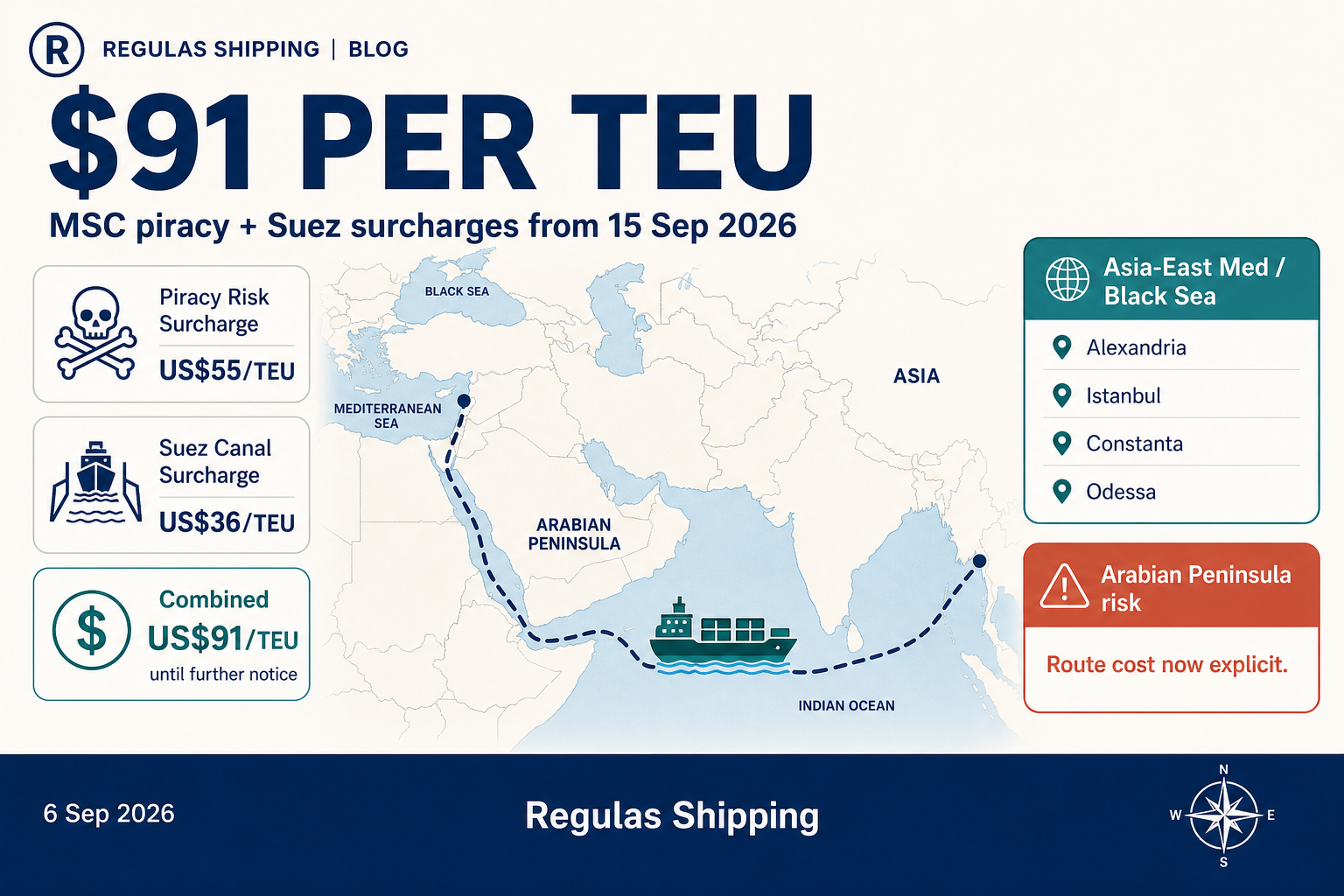
On 4–6 September 2026, Mediterranean Shipping Company told the market it will apply two new line items on Asia to East Mediterranean and Black Sea cargo from 15 September 2026, based on the proforma date: a Piracy Risk Surcharge (PRS) of US$55 per TEU and a Suez Canal Surcharge (SCS) of US$36 per TEU. Combined, the package is US$91 per TEU and remains in force until further notice. MSC tied the move to piracy and security risk around the Arabian Peninsula that is still distorting vessel operations and transit choices across its network.
The commercial effect is broader than a routine peak-season add-on. After more than two years of Cape-of-Good-Hope diversions, dark Bab el-Mandeb transits and overlapping Hormuz disruption, carriers have been recovering security and routing cost through a mix of emergency bunker, war-risk, contingency and diversion fees. MSC is now putting piracy exposure and Suez transit cost on the face of the tariff for a defined Asia–East Med/Black Sea corridor. That matters for anyone still quoting “all-in” Asia–Med freight, for NVOCCs rolling September proformas, and for charterers whose service contracts treat security recoveries as a pass-through rather than a locked rate.
The destination list is wide. MSC said the charges apply to cargo from Asia bound for Abu Kir, Alexandria Old, Aliaga, Antalya, Batumi, Burgas, Constanta, Evyap, Gebze, Gemlik, Giresun, Iskenderun, Istanbul, Izmir, Mersin, Odessa, Poti, Samsun, Tekirdag, Trabzon and Varna. That sweep covers Egypt, Turkey, the Levantine approaches, the western Black Sea and Georgian outlets. Operators should not assume a Turkish discharge or a Constanta transhipment escapes the fee simply because the last ocean leg looks “regional.” If the booking is Asia-origin and the bill shows one of those ports, the US$91 package is in scope unless MSC issues a later exemption.
Operationally, the surcharge also sends a routing signal. MSC has already resumed selected Suez crossings on Asia–Mediterranean and Asia–North Europe strings, including dark transits of Bab el-Mandeb. A named Suez Canal Surcharge implies that canal dues and Suez-related operating cost are being socialised across the box, even while piracy, Houthi residual risk and Arabian Sea boarding incidents remain live. Shippers who previously paid Cape-diversion recoveries should ask, in writing, which of those older line items fall away on Suez-restored services and which are simply being relabelled. Paying both a Cape contingency and a new Suez/piracy pair on the same box is a real September risk if contracts are not cleaned up.
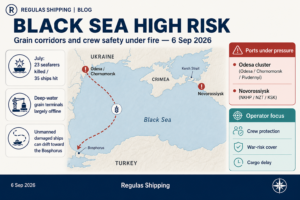
There is a second-order Black Sea problem. Odessa, Constanta, Varna, Burgas, Batumi and Poti sit on the same surcharge list at a moment when the Black Sea grain and general-cargo complex is itself under kinetic pressure. A box that already carries war-risk premium, possible transhipment delay at Piraeus or Istanbul, and now US$91 in MSC security/canal recoveries can lose its landed-cost case versus an earlier all-water quote. Freight desks should rebuild September–October Asia–East Med cost models with the new pair as a base case, not an optional extra.
What Operators Should Note
- Diary 15 September 2026 as a hard commercial date — MSC said application is by proforma date, so cargo already booked but sailing after that cutoff can still pick up the pair.
- Treat US$91/TEU as two distinct recoveries — challenge invoices that collapse PRS and SCS into a single undocumented “security” line, and keep backup for each code.
- Reconcile older Cape, EOCR, Red Sea diversion and war-risk add-ons on any string MSC has returned to Suez; do not pay both routing stories on one container.
- Map every Asia-origin booking against the named port list — Turkish, Egyptian, Romanian, Bulgarian, Georgian and Odessa discharges are in unless MSC confirms otherwise.
- Update customer quotations and service-contract rate sheets before mid-September cut-offs, including NVOCC refile and merchant-haulage landed-cost models.
- Keep Arabian Peninsula piracy, Bab el-Mandeb and Hormuz in the same voyage brief — a Suez surcharge is a cost signal, not a safety clearance for the southern Red Sea.
Regulas Shipping will keep tracking carrier security and canal recoveries against actual Suez versus Cape deployment so operators can see which fees still match the voyage they are buying.