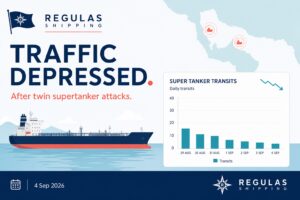
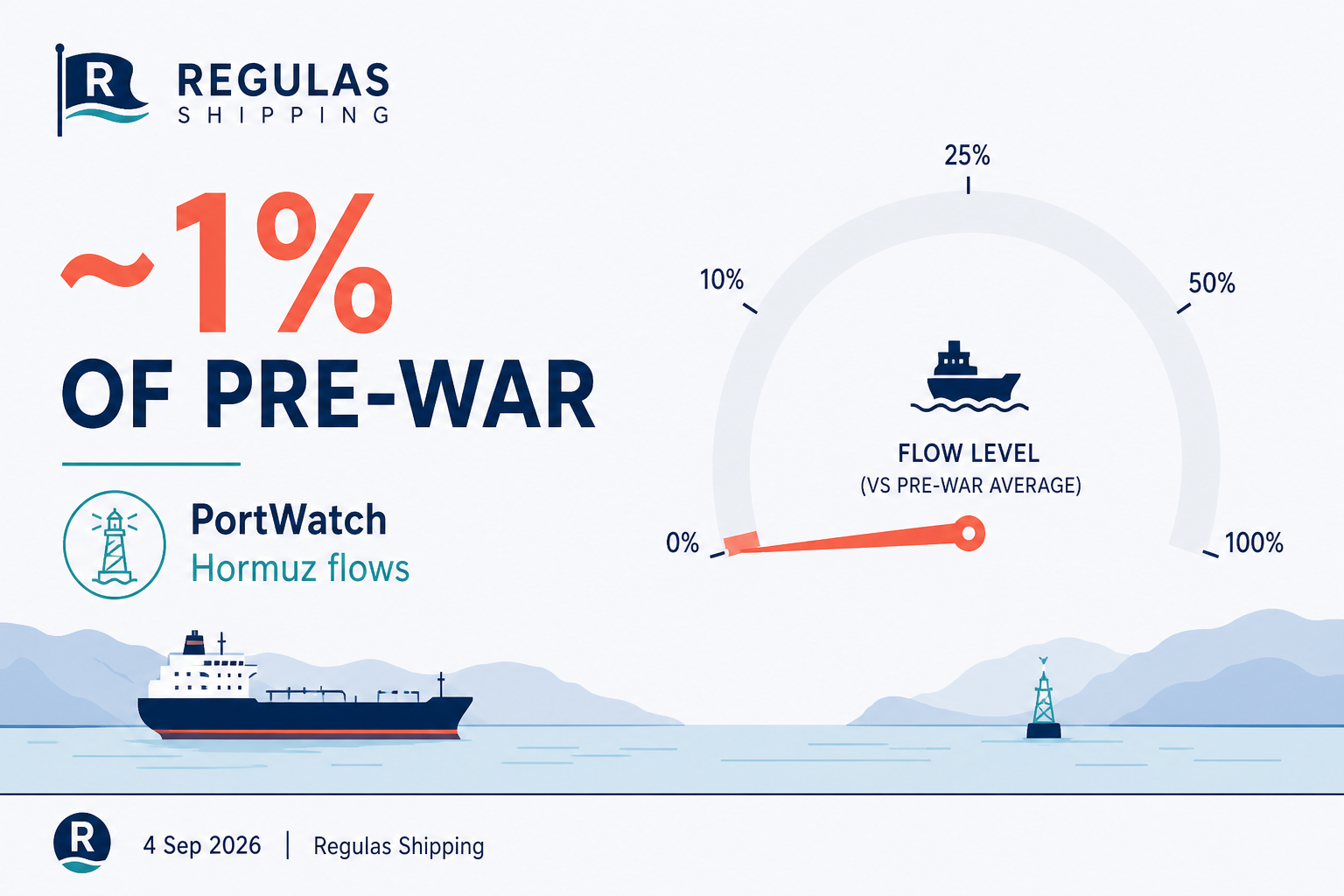
By 4 September 2026, throughput-monitoring readouts tied to initiatives such as PortWatch continued to describe Strait of Hormuz flows at roughly one percent of pre-war levels on recent lagged days — for example, single-digit daily transits against pre-crisis baselines on the order of 80–90+ monitored movements depending on methodology. Whatever the exact baseline definition, the operational conclusion is consistent with Kpler and JMIC: Hormuz is not functioning as a normal energy or liner artery.
That magnitude of collapse reshapes global schedules. Container and tanker networks that once threaded the Gulf must permanently budget Cape diversions, Red Sea uncertainty, Asian hub STS, and pipeline-assisted Gulf exports where available. Cost stacks — bunkers, hire, war-risk, delays — remain structurally higher while flows sit near one percent of normal.
Boards and chartering committees should stop treating Hormuz disruption as a temporary spike. Six months into the conflict, one-percent throughput is a regime, not a blip, and voyage economics must be rebuilt around that regime until proven otherwise.
What Operators Should Note
- Rebuild Q3/Q4 routing budgets on near-closure assumptions, not mean-reversion hope.
- Use PortWatch/Kpler/JMIC together for governance reporting to avoid single-source bias.
- Prioritise contracts that allow diversion without punitive default.
- Track secondary hub congestion in Asia and Red Sea load points caused by Hormuz avoidance.
- Communicate realistic ETA risk bands to cargo interests still expecting Gulf normalcy.
Regulas Shipping will continue translating throughput monitors into practical routing and cost guidance for clients.