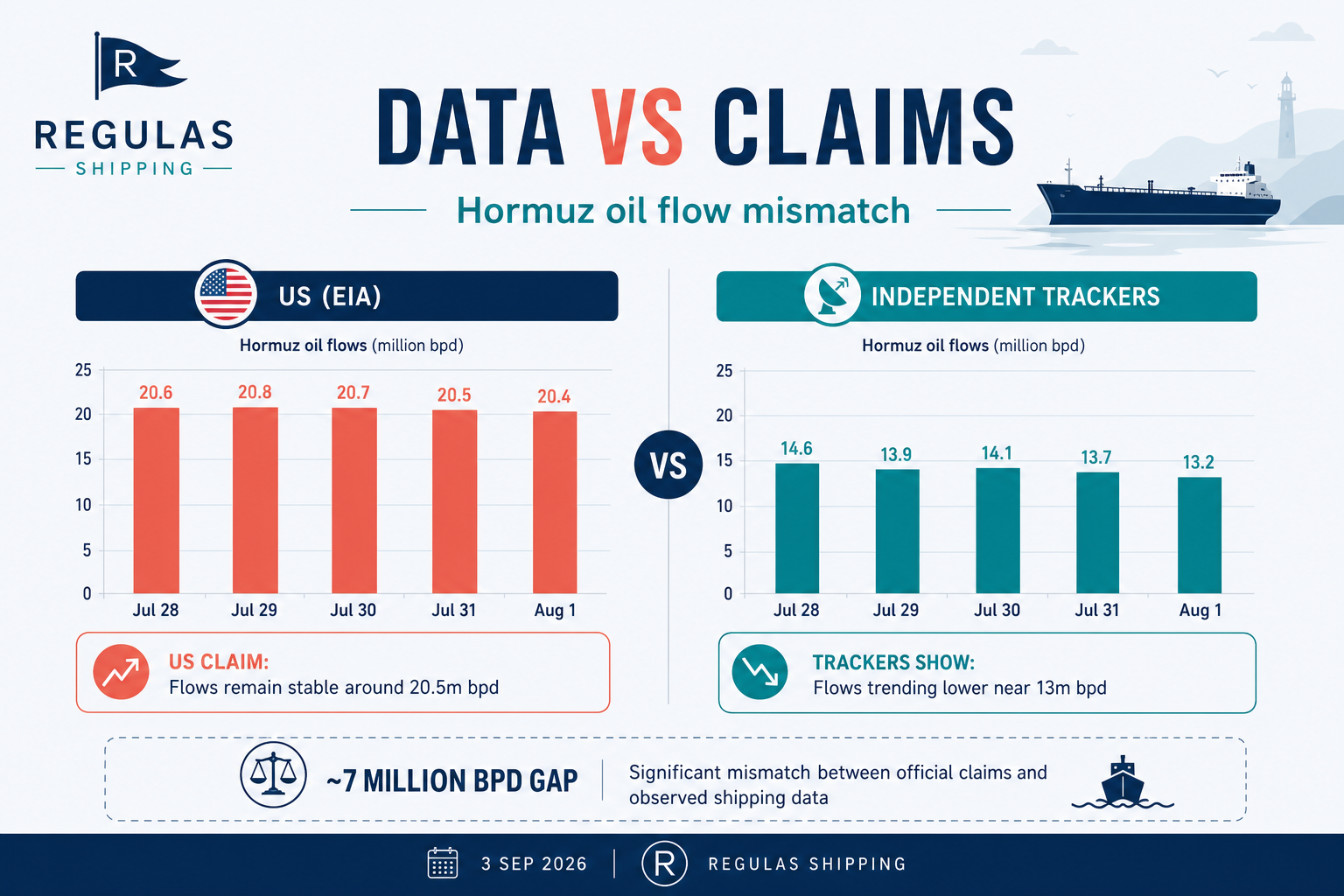
On 3 September 2026, open-source analysis crystallised a widening credibility gap over how much oil is actually moving through the Strait of Hormuz. US officials and cabinet-level comments in the preceding days spoke of dozens of escorted commercial ships and multi-million-barrel daily oil throughput — including claims of on the order of 10 million barrels a day or higher on peak days — while marine analytics firm Kpler recorded only about six vessels on Wednesday, 11 on Tuesday and five on Monday, with a ten-day average near 13.
Lloyd’s List Intelligence similarly reported averages around 12 transits per day from late August into 1 September, cautioning that dark-transit identification lags can undercount some stealth movements. Even allowing for AIS gaps, the order-of-magnitude distance between political flow claims and visible commodity traffic is large enough to matter for freight, insurance and energy-market briefing. JMIC’s earlier September messaging that traffic remained far below baseline under a SEVERE rating aligns more closely with the tracker picture than with maximal reopen narratives.
For operators, the practical rule is simple: voyage and cargo decisions should be grounded in tracker-plus-advisory evidence, not press-briefing barrel counts. Dark VLCCs may move incremental oil, but they do so under elevated kinetic and compliance risk — and they do not restore a normal, insurable TSS market.
What Operators Should Note
- Reconcile any “Hormuz is flowing” claim against same-day Kpler/LLI/JMIC evidence.
- Budget for dark-transit uncertainty without assuming hidden volumes equal peacetime throughput.
- Challenge fixture assumptions built on US barrel-count headlines alone.
- Keep energy-desk and marine-ops briefings on one shared traffic dashboard.
- Treat SEVERE + low teens averages as the working baseline until proven otherwise.
Regulas Shipping will continue publishing side-by-side comparisons of official flow claims and independent transit counts.