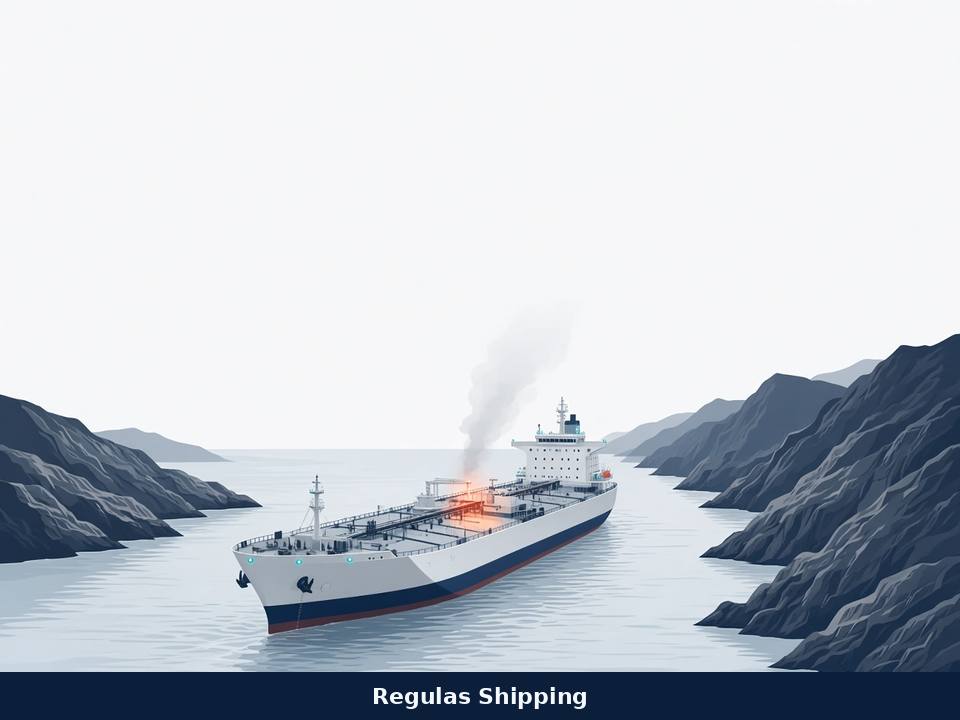
The United Kingdom Maritime Trade Operations centre issued Warning 147-26 on Thursday, 1 October, after a third-party report that a tanker was struck by an unknown projectile while transiting the Strait of Hormuz. Mike Schuler reported the warning for gCaptain the same evening. Arab Times, Iran International, Shafaq News and Clearwater Dynamics carried matching write-throughs. UKMTO classified the product as an attack, not as suspicious activity. The report time on the warning is about 1750 UTC on 1 October. A fire broke out on board. The crew were reported safe. Damage and any environmental impact were still unknown when the warning went out. UKMTO did not name the tanker, the flag, the projectile or a responsible party, and it advised vessels to transit with caution and report suspicious activity while authorities investigate.
Thursday’s warning is a new hull-unknown kinetic file. It is not a rewrite of Wednesday’s three time-late warnings — 144-26, 145-26 and 146-26 — which covered tanker attacks inside the strait on 29 September, and it is not a rewrite of Tuesday’s Warning 143-26 on the Kuwait-flag VLCC Al Funtas. Those four products were already on the public board before 1750 UTC. The Joint Maritime Information Center’s Update 101, issued earlier on Thursday with an information cut-off of 011500 UTC, counted exactly those four confirmed attacks or disruptions in the previous 96 hours and held the regional threat level at SEVERE. gCaptain noted that Thursday’s fire would sit outside that four-incident window. Operators who closed the week on Update 101 still have an open Thursday-evening casualty.
The public record remains thin because the reporting channel is voluntary. UKMTO’s own products this week have repeatedly arrived hours or days after the event, and they have withheld names. Industry matching of 144-26, 145-26 and 146-26 to AIS-off hulls is still not a UKMTO naming. Warning 147-26 adds another unnamed tanker and another fire. That is enough for a bridge and a DPA. It is not enough to treat the week’s tape as complete, and it is not a basis for reconstructing a hull, a cargo or an attacker from secondary market colour.
JMIC already had the week at SEVERE before the fire
Update 101 is the last official regional picture published before 147-26. JMIC listed 143-26 as suspicious activity on 28 September: an unnamed tanker struck by an unknown projectile while outbound in the southern quarter of the strait, a small fire extinguished, the ship continuing to its next port of call. It listed 144-26 as an attack on 29 September: an unnamed tanker struck on the port side while outbound, crew well, the hull later in the vicinity of Khor Fakkan with a damage assessment still incomplete. It listed 145-26 as an attack the same day: U.S. Navy NCAGS reporting an unknown projectile on an inbound tanker that then returned to its last port of call; crew safe, no environmental damage reported. It listed 146-26 as a high-confidence third-party report of an inbound tanker struck by an unknown projectile, with crew and vessel status still under investigation. Names on all four lines were withheld until further notice.
The operational summary underneath those four lines did not describe a quiet strait. IRGC attacks, attempted attacks and harassment had continued, including UAV overflight, targeted surveillance of merchant shipping and occasional VHF hailing. JMIC read that as Iran asserting presence along the transit lanes. Commercial traffic stayed below the 2025 baseline. Independent tracking still showed single-digit commodity counts in both directions, while U.S. NCAGS data averaged about 30 vessel transits a day across the same 96 hours. The 2025 historical average in the same annex is about 138 vessels a day. AIS-on ships, JMIC said, can expect elevated projectile risk and directed hails telling them to divert toward the northern Iranian-controlled route. Mariners were also told to stay alert for attempted mining in and next to the traffic-separation scheme. None of that was withdrawn when 147-26 arrived. The new warning is another projectile-and-fire data point inside a SEVERE rating that already treated a further attack as highly likely.
The rest of Update 101 is useful only as context, not as a second story. The Arabian Gulf and the Gulf of Oman had no confirmed attacks in the 96-hour window. CENTCOM’s latest official figure in that note, dated 30 September, was 125 commercial vessels redirected under the Iran-port blockade, three disabled and two boarded for compliance checks. Neutral transit remains permitted. Visit-and-search, a strong U.S. naval presence, IRGC monitoring and a 30-nautical-mile standoff from U.S. units remain the published hygiene. A humanitarian-cargo exemption still has to go through NAVCENT NCAGS, and approved ships still may not load cargo in Iran beyond fuel and stores. Southern Red Sea and Bab el-Mandeb stayed at SUBSTANTIAL, with Houthi control of Mocha, Dhubab, Mayun/Perim, Zuqar and the Hanish islands unchanged. Those files do not explain Thursday’s Hormuz fire, and they should not be folded into it.
A fire with no name still changes the night orders
The operational implication is not a new listed area and not a Hormuz reopen. It is that the 28–29 September cluster did not mark a pause. A master who planned a Friday or weekend transit on the basis of Update 101’s four-incident count is already behind the last UKMTO product. The ship that burned on Thursday is still unnamed. Damage is still unpublished. Pollution is still unpublished. That combination is familiar from this week’s earlier warnings, and it is why a company security officer cannot wait for a flag or class circular before refreshing the passage plan.
Treat 147-26 as an attack product. UKMTO used that word. It did not use the “suspicious activity” label it applied to 143-26 / Al Funtas. The fire is the difference a chief engineer has to brief: unknown projectile, fire on board, crew reported safe, no completed damage or pollution statement. Citadel, fire-main and engine-room isolation drills are the practical response, not a search for the missing hull name on social media. If the ship is still in the southern Omani corridor or heading for Khor Fakkan, Fujairah or a Gulf of Oman STS, the next watch needs a pollution and disabled-hull lookout in addition to the projectile watch. A second unnamed tanker making for Khor Fakkan after 144-26 is already in that picture.
Do not promote industry colour into a UKMTO fact. gCaptain, Arab Times, Iran International and Clearwater all repeated the unnamed-tanker, unknown-projectile, crew-safe, damage-unknown line. Shafaq called it an oil tanker; UKMTO said tanker. Secondary flashes that invent a cargo volume, an Emirati trio or a named attacker are not this file. The 1 October industry matching of Tuesday’s AIS-off hits to Al Ruwais, Mersin Prosperity and Sinbad remains an increment on 144-26, 145-26 and 146-26. It does not identify Thursday’s ship. If UKMTO later names a hull, or if a casualty or pollution primary appears, that is a new note. Until then, the working object is Warning 147-26.
Do not fold Thursday’s fire into the Yanbu loading recovery, the UAE MPCI container-filing mandate, or Iran’s Persian Gulf Strait Authority declaration channel. Those are crude-export, documentation and coastal-state products. 147-26 is a Hormuz projectile strike with a fire and an unnamed crew still described only as safe. It does not reopen the strait, change a Joint War Committee listed area, or complete JMIC’s 96-hour count. It also does not settle the mine-versus-projectile argument that has sat over earlier engine-room casualties. UKMTO said unknown projectile. That is the language that should go in the master’s report and the owner’s notice to underwriters.
What Operators Should Note
- Log 147-26 as a fifth Hormuz tanker event this week, not as a reprint of 144-26 to 146-26. Report time about 1750 UTC on 1 October. Attack, not suspicious activity. Unnamed tanker, unknown projectile, fire on board, crew reported safe, damage and pollution unknown. Transit with caution and report to UKMTO. Do not invent a name, flag or attacker to fill the gap.
- Keep JMIC Update 101 on the bridge, and add the Thursday fire on top of it. The 011500 UTC cut-off counted 143-26, 144-26, 145-26 and 146-26. Threat level SEVERE. Deliberate attacks highly likely. AIS-on ships can expect projectile risk and VHF hails toward the northern Iranian-controlled route. Mining watch in and next to the TSS remains in the same note.
- Brief the fire as an engine-room and deck-fire problem, not as a naming exercise. Citadel, fire-main isolation, steering-gear redundancy and a pollution lookout are the night orders. 143-26 already had a small fire extinguished while the ship stayed underway. 144-26 left a hull near Khor Fakkan awaiting survey. Thursday’s ship may still be a navigation object even if it does not appear on AIS.
- Do not treat the public warning tape as complete. UKMTO is still publishing time-late and third-party products. Voluntary reporting means a quiet afternoon is not a cleared lane. Industry hull-matching on Wednesday’s three attacks is not a UKMTO naming and does not identify 147-26.
- Hold the published hygiene around the strait. Neutral transit, 30-nautical-mile standoff from U.S. units, prompt answers to military queries, NAVCENT NCAGS for any Iran-port humanitarian exception, and no Iranian cargo lift beyond fuel and stores. CENTCOM’s 30 September tally in Update 101 was 125 redirected, three disabled, two boarded. That blockade file is separate from Thursday’s projectile.
- Keep this off the Yanbu, MPCI and PGSA desks. It does not restore a Red Sea loading programme, close a UAE pre-load filing, or legalise a coastal-state declaration. CSO, master and underwriters own 147-26 until a named casualty or pollution statement appears.
Regulas Shipping will keep lining Warning 147-26 against JMIC Update 101 and the earlier 143-26 to 146-26 cluster so operators can treat Thursday’s unnamed Hormuz fire as a new attack product, not as a completed weekly tape or a reason to assume the strait has gone quiet.