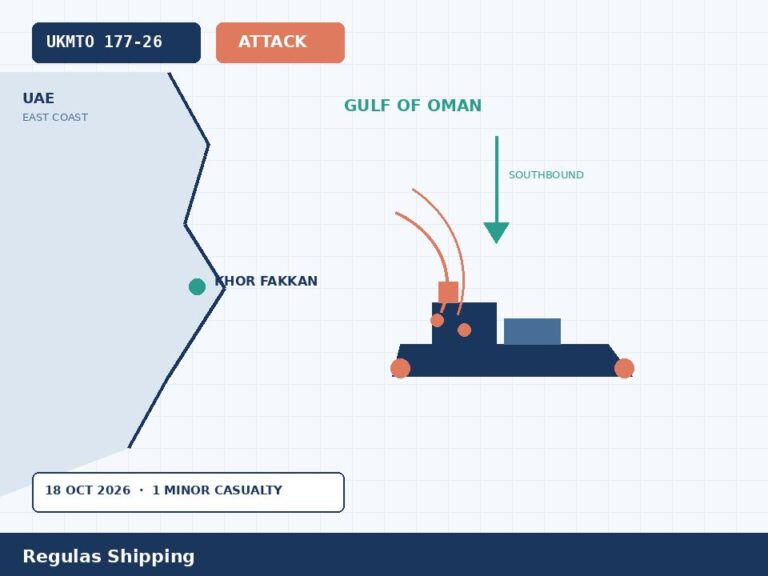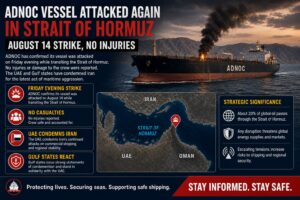
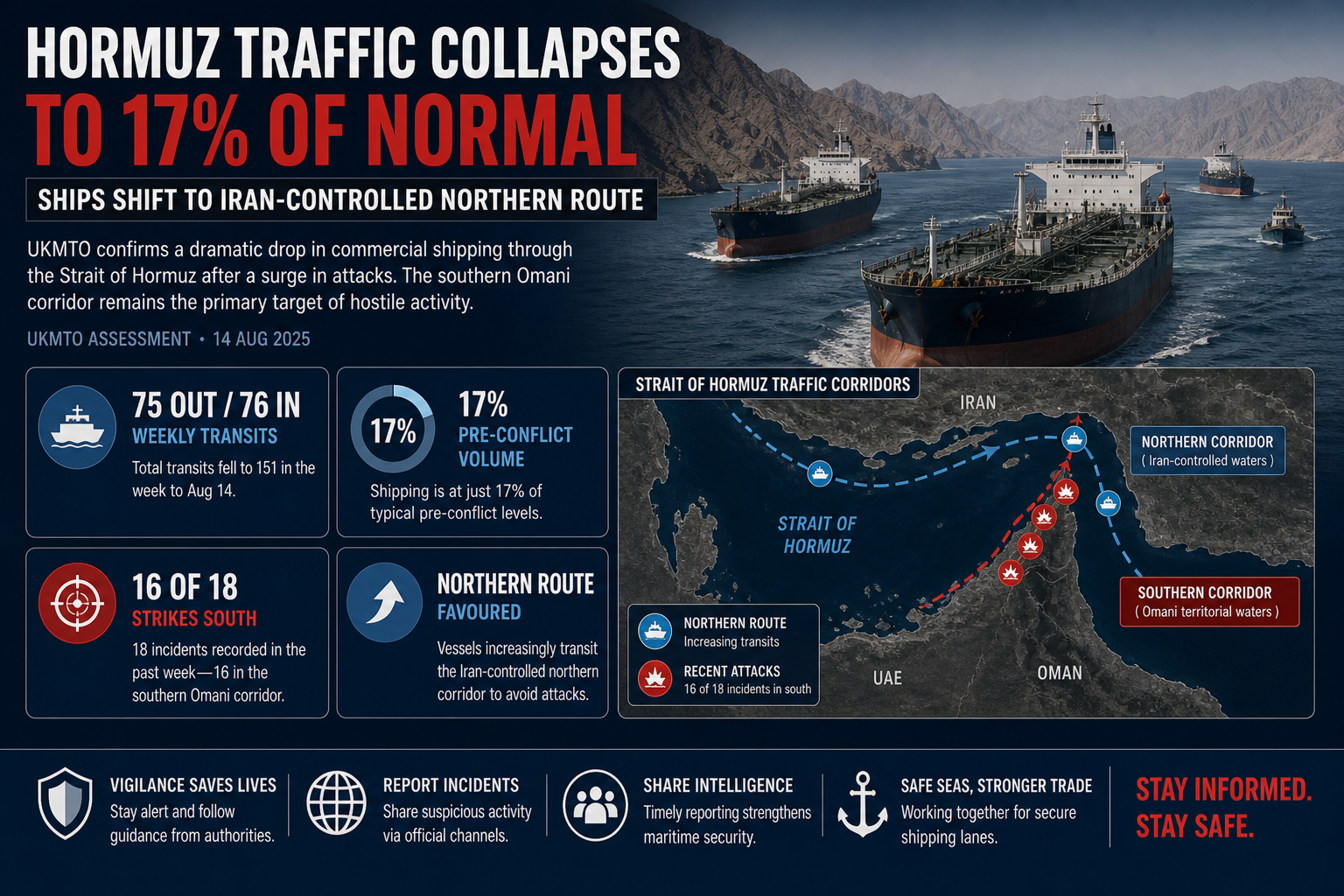
Commercial ships are abandoning the U.S.-coordinated southern corridor through Omani waters and drifting toward the northern, Tehran-controlled route through the Strait of Hormuz, according to the latest UK Maritime Trade Operations (UKMTO) Voluntary Reporting Area assessment. The shift follows a concentrated pattern of projectile attacks on the southern side of the chokepoint and leaves owners choosing between kinetic exposure and Iranian operational control.
UKMTO reported that 16 of 18 projectile strikes logged since 6 July occurred in the Omani corridor. For the seven days ending 14 August, the agency counted 75 outbound and 76 inbound full transits — volumes it put at roughly 17% of the pre-conflict average. AIS-detected traffic remains about 90% below pre-war levels, and the traditional IMO Traffic Separation Scheme stays suspended.
Northern Preference, Southern Pain
In AIS-visible route breakdowns cited by UKMTO, outbound traffic favoured the northern route 19–8 over the southern Omani track, with only two ships using the old TSS. Inbound, 26 vessels used the northern corridor against five on the southern route. Multiple ships aborted planned southern transits or rerouted north after attacks — “risk avoidance rather than route substitution alone,” in UKMTO’s framing.
The northern lane runs through Iranian waters under Iran’s Persian Gulf Strait Authority. The southern alternative has been coordinated with U.S. Naval Cooperation and Guidance for Shipping (NCAGS). JMIC has previously assessed Hormuz at a SEVERE threat level and warned that AIS-broadcasting ships could face radio calls directing them onto the Iranian-controlled corridor. Engine rooms were the primary damage location in 12 of the projectile incidents since early July, raising the risk of propulsion loss inside a narrow waterway.
What Operators Should Note
- Southern Omani routing is statistically the hotter kill zone in the current UKMTO strike set, despite sitting outside Iranian territorial control.
- Northern routing reduces some attack frequency but increases exposure to Iranian direction and control over who may pass.
- Expect engine-room targeting; propulsion redundancy and emergency machinery drills matter as much as bridge security briefings.
- Do not treat Hormuz as “recovering” on weekly transit counts alone — absolute volumes remain a fraction of the 130-plus ships that once crossed daily.
RegulAs Shipping will keep tracking UKMTO and JMIC routing assessments as operators weigh the southern kinetic risk against northern political and operational control.