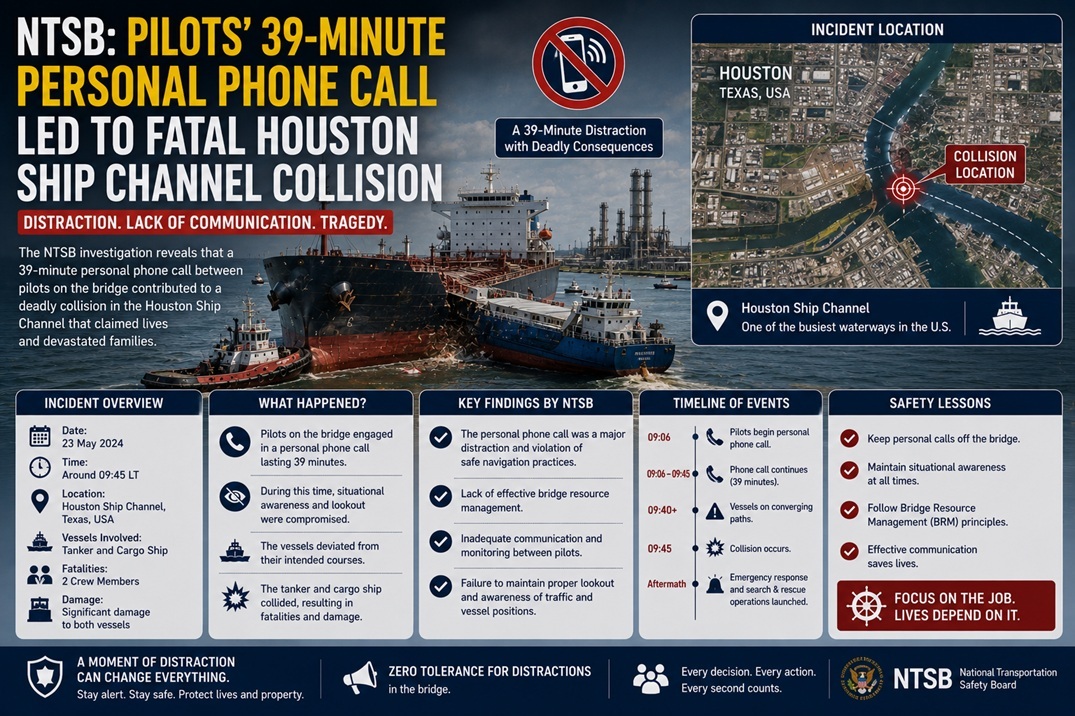
The US National Transportation Safety Board has released its final report into the fatal 19 July 2024 collision between the Liberian-flagged bulk carrier Yangze 7 and the towing vessel Miss Peggy in the Houston Ship Channel, finding that a Houston pilot’s extended personal cell phone call was the central contributing factor in a casualty that killed one crew member.
The 656-foot Yangze 7, inbound to a Kinder Morgan coal terminal, struck the stern of the 50-foot towboat Miss Peggy near Lynchburg, Texas, causing it to roll over and sink with five crew aboard. Four were rescued by a good Samaritan tug; the fifth was later found dead in the wreckage. Total damages, including salvage and pollution mitigation, were estimated at 3.7 million dollars. The Yangze 7 itself sustained no damage.
A 39-Minute Distraction
According to the NTSB, the Houston pilot directing the Yangze 7 answered a personal call from another pilot at 1:22pm and remained on the line for 39 minutes, continuing to issue rudder and heading orders while discussing golf, a home generator purchase, and travel plans. The call ended just over two minutes before the collision. The Yangze 7’s second officer told investigators he grew increasingly uneasy watching the pilot remain distracted as the vessel closed in on the Houston Ship Channel traffic.
Investigators found that both bridge teams failed to maintain a proper lookout: the Miss Peggy’s captain did not detect the Yangze 7 approaching from astern, while the Yangze 7’s own bridge team did not spot the towboat until it was less than a ship’s length ahead. The NTSB noted that the pilot’s crew was aware the call was non-operational but did not intervene, pointing to a broader culture of “normalization” of personal device use among Houston-area pilots.
A Recurring Pattern
The Board highlighted that personal electronic device distraction has been identified as a contributing factor or probable cause in at least ten marine casualties between 2009 and 2024, resulting in three deaths and 45 injuries industry-wide. In response, the NTSB has recommended that the US Coast Guard prohibit nonoperational personal device use by anyone directing vessel movement, and has called on the American Pilots’ Association to formalize a policy restricting personal device use and to encourage member associations to adopt it. The APA issued a statement acknowledging the findings as “deeply troubling” and extending condolences to the family of the deceased mariner.
What Operators Should Note
- Bridge resource management protocols should explicitly address personal device use, not only by ship’s crew but by pilots directing vessel movement.
- A culture of silence around distraction is itself a hazard. Crew who recognize a colleague or pilot is compromised need clear, low-friction ways to raise a concern in real time.
- Proper lookout failures rarely have a single cause. This casualty involved simultaneous lapses on both vessels, underscoring that channel transits in high-traffic waterways demand redundant, not single-point, situational awareness.
- Pilotage associations may face new regulatory scrutiny of personal device policies following this report, particularly in busy US ship channels.