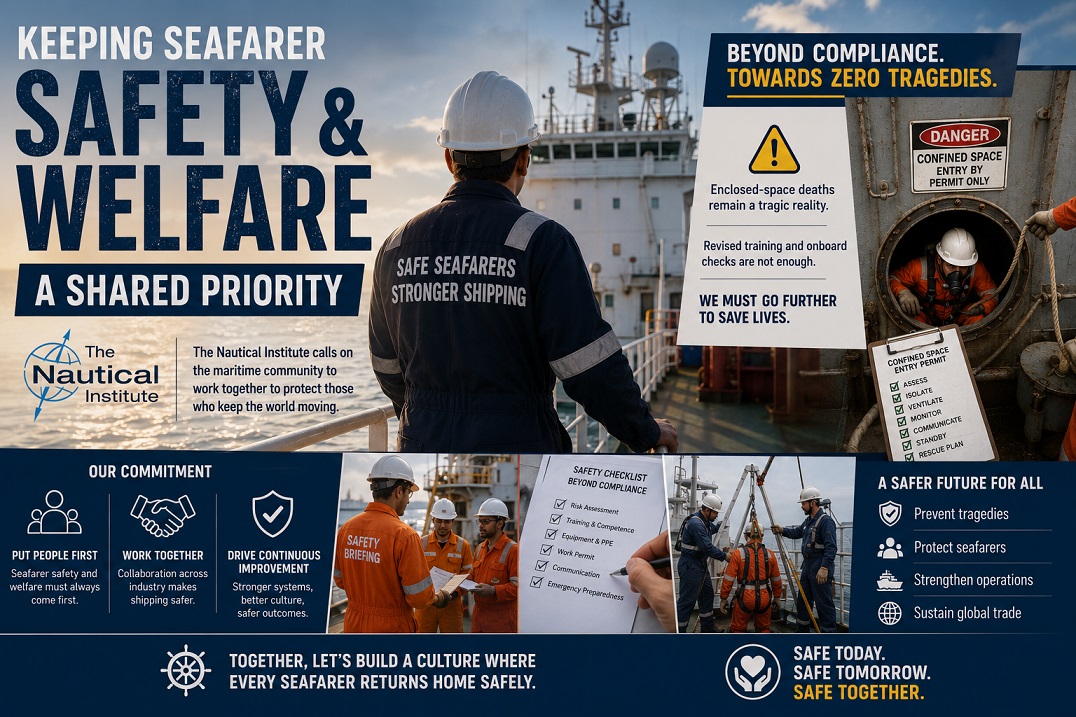
Nautical Institute Urges Industry to Keep Seafarer Safety a Shared Priority
July 2026 | Safety & Compliance Desk
The Nautical Institute has issued a fresh call for the international maritime community to treat seafarer safety and welfare as a shared responsibility, not a box-ticking exercise left to individual operators. The appeal lands alongside a broader industry debate over enclosed-space fatalities, with several voices arguing that revised training modules and additional onboard checks alone will not be enough to stop crew from continuing to die in confined spaces onboard.
A Persistent, Preventable Problem
Enclosed-space deaths have remained one of shipping’s most stubborn safety failures for years, despite repeated regulatory attention from the IMO and class societies. The pattern is well documented: a crew member enters a tank, hold, or void space without proper atmosphere testing or authorisation, is overcome by oxygen deficiency or toxic gas, and a would-be rescuer is frequently injured or killed attempting an unplanned entry to help. The tragedy is compounded by the fact that the hazard is entirely foreseeable and, in principle, entirely preventable.
Why Training Alone Isn’t Closing the Gap
Industry voices pushing back on a training-only approach argue that the sector has already run this playbook multiple times, updating STCW-aligned training content, adding permit-to-work procedures, and mandating better gas-testing equipment, yet incidents keep recurring. The underlying argument is that procedural fixes address the mechanics of a safe entry but do not address the operational pressures, understaffing, and normalisation of shortcuts that push crew toward unauthorised entry in the first place.
What “Shared Priority” Means in Practice
The Nautical Institute’s framing of safety as a shared priority points toward a wider set of stakeholders than the vessel crew alone. Ship managers, charterers setting turnaround schedules, classification societies conducting surveys, and flag states enforcing compliance all shape the operational conditions under which enclosed-space entries actually happen. A genuinely shared approach would mean each of those parties treating safety culture and realistic scheduling as part of their own accountability, rather than delegating the entire risk down to the individual seafarer at the point of entry.
Considerations for Compliance and Fleet Teams
- Audit whether enclosed-space entry procedures are followed in practice, not just documented on paper, through unannounced checks and incident near-miss reviews
- Review whether port turnaround times and workload pressures are inadvertently incentivising crew to skip or rush atmosphere testing and permit procedures
- Ensure rescue and emergency response drills specifically address enclosed-space scenarios, including the risk of secondary casualties among untrained rescuers
- Treat enclosed-space safety as a standing agenda item in safety management system reviews rather than a one-time training update
The Bottom Line
The Nautical Institute’s call, paired with growing industry frustration over repeated enclosed-space fatalities, signals that the conversation is shifting from “has the crew been trained” to “has the operational environment actually been made safe.” For compliance and safety teams, the practical takeaway is to look past training completion records and examine whether real onboard conditions, scheduling pressure, staffing levels, and safety culture, are quietly working against the procedures on paper.
This article is based on publicly reported statements from the Nautical Institute and broader industry commentary on enclosed-space safety. Operators should consult IMO and flag state guidance for the current regulatory requirements on enclosed-space entry.