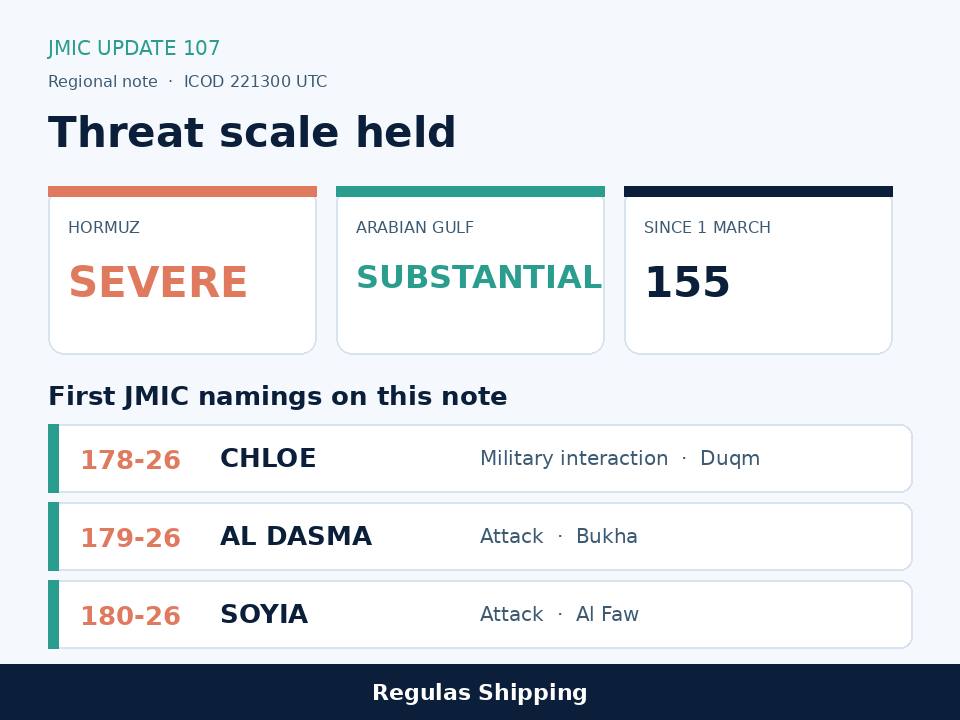
The U.S. Navy-led Joint Maritime Information Center published Update 107 to its regional advisory note with an information cut-off of 221300 UTC on 22 October. The note, JMIC# 001 26, is the first numbered public update since Update 106 of 18 October. The regional threat level remains SEVERE. Hormuz remains SEVERE. The Arabian Gulf remains SUBSTANTIAL. The Gulf of Oman stays MODERATE. The Gulf of Aden and Bab el-Mandeb / the southern Red Sea stay SUBSTANTIAL. Confirmed vessel incidents since 1 March are now printed as 155, up from 153 on Update 106. The confirmed-incidents table adds three files since the last report: UKMTO 178-26, 179-26 and 180-26. All three hulls are named. 178-26 is CHLOE, logged as military interaction, not as an attack. 179-26 is AL DASMA. 180-26 is MT SOYIA. JMIC counts two incidents since the last report — 179-26 and 180-26 — and states that Advisory 178-26 is not counted as an attack.
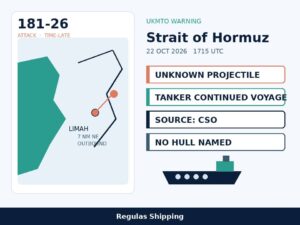
That is the working primary. Thursday’s note is a numbered regional instrument, not a Hormuz reopen, not a rewrite of the dedicated UKMTO 178-26, 179-26 and 180-26 pieces, and not a rewrite of Thursday afternoon’s dedicated IMO 120-count. It is also not Warning 181-26. Update 107’s cut-off is 221300 UTC. Warning 181-26’s incident time is 1715 UTC the same day, more than four hours later, and that Attack sits on its own dedicated piece. The International Maritime Organization’s highlighted-incidents board remains 120 confirmed incidents as at 22 October, with 24 confirmed seafarer fatalities. Those are different counters. The useful facts for a DPA and a bridge team are the first JMIC namings of Chloe, Al Dasma and Soyia against the three UKMTO products that Update 106 could not yet carry, the 155-incident tally, the first northern-Arabian-Gulf Attack off Iraq in the reporting period, the Fujairah / Khor Fakkan congestion print of about 201 hulls on 22 October, the about-501-vessel wait outside the Strait, and the outlook that still treats further Hormuz attacks as highly likely. Do not treat industry matching or the original unnamed UKMTO PDFs as a substitute for this numbered note, and do not treat Update 106 as still the current public instrument.
What Update 107 actually added
Update 106’s information cut-off was 181300 UTC on 18 October. It already carried 174-26 through 177-26, named ST3 on 174-26, and left 175-26, 176-26 and 177-26 withheld. It printed 153 incidents since 1 March and raised the Arabian Gulf from MODERATE to SUBSTANTIAL. Update 107 does not reprint that table and does not downgrade Hormuz or the Arabian Gulf. It adds the next three products that had cleared confirmation by 221300 UTC on 22 October, and it is the first numbered JMIC note to name Chloe, Al Dasma and Soyia.
On 178-26, Update 107 names CHLOE. UKMTO received a report that on 19 October a tanker, identified by the IMO as the CHLOE, was subject to interaction with military forces as part of ongoing blockade activity in the region, approximately 121 nautical miles east of Duqm, Oman. No crew injuries reported. The table labels the event type as military interaction and the location as Arabian Sea. That is the first JMIC naming of the hull that sat as Monday’s dedicated unnamed Advisory 178-26 and as Thursday afternoon’s dedicated IMO 120-count row, CHLOE (MIVERVA V), IMO 9315367, 19 October, 121 nautical miles from the coast of Oman, damaged, no pollution. Dedicated Advisory 178-26 remains an unnamed tanker-and-military-forces product, 1000 UTC, and the PDF remains an Advisory, not an Attack. IMO prints damaged. JMIC prints no crew injuries and does not print a damage line. Hold both. Open-register colour only, already used on this desk: former MINERVA V, VLCC-size. Do not treat the naming as a completed damage survey, a 178-26 PDF naming, or an upgrade of the Advisory to Attack. Do not move Ocean Molica / 163-26 onto Chloe.
On 179-26, Update 107 names AL DASMA and cites NAVAREA IX 396/26. UKMTO received a report from the Omani Coast Guard that on 21 October an oil tanker, identified by NAVAREA IX as the AL DASMA, was struck by an unknown projectile approximately 11 nautical miles west of Bukha, Oman. The fire was extinguished. NAVAREA IX reported that the vessel was anchored approximately 1.3 nautical miles west of Bukha. All crew reported safe and no environmental damage reported. That is the first JMIC naming of the hull that sat as Thursday morning’s dedicated unnamed Warning 179-26 and as Wednesday’s dedicated IMO 119-count second-attack row, AL DASMA, IMO 9653446, 20 October, Strait of Hormuz, damaged, no pollution. Hold the clocks as one hull — IMO and NAVAREA IX 396/26 on 20 October, UKMTO-MSCIO and this JMIC row on 21 October, India’s ports minister naming M/T AL DASMA with 21 Indian seafarers safe on 21 October — not two strikes. Dedicated 179-26 remains an unnamed Attack PDF. Do not treat Update 107 as a 179-26 PDF naming or as a rewrite of Thursday’s Bukha piece.
On 180-26, Update 107 names MT SOYIA. UKMTO received a report that on 20 October the tanker MT SOYIA was struck by an unknown projectile approximately 30 nautical miles southeast of Al Faw, Iraq. All crew reported safe; no vessel or environmental damage reported. The table labels the location as Northern Arabian Gulf. That is the first JMIC naming of the hull that sat as Tuesday’s dedicated unnamed Warning 180-26 and as Thursday afternoon’s dedicated IMO 120-count row, SOYIA, IMO 9263916, 20 October, 30 nautical miles southeast of Al Faw, damaged, no pollution. Dedicated 180-26 remains an unnamed Master Attack, 1830 UTC, with no reported damage on the PDF. IMO prints damaged. JMIC prints no vessel damage. Hold both damage lines. Open-register colour only: Liberia products tanker. Distinct from Al Dasma, New Andros and the Ambrey Basrah STS splash. Do not treat the naming as a 180-26 PDF naming or as a completed class survey.
What sits off the list, and the traffic that moved
Thursday’s cut-off is 221300 UTC on 22 October. Warning 181-26 is a Friday product against a 1715 UTC Thursday incident. Update 107 does not list it. Do not brief the Limah Attack as already inside this note. Update 107 does not print a new Bab el-Mandeb Attack, a named Pride wreck survey, or an IMO-board move off 120. 176-26 remains unnamed on this desk’s dedicated Mukalla piece; Update 107 does not reopen it. 171-26 remains unnamed on earlier tables.
The Arabian Gulf operational summary is the paragraph that should replace Update 106’s version in the master’s pack. One attack was reported to UKMTO in this period, 180-26. This is the first reported attack in the northern Arabian Gulf off Iraq in the reporting period and the fifth attack inside the Gulf since 7 October (UKMTO 158-26, 160-26, 174-26, 175-26 and 180-26). Traffic flows continued, with anchorage congestion high across the region. Navigational-system interference remained elevated and stable, concentrated in the western Gulf from Kuwait / Khafji via Dammam to Bahrain, with further indications on the Dubai – Ras Al Khaimah coast and at Fujairah / Khor Fakkan. The 24–48-hour outlook is plainer than a count: five attacks inside the Gulf since 7 October show that attacks remain a strong possibility throughout the Arabian Gulf, including at anchorages and STS areas off Iraq. Vessels stationary for extended periods, or maintaining AIS-on while static, may face elevated targeting risk.
The Strait of Hormuz summary carries one Attack in the period, 179-26. IRGC attacks, attempted attacks and harassment persisted, including UAV overflight, targeted surveillance of merchant shipping and occasional VHF hailing. Commercial traffic through the Strait remained at reduced levels against the 2025 baseline of about 138 vessels a day. Independent tracking still indicated single-digit transits. U.S. NCAGS data indicated U.S.-assisted flows averaging about 28 vessel transits a day. U.S.-facilitated Strait of Hormuz transits for 18–21 October, the past 96 hours, are printed as 111. Do not add the 111, the 28-a-day series and the independent single-digit series into one throughput figure. Mariners are still advised to remain vigilant for attempted mining within and adjacent to the traffic-separation scheme. AIS-on vessels can expect elevated targeting risk and directed hails instructing them to divert toward the northern Iranian-controlled route. A 30-nautical-mile standoff from U.S. units remains advised. The humanitarian-cargo exemption via NAVCENT NCAGS is still the published tool.
The Gulf of Oman summary says no confirmed attack or disruption was reported in this period. Naval presence remained elevated because of blockade enforcement. The latest official CENTCOM figures cited in Update 107, dated 17 October, are unchanged from Update 106: 138 commercial vessels redirected; four vessels had been disabled as of 10–11 October. No further CENTCOM blockade-enforcement action was announced in this period. Neutral transit remains permitted. Visit-and-search, AIS-on unless constrained by security threats, and continuous monitoring of VHF Channel 16 are still the published tools. The Arabian Sea summary carries 178-26 and no confirmed attack. The Gulf of Aden, southern Red Sea / Bab el-Mandeb, Somali Coast, northern Red Sea / Suez and Eastern Mediterranean paragraphs are marked no change. MT ASANA, the Tanzanian-flag product/chemical tanker hijacked on 17 July about 65 nautical miles southwest of Mukalla, is still the one merchant vessel remaining hijacked. Bab el-Mandeb cargo transits for 18–21 October, the past 96 hours, are printed as 136 against a 2023 baseline of about 61 vessels a day. The last confirmed Houthi attack on a merchant vessel on this note remains 24 August. The southwest monsoon subsided on 15 October; skiff operations further offshore are printed as more feasible.
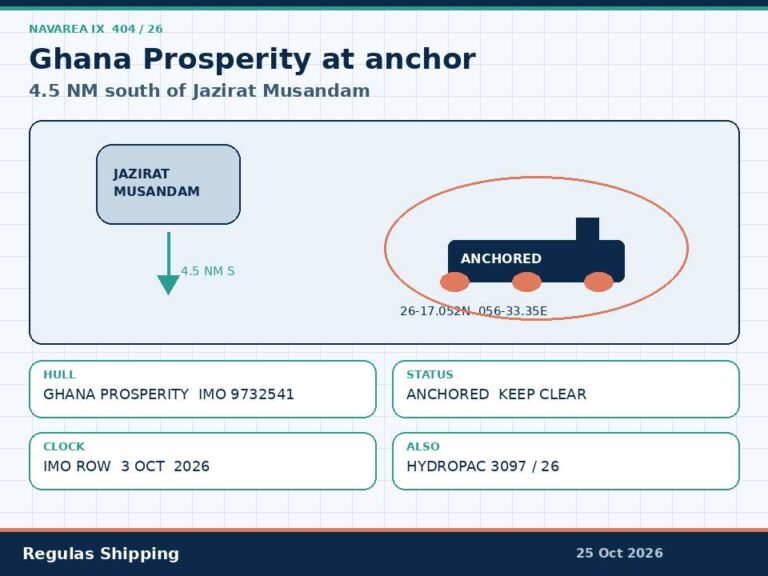
Port and anchorage congestion is printed as of 22 October and is the other operator paragraph. About 201 vessels were at anchor in the vicinity of Fujairah / Khor Fakkan, down from the 18 October peak of 217. About 188 were off Dubai / Jebel Ali to Ras Al Khaimah. About 53 were in the vicinity of Musandam / Sohar. About 22 were inactive off Bandar Abbas / Qeshm. Gulf of Oman congestion eased from the 18 October peak without a mass departure. Khor Fakkan shows no clearing-out after the 18 October tug attack in its approaches (UKMTO 177-26). Approximately 501 vessels were waiting outside the Strait of Hormuz, against single-digit AIS-visible transits; the backlog is expected to persist. All tracking excludes AIS-dark vessels. Periodic repositioning remains advisable in all areas.
GNSS / AIS interference in the Arabian Gulf is elevated and stable, concentrated in the western Gulf from Kuwait / Khafji via Dammam to Bahrain, with further indications on the Dubai – Ras Al Khaimah coast and at Fujairah / Khor Fakkan. Windward recorded 211 jammed vessels and 760 false STS events in the Gulf and Gulf of Oman on 20 October. The Strait of Hormuz and the Gulf of Oman remained at the established high baseline. No new specific UKMTO, MARAD, NAVCENT or NAVAREA IX GNSS/EMI notices were issued 18–22 October. Baseline advisories remain in force.
Operational implications
A numbered JMIC update is a routing and manning problem before it is a count of who was hit. Hormuz is still SEVERE, with deliberate attacks called highly likely, AIS-on targeting risk, directed hails toward the northern Iranian-controlled route, and a specific watch for attempted mining within and adjacent to the traffic-separation scheme. That guidance did not move because three hulls were named. The Arabian Gulf column did not move either. It stays SUBSTANTIAL. What moved is the named table, the incident tally from 153 to 155, the first northern-Gulf Attack off Iraq in the reporting period, and the congestion print from 217 hulls at Fujairah / Khor Fakkan down to about 201, with about 501 still waiting outside the Strait. Masters who still brief the region as Update 106 will have the wrong instrument in the folder. Masters who brief Thursday as a Hormuz downgrade will have the wrong scale on the chart.
The naming paragraph is a briefing-discipline problem, not three new casualties. Monday’s dedicated 178-26 piece left the Duqm tanker unnamed and the product an Advisory. Tuesday’s dedicated 180-26 piece left the Al Faw tanker unnamed and printed no reported damage. Thursday morning’s dedicated 179-26 piece left the Bukha tanker unnamed on the UKMTO PDF and treated Al Dasma as NAVAREA / ministry wrap. Thursday afternoon’s dedicated IMO 120-count named Soyia and Chloe and left Al Dasma on Wednesday’s 119-count. Update 107 is the first numbered JMIC note that puts Chloe on 178-26, Al Dasma on 179-26 and Soyia on 180-26. It does not convert those dedicated PDFs into named products. It does not convert IMO’s “damaged” lines on Chloe and Soyia into JMIC damage findings. A master’s pack that briefs “JMIC upgraded 178-26 to Attack” has over-read the military-interaction row. A pack that briefs Soyia as undamaged because JMIC printed no vessel damage, or as holed because IMO printed damaged, has collapsed two instruments. Hold both.
The 181-26 cut-off is the other briefing-discipline problem. Friday’s dedicated Limah Attack sits after 221300 UTC. Update 107 cannot absorb it. A master’s pack that briefs “JMIC already has Thursday evening” has over-read the ICOD. Plan the next outbound Hormuz run on Update 107 plus Warning 181-26, not on a headline that the regional note is current through Friday.
The anchorage paragraph is the line that should sit next to the 201-hull Fujairah / Khor Fakkan print and the 501-vessel wait. Vessels stationary for extended periods, or maintaining AIS-on while static, may face elevated targeting risk. Update 107’s own line is that congestion remains high and is driven by restricted transit, not port capacity, and that Khor Fakkan shows no clearing-out after 177-26. Harbour assists, wreck response and disabled-hull tows operating in that density are in the same watch as shuttle tankers. AIS-off is not a detection shield and is not an order on this note.
CSOs should replace the 18 October Update 106 pack with Update 107 in the master’s folder and in the charterer’s security clause file. The new named lines are Chloe on 178-26, Al Dasma on 179-26 and Soyia on 180-26. The new tally is 155 since 1 March. The new congestion line is about 201 hulls in the vicinity of Fujairah / Khor Fakkan as of 22 October and about 501 waiting outside the Strait. The new GNSS colour is Windward’s 20 October print of 211 jammed vessels and 760 false STS events. None of those edits is a flag circular, a class condition, or a completed MARPOL finding. Do not replace the dedicated UKMTO PDFs, Thursday afternoon’s dedicated 120-count, or Friday’s dedicated 181-26 piece. They are different instruments. Update 107 is the numbered regional threat note that now sits on top of Update 106 and underneath 181-26.
Do not recast Thursday as a UKMTO naming in the original PDFs, as a Hormuz reopen, as a rewrite of Warning 178-26 through 180-26, as a rewrite of Thursday’s IMO 120-count, or as a substitute for Warning 181-26. IMO’s 120 and JMIC’s 155 are different datasets. Masters who brief Thursday as Update 106 still in force, or as UKMTO finally printing Chloe, Al Dasma or Soyia on the original PDFs, will have misread the instrument.
What Operators Should Note
- Log Update 107, ICOD 221300 UTC 22 October, not a Hormuz downgrade. JMIC# 001 26. Regional threat SEVERE. Hormuz SEVERE. Arabian Gulf SUBSTANTIAL. Gulf of Oman MODERATE. Gulf of Aden SUBSTANTIAL. Bab el-Mandeb / southern Red Sea SUBSTANTIAL. 155 incidents since 1 March, two attacks since Update 106 (179-26 and 180-26). 178-26 is printed and is not counted as an attack. Replace Update 106 in the master’s pack. Do not confuse this numbered note with the IMO highlighted-incidents board’s count of 120 as at 22 October, and do not stretch it to Warning 181-26.
- Name only the hulls JMIC named, against the products it named. 178-26 CHLOE, Arabian Sea, 19 October, military interaction about 121 nautical miles east of Duqm, no crew injuries; the dedicated PDF remains an unnamed Advisory; IMO prints CHLOE (MIVERVA V), IMO 9315367, damaged, no pollution. 179-26 AL DASMA, Strait of Hormuz, unknown projectile about 11 nautical miles west of Bukha, fire extinguished, anchored about 1.3 nautical miles west of Bukha on NAVAREA IX 396/26, crew safe, no environmental damage; hold the 20 October / 21 October clocks as one hull. 180-26 MT SOYIA, northern Arabian Gulf, 20 October, unknown projectile about 30 nautical miles southeast of Al Faw, crew safe, no vessel or environmental damage on this note; IMO prints damaged. Hold both damage lines. Do not invent a 178-26 Attack upgrade.
- Treat the northern-Gulf increment and the Fujairah density as live routing, not as a published closure. 180-26 is the first reported attack in the northern Arabian Gulf off Iraq in the reporting period and the fifth inside the Gulf since 7 October. SUBSTANTIAL still means an attack is a strong possibility, including at anchorages and STS areas off Iraq. About 201 vessels were at anchor IVO Fujairah / Khor Fakkan as of 22 October, down from 217 on 18 October; about 188 Dubai / Jebel Ali to Ras Al Khaimah; about 53 Musandam / Sohar; about 501 waiting outside the Strait against single-digit AIS-visible transits. 177-26 still shows that density is exposed outside the Strait. Periodic repositioning remains advisable.
- Do not add Thursday’s traffic and blockade numbers into one throughput figure. NCAGS about 28 assisted transits a day. U.S.-facilitated Hormuz transits 18–21 October: 111. Independent series still single-digit each way. BAM cargo transits 18–21 October: 136. CENTCOM 17 October blockade line is still 138 redirected; four disabled remains the 10–11 October figure. Asana is still hijacked. The last confirmed Houthi merchant attack on this note remains 24 August. The southwest monsoon subsided on 15 October; skiff operations further offshore are more feasible.
- Keep the mining watch and the GNSS baseline. Update 107 still flags attempted mining within and adjacent to the TSS, AIS-on targeting risk, and directed hails toward the northern Iranian-controlled route. The 30-nautical-mile standoff from U.S. units and the NCAGS humanitarian exemption are still blockade procedure. GNSS remains elevated in the western Gulf; Windward’s 20 October print is 211 jammed vessels and 760 false STS events. No new UKMTO, MARAD, NAVCENT or NAVAREA IX GNSS/EMI notice was issued 18–22 October. Cross-check with radar and visual navigation.
- Leave 181-26 and the dedicated UKMTO PDFs on their own pieces. 181-26 remains Friday’s dedicated Limah Attack, after this ICOD. 174-26 / ST3 remains Update 106’s naming. 175-26 / Loyalty, 176-26 and 177-26 / Jif Barracuda remain their dedicated files. Thursday afternoon’s IMO 120-count remains the IMO instrument. Watch the next numbered warning, Update 108, or an IMO-board move off 120 — not a Hormuz reopen and not a retroactive naming of the original UKMTO PDFs.
Regulas Shipping will keep lining Update 107’s 221300 UTC cut-off against UKMTO 178-26 through 180-26, and against Friday’s Warning 181-26, so operators can treat Thursday’s Chloe, Al Dasma and Soyia namings and the 155-incident tally as a live routing pack, not as a Hormuz reopen or a retroactive naming of the original UKMTO PDFs.