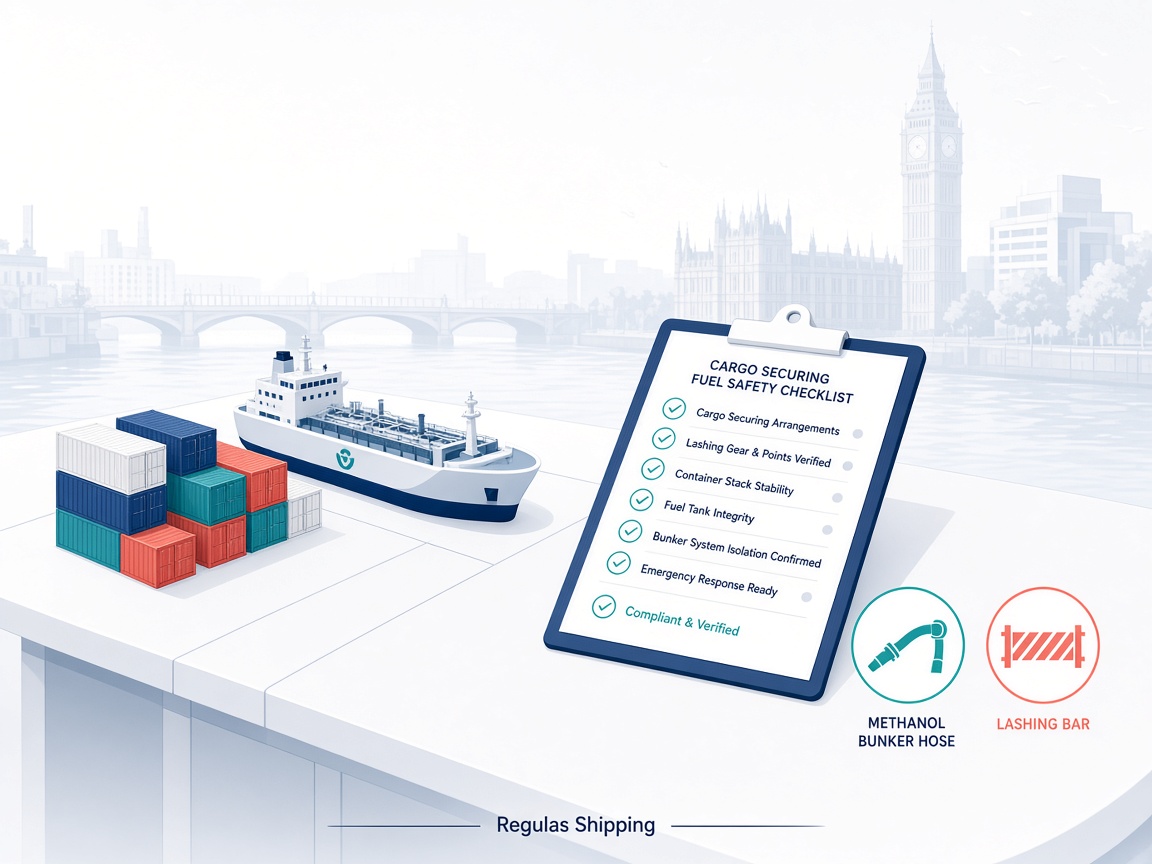
Lloyd’s Register published its CCC 12 summary on Thursday, 18 September 2026, the day the IMO Sub-Committee on Carriage of Cargoes and Containers closed a five-day sitting in London. The session that opened on 14 September with a casualty list has now left a short scorecard. The draft revision of the Interim guidelines for the safety of ships using methyl/ethyl alcohol as fuel (MSC.1/Circ.1621) was finalised. The draft revision of the Revised guidelines for the preparation of the Cargo Securing Manual (MSC.1/Circ.1353/Rev.2) was also finalised, so that lashing software can be used as a supplement to the approved manual. Both texts are expected at MSC 113 in June 2027. The low-flashpoint oil-fuel guidelines that the opening brief had treated as a candidate for finalisation this week were delayed by a year. Fuel-cell amendments ran out of time. Onboard carbon capture work started, with approval not expected before 2029. That is the operator result. It is not a licence to bunker methanol this week, and it is not a reason to treat the 2020 alcohol-fuel circular as current once MSC 113 meets.
Chair David Anderson of Australia and Vice-Chair Christian Allgeier of Germany will take the report forward. Qatar’s permanent delegation, among others, confirmed on Thursday that the week covered methanol and ethanol as marine fuels, low-flashpoint oil fuels, carbon capture and storage systems, and the securing of cargo and containers. Secretary-General Arsenio Dominguez’s opening call to stop attacking merchant ships remains a separate political file. CCC 12 did not reopen Hormuz, the Red Sea or the Black Sea. It wrote, or failed to finish, the circulars that a master, a bunker supplier, a cargo planner and a surveyor will be asked to show when those trades are already on the ship.
Alcohol fuel is the text that left London
The methyl/ethyl alcohol revision is the first working product. Lloyd’s Register says years of industry experience went into an extensive rewrite of MSC.1/Circ.1621, with specific requirements on toxicity, bunkering, fire safety, operations and personnel protection. MSC 113 is expected to approve it in June 2027. Until then the 2020 interim circular remains the published instrument. The practical gap is already on dual-fuel methanol ships and on newbuildings that were specified against the old text. Owners and managers should pull the IGF documentation, tank and cofferdam arrangements, bunker-manifold procedures, fire-fighting media, and crew PPE and medical-response kits against the new draft now, not after the committee stamp. A ship that can show an administration it has mapped the delta will have a survey conversation. A ship that waits for June 2027 will have a deficiency conversation.
The rewrite is a toxicity and interface document as much as a tank document. Methyl and ethyl alcohol fires, vapour behaviour, and personnel exposure are not the same problem as HFO. Bunkering is the shore–ship interface that ports have not standardised. Fire safety and operations sit with the SMS and with the people who will actually connect the hose. Personnel protection is the item that gets dropped when a charterer wants a methanol-capable ship tomorrow. CCC 12’s draft is the list those four files will be measured against. It is still interim. Mandatory IGF provisions for methyl and ethyl alcohols remain on the longer track. Do not write “IMO approved methanol fuel” into a fixture recap because a Sub-Committee finalised a draft circular.
What slipped, and what only started
Draft interim guidelines for ships using low-flashpoint oil fuels — the 52°C to 60°C band that includes the HVO and biofuel questions sitting in the work plan since CCC 11 — were not finalised. Lloyd’s Register says completion has been delayed by one year. A correspondence group will develop the draft further, and CCC 13 is expected to finalise it. That is a specification problem for any owner already blending, or being asked to blend, fuels that sit below the conventional 60°C flashpoint assumption. The ship can still bunker what flag, class and the bunker supplier will document. It cannot point to a finished IMO circular for that band. Charter clauses that treat “IMO low-flashpoint oil-fuel guidelines” as a current instrument are ahead of the text.
Amendments to the Interim guidelines for the safety of ships using fuel cell power installations (MSC.1/Circ.1647) also ran out of time. A correspondence group will start the work, with CCC 13 expected to move toward finalisation. Ships already fitted, or on order, with fuel-cell installations remain on the 2023 interim circular plus class rules. That is enough for a notation. It is not enough to assume next year’s surveyor will accept last year’s integration drawing without a mapping to the correspondence-group draft.
Onboard carbon capture and storage is the new start, not a finish. Work on goal-based interim guidelines has begun. Approval is expected in 2029. Lloyd’s Register says the finished guidelines are expected to carry annexes with detailed provisions for specific OCCS technologies. IACS had tabled CCC 12/4 on that file, pointing to gap G 34 from MSC 110 and to the ship-integration, CO2 processing and storage, and chemical-treatment hazards that a brochure does not cover. Operators ordering “OCCS-ready” tonnage, or being offered a retrofit option priced as a GHG compliance tool, still do not have a circular to put in the specification. They have a work plan. A yard option sold against a 2029 target year is a commercial bet. It is not a regulatory product.
Lashing software is the item inspectors can already use
The Cargo Securing Manual revision is the change that applies to ships that are not burning methanol. CCC 12 finalised amendments to MSC.1/Circ.1353/Rev.2 so that lashing software can support preparation of the Cargo Securing Manual. The text is expected at MSC 113 in June 2027. The software is a supplement. It does not replace the approved manual. Ships that already run lashing programs as a convenience will need to show that the program meets the harmonized performance standard and that the approved CSM still governs. Ships that have been treating the software as the manual will have a non-conformity waiting at the next class survey or port-state inspection.
Paris and Tokyo MoU cargo-securing concentrated inspection campaigns run through 30 November 2026. Those inspectors are already looking at lashing, securing and cargo documentation. They will not have the MSC 113 circular in hand this autumn. They will have the existing CSM, the Cargo Securing Manual on board, and a growing industry expectation that software output matches the approved plan. A finalised draft in London is the text those regimes will eventually quote. It is also the reason to stop printing a software screenshot as if it were the manual.
A related proposal to add a new annex to the CSS Code, with a standardised method to assess the efficiency of securing arrangements for containers on containerships, was agreed with a target completion year of 2030. That is a containership structural and lashing-design file, not a 2026 voyage instruction. Put it on the newbuilding and class agenda. Do not brief it as an IMDG change for Monday’s load.
What this week did not settle
IMSBC and IMDG amendments remained on the agenda through the week. They are a continuing amendments cycle, not a single London event. Incident reports on packaged dangerous goods and marine pollutants were also before the Sub-Committee. The World Shipping Council’s Special Provision 188 lithium-battery proposal was already a separate industry file going into the session. None of that is finished business in the Lloyd’s Register scorecard, and none of it should be briefed as if CCC 12 closed the declaration loophole. Documentation and declaration remain the control, whether the cargo is batteries, alternative-fuel samples, or a bulk that shifts the ship’s stability.
The 17 September Future Fuels and Technology Project seminar on ammonia as a marine fuel sat beside the Sub-Committee rather than inside the finalised circulars. MSC 111’s interim guidelines for using ammonia cargo as fuel on gas carriers still do not automatically cover ammonia as bunker on a dry or container ship. Charter and newbuilding language that says “ammonia-ready” without naming the instrument, the tank arrangement and the spill-response standard is still a specification gap. CCC 12 did not fill it.
The Sub-Committee also did not finish the net-zero political fight that stalled at ISWG-GHG 22. Fuel certification, lifecycle accounting and the incentive design for zero and near-zero fuels remain MEPC business. CCC 12’s job was the safety layer under fuels and cargoes that commercial teams have already sold. Where that layer was finished — alcohol fuel and lashing software — the next date is June 2027. Where it slipped — low-flashpoint oil fuels and fuel cells — the next date is CCC 13. Where it only started — OCCS — the next date is the end of the decade. Owners should put those three dates on the same sheet as the ships that are already in the water.
What Operators Should Note
- Map existing methanol dual-fuel ships to the revised MSC.1/Circ.1621 draft now. Toxicity, bunkering, fire safety, operations and personnel protection are the new headings. The 2020 circular remains the published instrument until MSC 113 in June 2027. The survey conversation will be about the delta, not about the press line that “alcohol-fuel rules were finalised.”
- Do not write low-flashpoint oil-fuel guidelines into a 2026 charter as if they exist. The 52°C–60°C band, including HVO and biofuel questions, slipped a year. A correspondence group will work to CCC 13. Flag, class and the bunker delivery note still govern what the ship can take. An IMO circular does not.
- Treat “OCCS-ready” as a yard option without a circular. Goal-based interim guidelines have started. Approval is expected in 2029, with technology-specific annexes still to be written. Price the option as a commercial bet. Do not brief it as IMO-ready tonnage.
- Keep fuel-cell installations on MSC.1/Circ.1647 plus class rules. Amendments did not start in plenary. A correspondence group will take them to CCC 13. Update the integration file against the draft when it appears. Do not assume last year’s drawing is next year’s notation.
- Make lashing software a supplement to the approved Cargo Securing Manual, not a substitute. The MSC.1/Circ.1353/Rev.2 revision is finalised for MSC 113. Paris and Tokyo MoU cargo-securing CICs run through 30 November. A software screenshot that does not match the approved CSM is the deficiency, not the circular.
- Leave the CSS Code container-securing annex on the 2030 newbuilding list. A standardised method to assess securing efficiency was agreed as a target, not as a 2026 load-port instruction. Containership owners should ask class how the annex will sit against existing lashing software and CSM approvals.
- Keep IMDG and IMSBC declaration discipline in the same pack as the fuel work. CCC 12 did not close undeclared-hazard loopholes in the published scorecard. Batteries, marine pollutants and poorly documented bulks remain a hold-fire and port-state problem whether or not a special-provision amendment moved this week.
Regulas Shipping will keep lining CCC 12’s finalised alcohol-fuel and lashing texts against the delayed low-flashpoint file and the 2029 OCCS work plan so operators can treat London’s close as a specification and survey calendar, not as a slogan about alternative fuels.