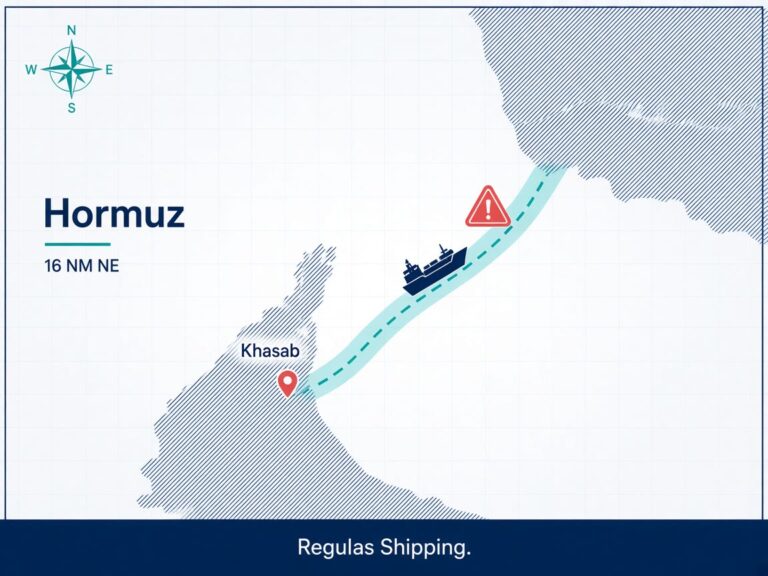
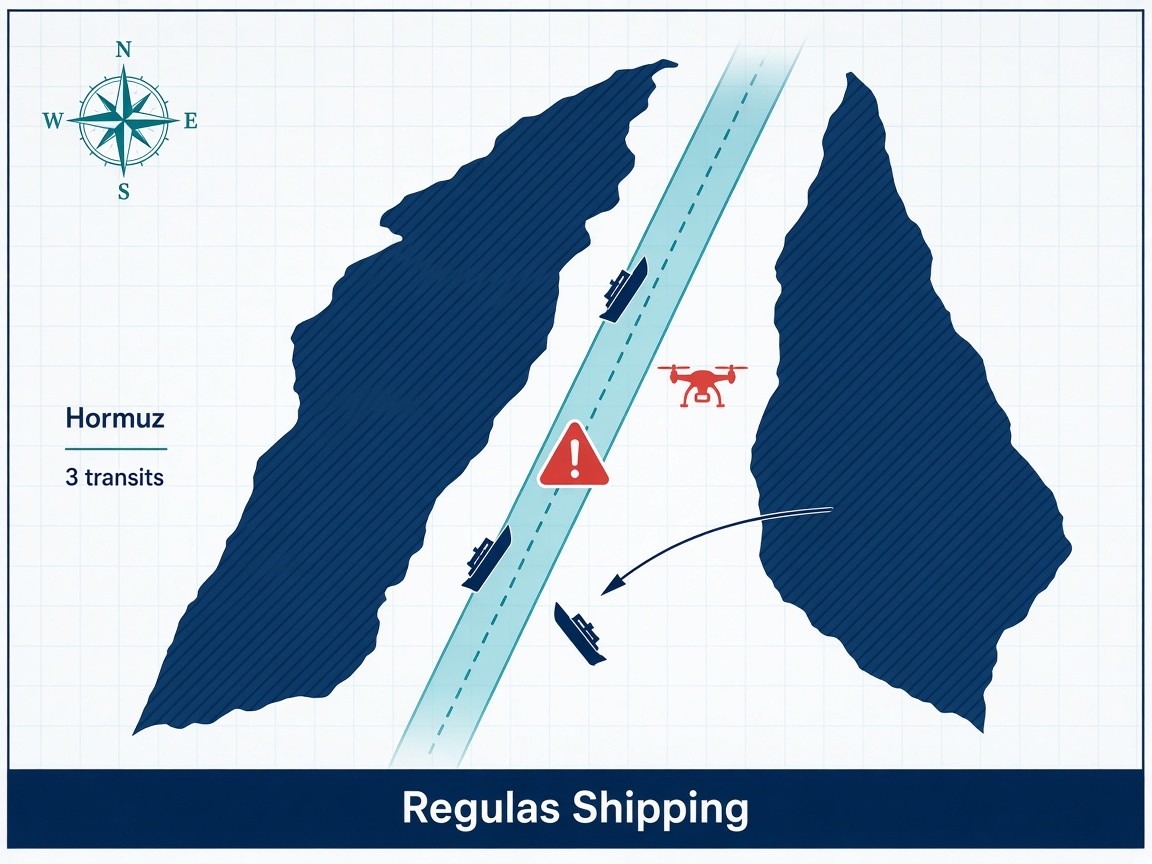
Preliminary Kpler data reported by Reuters on Thursday, 17 September 2026, put commodity-vessel transits through the Strait of Hormuz at three on Wednesday, 16 September, down from 12 a day earlier and well below the preceding ten-day average of about 17. The three AIS-visible hulls were an empty Supramax dry-bulk carrier entering on the Iranian-managed route, an empty petroleum-products tanker entering on an unidentified dark route, and a Panamax tanker exiting on a dark route. None of the three was a very large crude carrier. None was an LNG carrier. The figures exclude ships that may have passed with Automatic Identification System transponders switched off.
That print landed beside a second, still-unconfirmed security report. U.S. media, citing two sources and later carried by SAFETY4SEA and maritime risk desks, said a U.S.-contracted vessel near the strait had been attacked with four Iranian drones and at least one missile, that one projectile struck, and that injured personnel, including crew affected by smoke inhalation, were receiving medical treatment in an unidentified Gulf country. Several U.S. personnel were said to have been on board. The vessel’s name, flag, type and cargo have not been released. Neither Washington nor Tehran has issued an official confirmation. Treat the strike as a reported incident under investigation, not as a named UKMTO warning, until a military, flag or UKMTO product carries the hull.
The operational point is the combination, not either item alone. Wednesday’s three-ship count is a commercial closure in all but name. A reported combined drone-and-missile attack on a contracted hull, even unnamed, is the kind of loss data war-risk underwriters and crewing desks will use on the next fixture. A waterway can stay physically open, as U.S. Central Command continues to say, and still be a waterway owners will not stem.
What Thursday’s count actually moved
Reuters, citing Kpler at 0445 GMT on Thursday, did not name Wednesday’s three ships. It did name the mix. One empty Supramax entered via the Iranian route. One empty products tanker entered via a dark route. One Panamax tanker exited via a dark route. Dark-route in this feed means the tracker could not assign the transit to a published traffic-separation scheme or to the Iranian-managed lane, not that the ship was necessarily AIS-off for the whole passage. Empty, in the same feed, means the ships were not carrying a cargo Kpler could book as a laden commodity movement. A strait that is moving ballast bulk, ballast products and a single Panamax is not moving Gulf crude or LNG to Asia.
Thursday’s Reuters product also revises Tuesday. Wednesday’s Reuters/Kpler snapshot had put Tuesday, 15 September, at four commodity transits against a ten-day average of 18, with no VLCC and no LNG tanker in the visible set. Thursday’s product puts Tuesday at 12 and the ten-day average at about 17. Preliminary tracker counts on this waterway move as delayed AIS fills, Iranian-route assignments and dark transits are reconciled. Operators should use Thursday’s print as the working figure for Wednesday and should not brief charterers that Tuesday was a four-ship day as if the later revision had not arrived. The direction is not in dispute on either read. Hormuz is in single digits on Wednesday. It is not a 125-ship peacetime lane, which is the order of traffic the strait handled before the Iran war when it carried about one-fifth of the world’s oil and liquefied natural gas.
UKMTO and JMIC products from the preceding 72 hours remain the threat overlay, not a substitute for the traffic count. JMIC still rates the strait SEVERE. Projectile and fire incidents around Musandam, including the Panama-flagged products tanker El Gaia now under tow after an engine-room fire, sit in the same week as Monday’s Larak Saildrone exchange, in which CENTCOM said it destroyed two Iranian boats after an unsuccessful attempt to seize a U.S. unmanned surface vessel. Those are separate files. They are why a three-ship Wednesday is not a quiet day. It is a day on which almost nobody accepted the residual risk.
The reported U.S.-contracted strike
Fox News, citing two sources, reported on 16 September that Iranian forces used four drones and at least one missile against a U.S.-contracted vessel near the Strait of Hormuz, that the ship was carrying American personnel, and that there were casualties. EOS Risk Group’s subsequent bulletin placed the event between 15 and 16 September, said one missile reportedly hit, described damage as limited, and said injured personnel were being treated. The identity of the ship has not been disclosed. Pentagon and White House queries were referred to CENTCOM, which had not issued a named confirmation as of Thursday morning. Iranian state media have not adopted the U.S. account. Company security officers should keep the hull unnamed in standing orders until a warning product, a flag circular or a CENTCOM release identifies it.
What can go into the voyage order now is narrower and still useful. A combined UAV-and-missile profile against a contracted ship is a different geometry from a small-boat seizure attempt or a single unknown projectile. Extra lookouts, a written UAV watch, and an instruction not to close small-boat or unmanned-surface contacts remain live. So does the 30-nautical-mile standoff from U.S. units that owners have been writing into Hormuz passage plans. If the reported ship was under contract to a U.S. government customer, other contracted tonnage in the same envelope inherits the targeting question whether or not the next ship flies a U.S. flag. War-risk warranties that require prompt notice of a material change in the risk should be read before the next stem, not after a casualty.
CENTCOM’s public line is that the strait remains open. U.S. Navy Captain Tim Hawkins, speaking to Al Jazeera this week, said traffic “continues to flow,” that Iran does not control the waterway, and that U.S. forces have assisted commercial vessels moving more than 900 million barrels of crude through Hormuz since early May. He described two simultaneous missions: facilitating commercial traffic and enforcing a blockade CENTCOM calls highly effective. Those are military logistics statistics. They are not a commercial traffic picture. Three AIS-visible commodity transits on Wednesday, two of them dark-routed and two of them empty, is the commercial picture. Facilitation of residual barrels under naval cover does not restore a TSS that owners, insurers and crews will use.
Why the mix still matters more than the headcount
A VLCC lifts on the order of two million barrels. Wednesday’s named set had no VLCC and no LNG tanker. Two of the three ships were empty. The only exit in the Kpler read was a Panamax tanker on a dark route. Transit counts understate the energy shock when the mix shifts away from laden crude. Cargoes not lifted this week are deliveries that do not arrive in six to eight weeks. Physical tightness in the barrel tends to print after the shipping data.
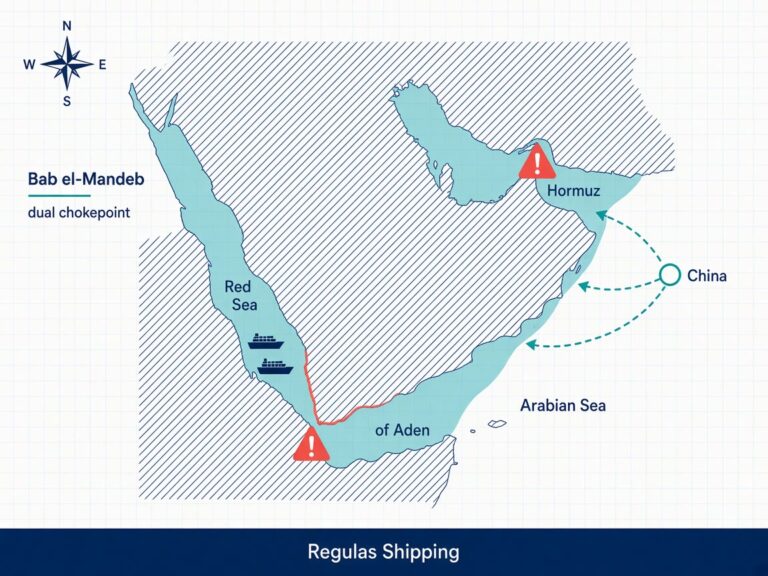
The workarounds remain impaired. Saudi Arabia’s East–West Petroline to Yanbu, which had been absorbing on the order of 4 to 5 million barrels a day after Hormuz tightened, is still stopped after drone strikes on pumping stations. Rystad Energy had put recent Yanbu loadings in a 2.6 to 4 million barrel-a-day range now at risk of disappearing from the market. Officials have said repairs could take weeks. A Kpler market note earlier this week put MEG–China VLCC freight at $24 per barrel and Gulf of Oman loadings outside the Strait at $12 per barrel, with freight around 25 percent of the MEG fob crude price against about 5 percent before the war. Brent has been trading around and above $108 a barrel as the dual-chokepoint story has printed. Those numbers are the rationing mechanism. A three-ship Wednesday with no VLCCs is that mechanism in the transit count.
West of Suez the picture is different in degree, not in kind. Reuters put Bab el-Mandeb commodity crossings at 21 on Wednesday against 24 on Tuesday — thin against peacetime, but an order of magnitude above Hormuz. That gap is why some liner schedules are being put back through Suez while crude remains stuck behind a strait that is not carrying VLCCs. It is not a reason to treat either waterway as restored. Houthi control along the Yemeni Red Sea coast, including Mokha, Perim and the Hanish islands, is still the southern-entrance overlay. IMO Secretary-General Arsenio Dominguez on 16 September told Member States not to use geopolitical conflicts as a pretext to attack merchant ships, citing 80 verified Hormuz attacks and at least 22 seafarer deaths since 28 February. Wednesday’s traffic print is what that casualty record looks like when owners stop offering the voyage.
What Operators Should Note
- Use Thursday’s Kpler/Reuters print as the working figure for Wednesday. Three commodity transits on 16 September, against 12 on Tuesday in the revised feed and a ten-day average of about 17. Wednesday’s earlier snapshot had put Tuesday at four against an 18-ship average. Brief the later number. Do not leave charterers on a residual “18-ship average” as if Wednesday had not printed.
- Log the mix, not only the headcount. Empty Supramax in on the Iranian route; empty products tanker in on a dark route; Panamax tanker out on a dark route. No VLCC. No LNG carrier. Two of three hulls empty. That is not a crude-export day. Dark-route means unassigned to a published lane, not proof the ship was AIS-off for the whole transit.
- Treat the U.S.-contracted strike as reported, unnamed, and material to contracted tonnage. Fox News, EOS Risk Group and SAFETY4SEA describe four drones and at least one missile, one hit, U.S. personnel on board, and smoke-inhalation casualties treated in an unidentified Gulf country. No IMO, flag, type or UKMTO identifier has been published. Do not write a ship name into the master’s orders. Do write a UAV-and-missile profile, a contracted-hull targeting question, and prompt notice to war-risk underwriters.
- Do not read CENTCOM facilitation numbers as a commercial TSS. Hawkins’ 900 million barrels since early May and the line that “the strait is open” describe a military logistics picture. JMIC’s SEVERE rating, Iran’s PGSA 77-vessel Non-Compliance List, directed hails onto the northern route, and Wednesday’s three-ship print govern the commercial go/no-go.
- Keep dark-AIS and empty-lane procedures in the standing orders. Two of Wednesday’s three transits were dark-routed. Reuters says uncounted AIS-off ships are likely. Extra lookouts, a UAV watch, a 30-nautical-mile U.S. unit standoff, and a written instruction not to close small-boat or USV contacts remain live on approach, even when the radar looks empty.
- Re-price the dual-chokepoint case in the charter, not in a later email. Petroline/Yanbu is still offline. Bab el-Mandeb printed 21 on Wednesday against 24 on Tuesday — usable for some liner schedules, not a substitute Hormuz crude lane. If the fixture still assumes a Hormuz VLCC or a Yanbu–Red Sea workaround, name the alternative (Gulf of Oman STS, Mediterranean outturn, Cape, or cancellation) before the ship is stemmed.
- Separate this file from Monday’s Larak Saildrone exchange and from El Gaia. Those are already on the voyage file. The new facts for Thursday’s briefing are Wednesday’s three-ship count and the unnamed contracted-vessel report. Stacking every Hormuz incident into one paragraph hides the decision: whether the next ship is offered at all.
Regulas Shipping will keep lining Kpler, Reuters and UKMTO products against the daily Hormuz count so operators can treat a three-ship, no-VLCC Wednesday — and a reported drone-and-missile hit on contracted tonnage — as a routing and insurance decision, not as residual peacetime traffic.