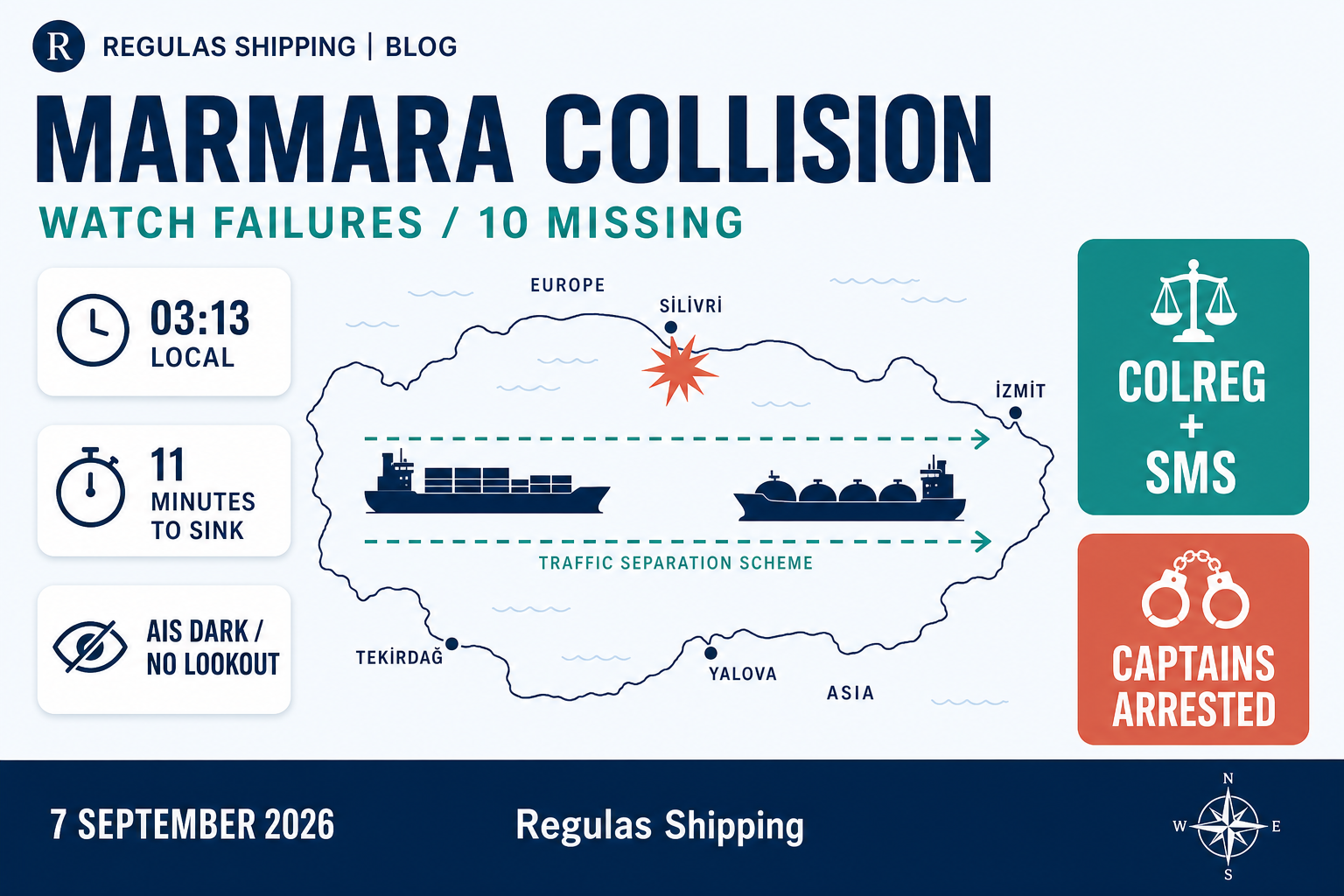
On 2 September 2026, at about 03:13 local time, two Turkish-flagged ships met in the Sea of Marmara Traffic Separation Scheme about 18 nautical miles south of Silivri. The 1990-built general cargo ship Tuğberk İmamoğlu (about 90 metres, roughly 4,600 dwt), loaded with some 4,200 tonnes of steel coil and rebar on a voyage from İskenderun toward Karadeniz Ereğli, tore open on the port side and sank in about 11 minutes. All 10 crew, Turkish nationals including the master, remain missing. Water depth at the site is on the order of 800–900 metres. Search teams later found the ship’s free-fall lifeboat and other survival craft empty in the water.
The other ship, the 2022-built product/chemical tanker Alsu (about 91 metres, 3,338 dwt), was in ballast from Kocaeli toward Aliağa. She took only light starboard-side scrapes, continued, and later anchored at Aliağa pending investigation. Weather was not a factor: a north wind of about Beaufort 4, slight sea, broken cloud and roughly six nautical miles of visibility, with no fog, heavy rain or current that would have limited manoeuvre. Turkey’s Transport Minister confirmed the cargo ship went down “extremely fast,” which is the operational reason the crew never organised a controlled abandonment.
A preliminary expert report prepared for the Silivri Chief Public Prosecutor now frames the collision as a two-bridge failure, not a single last-second steering error. Investigators who reviewed Alsu’s limited ECDIS playback, log entries, crew statements and Bridge Management Manual say the root cause was “bilateral bridge discipline failure, complete abandonment of watch standards, and loss of situational awareness.” Tuğberk İmamoğlu was operating, in the committee’s words, in “ghost ship” mode: AIS off, failed or otherwise not transmitting, so Alsu first saw her as a radar echo at about 1.8 nautical miles rather than as an identified AIS target. Coastal VTS recordings submitted to the file so far show no image of Tuğberk İmamoğlu, even though she appeared on Alsu’s ECDIS.
The playback timeline is tight. Around 03:06 the cargo ship was a missing-echo radar contact on course about 082° at 7.2 knots. Between 03:08 and 03:09 Alsu’s lone watch officer said he agreed on VHF 16 that the other ship would keep clear to port, and Alsu began altering to port. At about 03:10, with Alsu heading near 284°, the cargo ship dropped off and reappeared about 0.5 nautical miles away, turning hard to starboard contrary to that radio understanding. Collision followed at 03:12–03:13: Tuğberk İmamoğlu on about 133° at 5.8 knots, Alsu still making about 7.8 knots. The committee’s working reconstruction is that the cargo ship crossed Alsu’s bow and struck port shoulder to starboard shoulder. Why a 90-metre cargo ship then sank in 11 minutes is still open; cargo shift, lashing and stability calculations from the loading port have been requested.
Alsu’s own SMS is what turns a close-quarters event into a company-level finding. The tanker’s Bridge Management Manual required Watch Condition B in that TSS. At the time of impact the only person on the bridge was third officer Murat Evciman, who had joined the ship on 31 August and was standing his first navigational watch on board (0000–0400). There was no lookout and no helmsman. Master Ahmet Erarslan was asleep in his cabin and reached the bridge only 7–10 minutes after the collision. The report treats that manning as a COLREG lookout breach and an SMS breach, and it argues that an experienced master plus a lookout would likely have detected the starboard swing at 1.5–1.8 nautical miles instead of 0.5, leaving time under COLREG Rule 8 to stop engines or go emergency astern. Instead the officer kept altering to port at close range rather than taking off way.
Liability is already moving from the expert file into criminal process. The prosecutor has opened proceedings against nine suspects. On the current evidence, Alsu’s master and the watch officer were arrested on a charge of causing the death of multiple persons through negligence; four other crew were released under judicial control. Tuğberk İmamoğlu’s owner has said the ship was in her TSS lane, classed and certificated, and that her master had already warned Alsu by VHF that the tanker was entering her water — a claim that sits awkwardly against Alsu’s later VTS report of a collision with an “unidentified” vessel. Final fault will wait on VDR, full VHF audio, expanded radar and the cargo-securing record. For operators, the usable lesson does not wait: a busy TSS at 03:00, a dark AIS target and a single unfamiliar officer is already a predictable loss-of-life scenario, even in clear weather.
The commercial overlay is narrower than a war-risk story but still real for Marmara, Turkish Straits and short-sea steel trades. A loaded coil ship that sinks in 11 minutes will drive P&I, hull and cargo questions about watch composition, AIS availability, night-order books and cargo securing. Charterers who treat “domestic TSS, good visibility” as low risk should re-price the human factor. The empty lifeboat is a reminder that SOLAS survival craft do not compensate for a hull-opening event that outruns abandonment drills.
What Operators Should Note
- Treat Watch Condition B as a hard night-order in TSS waters — master or extra lookout on the bridge in the 0000–0400 watch, not a single newly joined officer, regardless of visibility.
- Do not accept a dark or intermittent AIS target as “unidentified until VHF.” Radar echo at 1.8 nautical miles is already a close-quarters problem; plot, reduce speed and call VTS immediately.
- VHF agreement is not a COLREG dispensation. If the other ship turns across the agreed side, Rule 8 speed reduction and astern take priority over continuing a port alteration at 0.5 nautical miles.
- Audit AIS as a critical navigation aid, not a convenience transmitter. A cargo ship that is invisible to VTS while still painting on another ship’s ECDIS is a company ISM finding waiting to happen.
- Steel-coil and other high-density cargoes need a sinking-time assumption in the drill. Eleven minutes from impact to foundering leaves no margin if the port shell is opened; abandon-ship cues must start from flooding, not from a completed damage-control round.
- Expect criminal as well as civil exposure when SMS watch tables are ignored. Alsu’s master and watch officer are already in custody; “I had authority not to post a lookout” did not survive comparison with the ship’s own BMM.
- Keep Marmara and Turkish Straits voyage files updated with the prosecutor’s requests for VDR, VHF audio, stowage plans and lashing certificates — those records will decide both fault and cargo recoveries.
Regulas Shipping will keep following the Silivri investigation, AIS and VTS evidence, and any further findings on why Tuğberk İmamoğlu sank so quickly, so masters and CSOs can turn this TSS collision into concrete night-watch and cargo-securing controls.