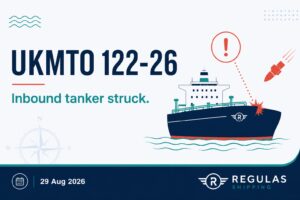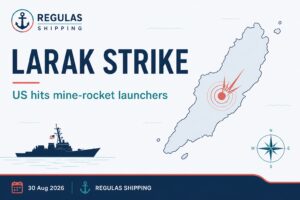
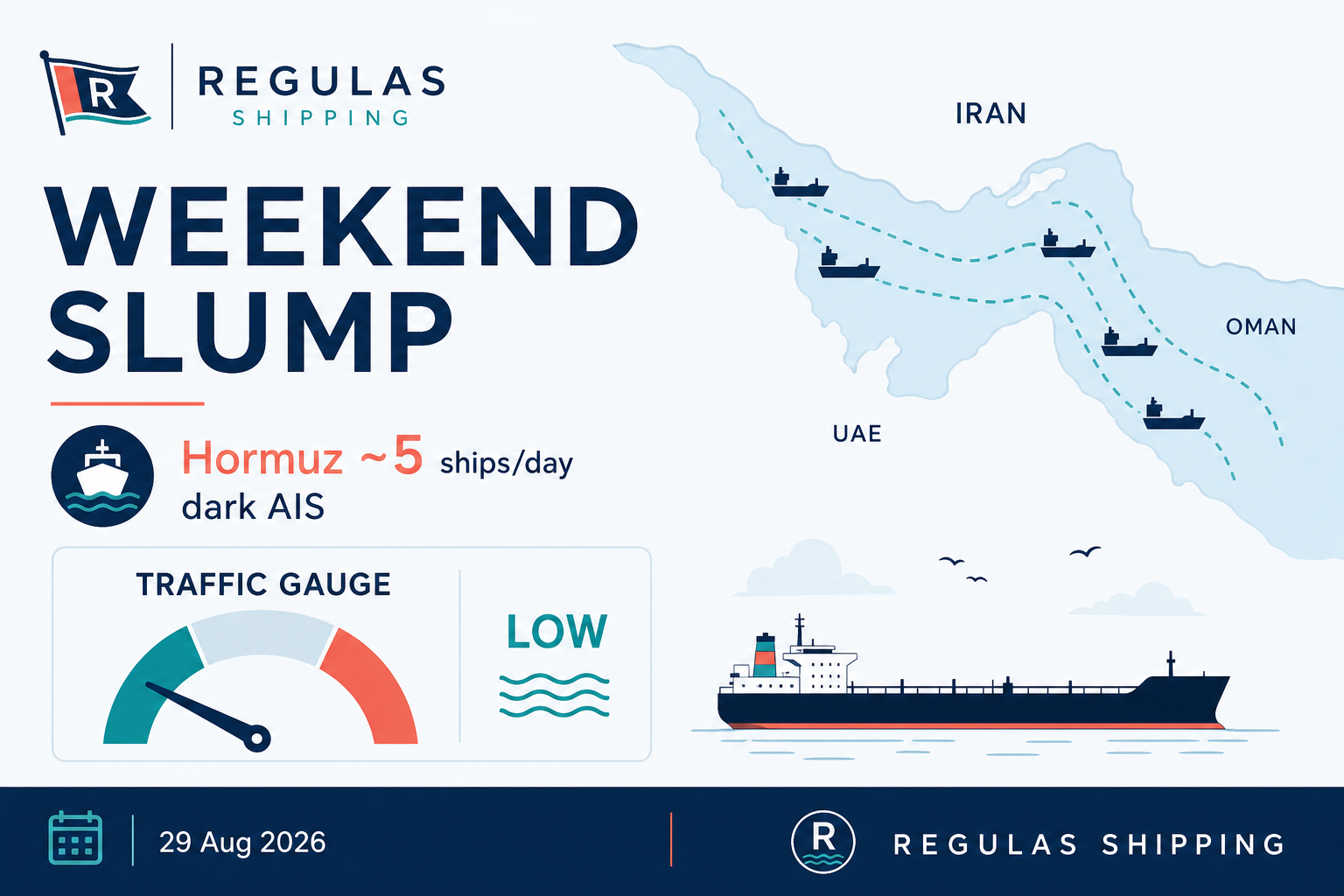
Over the 29–30 August 2026 weekend window, visible commodity traffic through the Strait of Hormuz contracted sharply as owners and charterers reacted to another cluster of tanker strikes. Ship-tracking later summarised by commodities intelligence firm Kpler pointed to about five visible commodity vessels per day across the weekend — a steep drop from Friday’s higher print, which had included a dark VLCC movement laden with Qatari crude.
Composition mattered as much as the headline count. Weekend crossings were skewed toward smaller tonnage, including LPG carriers, with at least one exit via the Iranian route and another sailing dark toward India. That mix signals risk aversion among mainstream crude and product programmes: when liquid-tanker participation thins, the strait may still show “some traffic” without restoring pre-war energy throughput.
Dark AIS behaviour continues to blur the true flow picture. Actual passages may exceed lit counts, but dark steaming also reduces collision awareness and complicates search-and-rescue and naval facilitation. For commercial desks, the weekend data reinforced that Hormuz remains a suppressed, high-premium chokepoint rather than a normalised TSS.
What Operators Should Note
- Read traffic quality, not only vessel counts — zero or few liquid tankers is a stronger signal than a raw daily total.
- Assume dark AIS peers are present and tighten lookout, radar and CPA discipline.
- Reprice delay and war-risk costs against single-digit weekend baselines, not Friday spikes.
- Keep Gulf fixtures contingent on updated UKMTO warnings issued over the weekend.
- Brief crews that smaller-vessel traffic does not imply a safe corridor for VLCCs or product tankers.
Regulas Shipping will keep pairing daily Hormuz counts with vessel-type mix and dark-transit caveats for commercial planning.