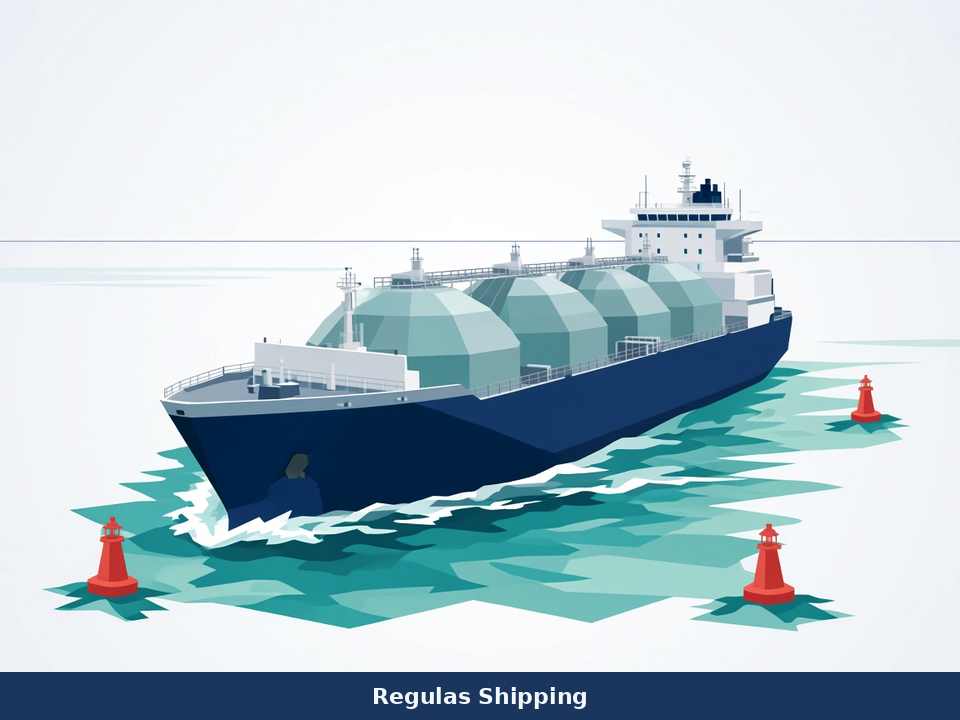
Reuters in Singapore reported on Monday, 28 September, that more QatarEnergy-linked liquefied natural gas vessels, laden and in ballast, have transited the Strait of Hormuz in the last week despite the continuing United States–Iran conflict. The latest hull to reappear outside the strait is the Bermuda-flagged GasLog Skagen (IMO 9626285), which showed up off Sri Lanka on 27 September with a cargo from Ras Laffan, according to LSEG and Kpler data cited by Reuters. That Monday file, written by Emily Chow, is the primary for this note. It is not a rewrite of the 18 September three-carrier reappearance already on this blog, of the 22 September QatarEnergy North Field equipment-delay briefing, or of Sunday’s Joint Maritime Information Center severe rating.
Kpler data cited by Reuters showed no visible transits in August by Qatar-linked LNG vessels or by vessels carrying cargoes from Ras Laffan, amid fears of attack as Iran has tried to throttle traffic through the strait. Some ships may have got through undetected with Automatic Identification System transponders off. This month, Reuters said, visible LNG transits have begun to pick up. That is a tracking change, not a restored export programme. Bloomberg, carried by The National on Monday, reported that QatarEnergy has again extended force majeure on LNG shipments to Asia and Europe: Pakistan and Bangladesh cancellations through November, at least one Indian buyer told the same, and Italy’s Edison saying deliveries remain suspended until early December. QatarEnergy did not immediately comment to Reuters or to Bloomberg. Do not recast a handful of named reappearances as a Hormuz reopen, an AIS recovery, or a return to pre-war Qatari LNG volumes.
Named hulls, dark transits and a still-reduced plant
GasLog Skagen, managed by Greece’s GasLog LNG Services, is a 2013 LNG tanker of about 285 metres, 98,451 gt and 81,847 dwt, MMSI 310664000, call sign ZCEJ7. Reuters said it had been inside the Gulf from the start of the war, ferrying cargoes from Qatar to the United Arab Emirates and Kuwait, until it was last seen there on 20 September. Its 27 September Sri Lanka appearance is therefore an exit from a wartime intra-Gulf shuttle pattern, not a first-time Ras Laffan loading. GasLog LNG Services did not immediately respond to Reuters.
Another LNG vessel carrying a Qatar-origin cargo, Al Shamal (IMO 9360893), a 2008 Samsung-built Q-Flex of about 217,000 cubic metres jointly associated with Nakilat and Seapeak, was last seen inside the strait on 19 September and reappeared outside Hormuz around 24–25 September. Reuters said it is managed by Seapeak Maritime and was skirting southern India. Argus, using Kpler, dated the Indian Ocean AIS return to late on 24 September and counted that as bringing visible QatarEnergy transits so far this month to 13. Argus also said at least five QatarEnergy-operated carriers sailed through Hormuz without displaying location in the past week, and that on 23 September three other LNG carriers besides Al Shamal went through without displaying location. Traders told Argus the dark-transit cluster weighed on LNG spot prices but was not, in their view, a signal of sustained large-scale Qatari outflows.
Reuters named two further Qatari-linked exits with Ras Laffan cargoes. Mesaimeer (IMO 9337729), a 2009 Marshall Islands-flag Q-Flex of about 315 metres managed in open sources by Nakilat Shipping Qatar Ltd, reappeared off Oman on 23 September. Al Ghashamiya (IMO 9397286), a 2009 Q-Flex of about 315 metres, delivered its cargo to Dahej, India, on 24 September. At least one LNG vessel entered: Qatari-linked Al Mafyar (IMO 9397315), a Q-Max, was last seen outside Hormuz on 19 September and reappeared in ballast inside the strait on 22 September. Seapeak Maritime and Shandong Marine Energy also did not immediately respond to Reuters.
The 17 September reappearances of Qatari-linked Al Samriya and Seapeak-managed Al Daayen, the latter with a cargo then described as en route for Caofeidian, China, and the 19 September transit of Shandong Marine Energy-managed Shandong Redwood, which Reuters said delivered to Pakistan on 23 September, are already on this blog as the 18 September three-carrier file and as context in the 22 September North Field note. They are listed here only so Monday’s new names are not confused with last week’s. Argus said most of the recent laden exits have gone to India, with others to Pakistan, and that after those deliveries Indian importers started seeking cargoes further out — a downstream-planning effect, not a statement that term Qatari volumes are back.
The plant behind the cargoes is still not at pre-war output. QatarEnergy chief executive and energy minister Saad Sherida Al-Kaabi said on 20 September that critical expansion equipment could not enter because of Hormuz and that a delay to some projects was possible if that continued; that North Field East briefing is already covered. Bloomberg’s Monday force-majeure extension is the commercial overlay on the same constraint: Ras Laffan has been operating at reduced capacity after March attacks, with two trains (about 12.8 million tonnes a year) damaged, and the company has been renewing customer notices roughly once a month since the war began. The National added that the plant is being kept ready for a rapid increase if Hormuz reopens. Al-Kaabi’s earlier remark that, aside from that 17 percent, operations could get back toward normal within a couple of weeks if the strait reopened remains a conditional plant statement, not a sailing window.
What a visible LNG pickup does not change for Masters
Reuters recalled that Hormuz carried about a fifth of global crude and LNG supplies before the war that began in February with US-Israeli strikes on Iran, and that many vessels still make dark transits. JMIC on Sunday kept the threat at severe, with no confirmed attacks in the previous 72 hours but with IRGC UAV overflight, surveillance and occasional VHF hailing still described. UKMTO’s last named-casualty product in the strait remains the 23 September Cape Dao projectile and fatality. A gas carrier that has just run the strait dark, or that has just come back onto AIS off Oman, Sri Lanka or southern India, is not evidence that the threat product has changed. It is evidence that some owners, charterers or QatarEnergy-linked operators are accepting residual kinetic and electronic risk to move a limited number of cargoes, mostly toward the subcontinent, while term buyers in Pakistan, Bangladesh, India and Italy are still being told that scheduled deliveries are cancelled into November or early December.
That split is the operational point. A Master or operator of an LNG, LPG or associated shuttle hull should not read Monday’s Reuters list as permission to treat Hormuz as a normal Q-Flex/Q-Max lane. PGSA declarations, the US Office of Foreign Assets Control designation of PGSA and FAQ 1249, the MARAD stand-off from Iranian units, and the instruction not to comply with over-the-horizon VHF or email routing orders from Iranian authorities are unchanged. Dark AIS through the strait remains a targeting-avoidance tactic that also degrades the collision-avoidance picture for everyone else. If your company requires AIS on, say so in the voyage orders before the Musandam approaches; if your company accepts a dark transit, write the bridge procedure for radar, visual, VHF and reporting to UKMTO and the company security officer, and do not assume the public web tracker is the ship.
Charterers and cargo interests should keep force majeure and physical movement in separate columns. Edison’s early-December suspension and the November notices to Pakistan, Bangladesh and at least one Indian buyer mean a Ras Laffan stem that appears on AIS is not automatically a term-cargo restoration. Argus’s observation that Indian importers, having received some Qatari molecules, pushed tenders out toward early October through 21 November is consistent with prompt holes being patched, not with winter cover being rebuilt. Europe and Asia LNG prices, Bloomberg said, are around their highest since late 2022. That is a market consequence of the same chokepoint, not a reason to hurry a hull into a severe-rated strait without a current security plan, insurance agreement and, where US persons or US-dollar clearing are in the chain, a sanctions read on any Iranian declaration or fee.
Insurers and war-risk underwriters will price named LNG exits the same way they have priced other Hormuz commodity days this month: as evidence of residual traffic, not as a listed-area change. Joint War Committee maps are unchanged by a Sri Lanka AIS hit. A Q-Flex that reappears off Oman on 23 September and a Bermuda GasLog ship that reappears off Sri Lanka on 27 September are useful for reconstructing dark time, not for arguing that the 72-hour quiet JMIC described is a downgrade. Companies that operate intra-Gulf LNG shuttles — the pattern Reuters attributed to GasLog Skagen until 20 September — should treat an outward Ras Laffan cargo as a different risk from a Dubai–Kuwait ferry: longer dark time, a full-strait transit, and a destination-state discharge that will be visible to every tracker once AIS comes back on.
What Operators Should Note
- Treat Monday’s named reappearances as a tracking pickup, not as a restored Qatari export lane. Reuters said August showed no visible Qatar-linked or Ras Laffan LNG transits; this month visible movements have begun to pick up, with GasLog Skagen off Sri Lanka on 27 September the latest. Argus counted 13 visible QatarEnergy transits so far in September and at least five dark transits in the past week. Pre-war Hormuz handled about a fifth of global LNG. That gap is still the planning number.
- Keep force majeure in the commercial file. Bloomberg on Monday said QatarEnergy told Pakistan and Bangladesh that cancellations run through November, that at least one Indian buyer was told the same, and that Edison’s deliveries remain suspended until early December. A hull on AIS is not a term nomination. Confirm with the charterer whether the stem is a spot patch, an intra-Gulf leftover, or a contract cargo that still sits under a monthly notice.
- Do not copy a dark transit without a written bridge procedure. Reuters and Argus both describe AIS-off as the method through the strait. If company policy is AIS on, say so before Musandam. If the voyage is dark, the collision-avoidance stack is radar, visual and VHF; UKMTO and the CSO get the position by other means. A Q-Flex that reappears off Oman or southern India has already spent days as a radar target only.
- Separate this list from last week’s three-carrier file. Al Samriya and Al Daayen on 17 September, and Shandong Redwood on 19 September, are already covered. Monday’s new names are GasLog Skagen, Al Shamal, Mesaimeer, Al Ghashamiya and inbound ballast Al Mafyar. Do not merge them into one “LNG is back” day-message.
- JMIC severe, PGSA and OFAC FAQ 1249 are unchanged by a Sri Lanka AIS hit. Sunday’s advisory still described UAV overflight, surveillance and occasional VHF hailing. Do not comply with Iranian over-the-horizon routing instructions. A declaration or fee that looks like a transit service can create US exposure even when the alternative is delay.
- Discharge pattern is mostly India and Pakistan so far. Reuters put Al Ghashamiya into Dahej on 24 September and Shandong Redwood into Pakistan on 23 September; Al Shamal was skirting southern India. That is useful for bunker and canal planning on the other side. It is not a European winter restoration, which Edison’s early-December line already contradicts.
- Companies named by Reuters had not commented by Monday evening. QatarEnergy, GasLog LNG Services, Shandong Marine Energy and Seapeak Maritime did not immediately respond. Until an owner, manager or charterer puts voyage orders on paper, treat open-source AIS as a reconstruction, not as permission to follow the same track.
Regulas Shipping will keep lining Reuters’ 28 September Qatar-linked LNG reappearances against the same-day force-majeure extension and the still-severe Hormuz threat product so operators can treat a named Q-Flex on AIS as a residual-risk cargo movement, not as a reason to assume Ras Laffan term volumes or a normal strait.