MarinePALS Calls for Engineering Safeguards to Prevent Enclosed-Space Deaths
July 2026 | Safety & Compliance Desk
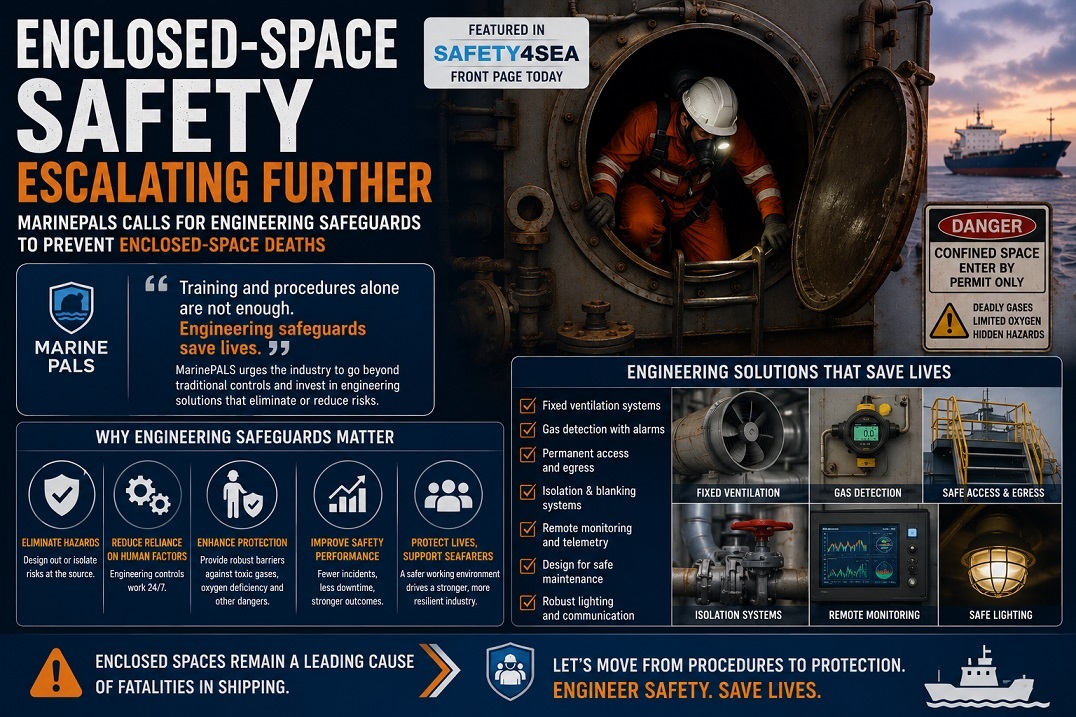
MarinePALS has added a sharper edge to the ongoing industry conversation on enclosed-space fatalities, arguing that the sector needs physical, engineering-level safeguards rather than relying on training updates and paperwork controls alone. The call builds directly on the Nautical Institute’s recent appeal for seafarer safety to remain a shared priority, but pushes the discussion toward a more concrete and arguably more uncomfortable question: why hasn’t the industry engineered the hazard out of the equation by now?
The Argument for Engineering Over Procedure
MarinePALS’ position rests on a well-established safety principle: hazard controls that rely purely on human behaviour, remembering to test the atmosphere, following the permit system, wearing the right equipment, are inherently less reliable than controls built into the physical design of the space itself. A permit-to-work form does nothing to stop an entry if a crew member under time pressure decides to skip it. A hatch that physically cannot be opened without an interlocked gas-detection check does.
What Engineering Safeguards Could Look Like
While specific technical proposals vary across the industry, the general direction points toward interlocked hatch and access systems that require verified atmosphere readings before entry is physically possible, fixed and continuously monitored gas detection in high-risk void spaces rather than relying solely on portable meters, and ventilation systems that can be verified as running before a space is certified safe to enter. The common thread is removing single points of human failure from the critical safety step, rather than adding another layer of paperwork on top of an already procedure-heavy process.
Why This Lands Now
The timing is notable. Enclosed-space deaths have persisted for years despite repeated rounds of STCW-aligned training updates and IMO circulars, and the Nautical Institute’s recent call for shared industry responsibility has already reframed the issue as a systemic one rather than an individual seafarer failing. MarinePALS’ engineering-focused argument is a natural next step in that reframing, shifting the conversation from who is responsible for safety to what physical changes would actually make unsafe entry harder to do by accident or under pressure.
Practical Considerations for Owners and Technical Managers
- Assess newbuild specifications and major retrofit opportunities for interlocked hatch or access control systems on high-risk tanks and voids
- Review whether fixed gas-detection coverage extends to all enclosed spaces with a history of entry, not just those flagged in the vessel’s original design
- Treat portable gas meters as a backup layer rather than the sole line of defence, and budget for engineering upgrades where feasible during scheduled drydocking
- Engage class societies early on any proposed engineering modifications, since interlocked access systems may require class approval and updated stability or fire-safety documentation
The Bottom Line
MarinePALS’ call for engineering safeguards doesn’t dismiss training and procedure, but it does argue those measures have reached their practical limit as the primary defence against enclosed-space deaths. For fleet managers and safety officers, the useful takeaway is to start treating physical, engineered barriers as a genuine investment category in vessel safety upgrades, not a future aspiration, since the incident record suggests procedural controls alone are not closing the gap.
This article is based on publicly reported statements from MarinePALS regarding enclosed-space safety. Operators should consult IMO and class society guidance for current technical and regulatory requirements on enclosed-space access and gas detection.