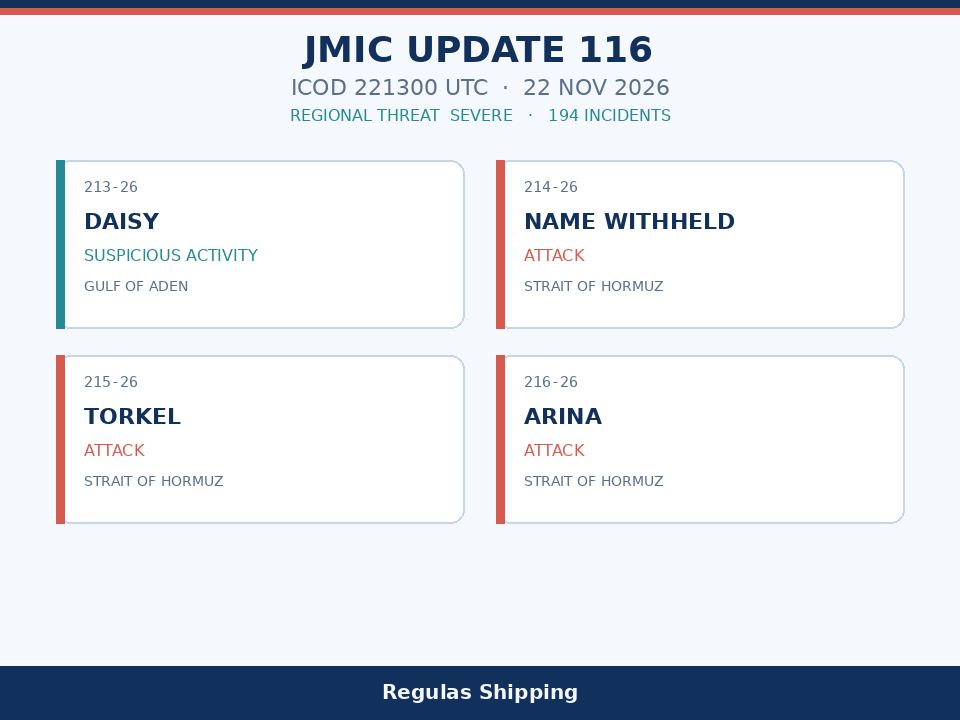
The U.S. Navy-led Joint Maritime Information Center published Update 116 to its regional advisory note with an information cut-off of 221300 UTC on 22 November. The working primary retrieved this run is the numbered PDF posted on the UKMTO product board as jmic_advisory_update_116_22-nov.pdf. The face of the note is titled Update 116 to JMIC Advisory Note, 01 March – 22 November 2026. The information cut-off is printed as ICOD 221300 UTC. The note is printed as JMIC# 001 26. The regional threat level remains SEVERE. The Strait of Hormuz remains SEVERE. The Arabian Gulf remains SUBSTANTIAL. The Gulf of Oman stays MODERATE. The Arabian Sea stays MODERATE. The Gulf of Aden stays SUBSTANTIAL. Bab el-Mandeb / the southern Red Sea stay SUBSTANTIAL. The Somali Coast / Somali Basin stay MODERATE. The Northern Red Sea / Suez Canal stay MODERATE. The Eastern Mediterranean stays LOW. Confirmed vessel incidents since 1 March are now printed as 194. Four incidents are counted since the last report: UKMTO 213-26, UKMTO 214-26, UKMTO 215-26 and UKMTO 216-26.
That is the working primary. Sunday night’s product is a numbered regional instrument, not a Hormuz reopen, not Update 117, and not a rewrite of 8 November’s dedicated Update 112, this morning’s dedicated Warning 216-26, unused Warning 215-26, or tonight’s companion Advisory 217-26. The useful facts for a DPA and a bridge team are the first JMIC conversion of unused 213-26 onto DAISY as Suspicious Activity in the IRTC; the still-withheld 214-26 row; the first JMIC conversion of unused 215-26 onto TORKEL as Attack, identified by NAVAREA IX; the first JMIC conversion of this morning’s dedicated 216-26 onto ARINA as Attack; the 194-incident tally after four counted files; the 19–21 November congestion print of about 167 hulls at Fujairah / Khor Fakkan and about 218 stationary east of the Strait; the 19–21 November U.S.-facilitated Hormuz count of 114; CENTCOM’s 11 November print of nearly 150 redirected and five disabled; GNSS interference about four times its seven-day average over the Gulf of Oman on 21 November; and the outlook that still treats further Hormuz attacks as highly likely, particularly off Musandam. Do not treat the 17 November dedicated IMO 138-count / 25-fatality sheet as a substitute for this numbered note, and do not treat Update 112 as still the current public instrument. Update 116 still withholds 214-26. It still withholds Velos Sapphire against dedicated 196-26. It does not print tonight’s companion 217-26, whose 1425 UTC clock sits after this cut-off.
What Update 116 actually added
The confirmed tape is the body of Update 116. ICOD 221300 UTC 22 November. JMIC# 001 26. Regional threat SEVERE. Four incidents since the last report, counted as 213-26, 214-26, 215-26 and 216-26. Total 194 since 1 March. That is the product. Stay with that wording. Do not invent a fifth counted row for tonight’s companion 217-26; that Advisory sits after the cut-off. Do not invent a Hormuz downgrade. Do not invent a completed Update 117. Do not invent a UKMTO PDF revision of 216-26, unused 215-26 or 214-26. Do not invent a 139th IMO board row on this note. This desk’s last dedicated JMIC note remains Update 112, ICOD 081300 UTC 8 November, 177 incidents. Updates 113 through 115 were not retrieved as dedicated pieces during the ten-day gap on this board. Do not invent their tables. Brief the jump from 177 to 194 as a later instrument, not as four files doing seventeen counts.
On 213-26, Update 116 names the hull. Vessel: DAISY. Vessel type: Bulk Carrier. Event type: Suspicious Activity. Location: Gulf of Aden. The narrative says that on 20 Nov the bulk carrier DAISY, transiting eastbound in the IRTC approx. 95 NM southwest of Al Mukalla, Yemen, was approached by a skiff with six armed persons on board, who fired four shots. The armed security team on board returned warning shots and the skiff moved away. No damage or injuries were reported. Also tied to MSCIO 188/26 in the operational summary. 213-26 was unused as a dedicated UKMTO piece on this desk. Update 116 is the first numbered JMIC print of DAISY against that number. Hold DAISY. Do not invent a flag or an IMO number on this note. Do not convert Suspicious Activity into Attack. Do not invent a boarding, a hijack or a TSS closure. The note says this was the second armed skiff approach southwest of Al Mukalla in four days, after the 17 November incident (UKMTO 210-26); in both cases warning shots from the armed security team ended the approach. 210-26 remains wrap. Do not collapse 210-26 onto DAISY as a second named hull.
On 214-26, Update 116 withholds the name. Vessel: Name withheld UFN. Vessel type: Tanker. Event type: Attack. Location: Strait of Hormuz. The narrative says that on 20 Nov a tanker transiting the Strait of Hormuz outbound was struck on the port bow by an unknown projectile approx. 8 NM north of Khasab, Oman, causing a fire on board. No crew casualties or environmental impact were reported. Also tied to MSCIO 189/26. 214-26, 20 November, 1500 UTC, Company Security Officer, remains wrap, unused as dedicated. Update 116 reprints that clock and still withholds the hull. Do not invent a name. Do not collapse this morning’s dedicated 216-26 onto this 8 NM north offset. Do not collapse unused 215-26 onto it as a stern rewrite. A port-bow fire 8 nautical miles north of Khasab on 20 November is not a stern hit 11 nautical miles north of Khasab on 21 November, and it is not an engine-room hit 17 nautical miles east of Khasab on 21 November.
On 215-26, Update 116 names the hull. Vessel: TORKEL. Vessel type: Tanker. Event type: Attack. Location: Strait of Hormuz. The narrative says that on 21 Nov a tanker, identified by NAVAREA IX as the TORKEL, was struck on the stern by an unknown projectile approx. 11 NM north of Khasab, Oman, while transiting the Strait of Hormuz outbound, causing a fire on board. The vessel was later reported at anchor. No crew casualties were reported. Environmental impact is unknown. Also tied to MSCIO 190/26. Unused 215-26 remains an unnamed Attack on this desk: incident 21 November 2026, 0500 UTC, source Military authorities, tanker outbound, stern, unknown projectile, 11 nautical miles north of Khasab, no reported casualties, environmental impact currently unconfirmed, footer Khasab, Oman, unused as a second dedicated 21 November Khasab piece. Update 116 is the first numbered JMIC print of TORKEL against that number. “Identified by NAVAREA IX” is a JMIC sourcing line. It is not a dedicated conversion of unused 215-26 on this desk, and it is not a revision of the public 215-26 PDF, which still withholds the name. Do not invent a flag or an IMO number on this note. Do not convert unused 215-26 into a dedicated TORKEL UKMTO piece this run. Do not collapse TORKEL onto this morning’s dedicated 216-26. The note adds fire on board, later at anchor, and environmental impact unknown — colour of this JMIC row, not a 215-26 PDF revision. This morning’s dedicated 216-26 correctly held 215-26 as wrap and did not print fire or at-anchor on that unused file.
On 216-26, Update 116 names the hull. Vessel: ARINA. Vessel type: Tanker. Event type: Attack. Location: Strait of Hormuz. The narrative says that on 21 Nov the tanker ARINA, transiting the Strait of Hormuz outbound, was struck in the engine room by an unknown projectile approx. 17 NM east of Khasab, Oman. No crew casualties were reported. Environmental impact is unknown. Also tied to MSCIO 191/26. This morning’s dedicated Warning 216-26 remains an unnamed military-authorities Attack, 0550 UTC 21 November, tanker, engine-room hit, unknown projectile, 17 nautical miles east of Khasab, no reported casualties at this time, environmental impact currently unconfirmed. Update 116 is the first numbered JMIC print of ARINA against 216-26. It is not a revision of the public 216-26 PDF, which still withholds the name. Do not invent a flag or an IMO number on this note. Do not convert “no crew casualties were reported” onto 216-26 as a completed “all crew are safe and accounted for” line. Do not convert “environmental impact is unknown” onto 216-26 as a completed “no environmental impact reported” line. This morning’s PDF still prints no reported casualties at this time and environmental impact currently unconfirmed. Hold both instruments.
The Arabian Gulf operational summary is marked no confirmed attacks or disruptions in this period. Traffic flows continued, with anchorage congestion high across the region. The 24–48-hour outlook is unchanged in kind: multiple attacks inside the Gulf since 07 Oct demonstrate that attacks remain a strong possibility throughout the Arabian Gulf, including the northern and central Gulf, anchorages and STS areas. Electronic interference remains a credible concern, particularly along the UAE coast and off Bahrain and the Saudi east coast. Vessels stationary for extended periods, or maintaining AIS-on while static, may face elevated targeting risk. Do not invent a new Arabian Gulf Attack on this cut-off.
The Strait of Hormuz summary carries three Attacks in the period (UKMTO 214-26, MSCIO 189/26; UKMTO 215-26, MSCIO 190/26; UKMTO 216-26, MSCIO 191/26), against four in the previous period. All three were outbound tankers struck by unknown projectiles 8–17 NM from Khasab, Oman, within about 15 hours on 20–21 Nov; two of them (UKMTO 215-26, 216-26) were struck about 50 minutes apart, the second 17 NM east of Khasab. Seven tankers have been struck in the Strait of Hormuz since 16 Nov. IRGC attacks, attempted attacks and/or harassment activity persisted, including UAV overflight, targeted surveillance of merchant shipping, and occasional VHF hailing. Iranian claims of mine strikes on tankers have not been confirmed by any official or national authorities. Commercial traffic through the Strait remained at reduced levels compared to the 2025 baseline. AIS-visible commercial transits through the Strait of Hormuz remained very low, with no transits by cargo-carrying vessels above 1,000 deadweight tons recorded on S&P tracking on 19–21 Nov. US NCAGS data indicated an average of approx. 38 U.S. assisted transits per day on 19–21 Nov compared to 27 per day on 15–18 Nov. U.S.-facilitated Strait of Hormuz transits 19–21 Nov, the past 72 hours, are printed as 114 against a 2025 baseline of about 138 vessels/day. The outlook says further attacks on tankers transiting the Omani side of the Strait are highly likely, and disabled or anchored vessels remain exposed. AIS-on vessels can expect elevated targeting risk and directed hails instructing them to divert toward the northern Iranian-controlled route. A 30-nautical-mile standoff from U.S. units remains advised. JMIC Advisory Note 016-26 remains the clearance-request tool.
What sits off the list, and the traffic that moved
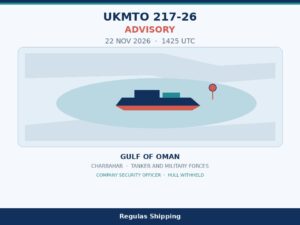
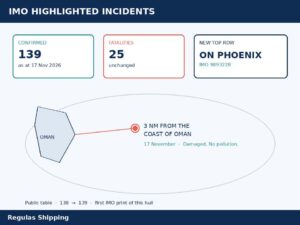
Sunday’s cut-off is 221300 UTC on 22 November. Update 116 does print this morning’s dedicated Warning 216-26, as ARINA. It does print unused 215-26, as TORKEL. It does not print tonight’s companion Advisory 217-26, tanker and military forces, Gulf of Oman, 1425 UTC, Company Security Officer, footer Charbahar, Iran. That Advisory sits 85 minutes after the cut-off. It does not print Velos Sapphire against dedicated 196-26. The IMO highlighted-incidents board remains 138 confirmed / 25 seafarer fatalities as at 17 November, AL DHANNAH (IMO 9783734) the named top row. JMIC’s 194 and IMO’s 138 are different datasets. Do not back-fit an IMO hull onto a 221300 UTC JMIC sheet that still reads Name withheld UFN on 214-26.
The Gulf of Oman summary is marked no change on confirmed attacks. No confirmed attacks or disruptions were reported in this period. Naval presence remained elevated due to blockade enforcement activity. According to official CENTCOM figures issued on 11 Nov, nearly 150 commercial vessels have been redirected and five merchant ships have been disabled as a result of blockade enforcement. Two vessels had previously been reported boarded for blockade compliance. No further blockade-enforcement disablement was announced in this period. Vessels were expected to respond promptly to military queries and maintain AIS-on unless constrained by security threats. Neutral vessels between non-Iranian ports may be questioned, visited and searched under the blockade and should be prepared to provide the documentation noted in JMIC Advisory Note 016-26. A 30-nautical-mile standoff from U.S. units remains advised, as well as continuous monitoring of VHF Channel 16. Unauthorized entry or departure may result in interception or force. Do not treat the nearly-150 / five figures as a 198-26 PDF revision, and do not treat them as a 217-26 naming. Update 112’s CENTCOM line was still dated 7 November: 147 redirected, five disabled. Sunday night is a later 11 November print on this note, still five disabled.
The Arabian Sea paragraph is marked no confirmed attacks or disruptions. Residual risk persists due to broader regional tensions. The southwest monsoon has ended and small-craft operations farther offshore are more feasible, as seen by the armed skiff approach, with a possible mothership, reported in UKMTO 206-26 and MSCIO 181/26. NAVAREA IX 441/26 warns vessels to keep well clear of the position. 206-26 and 441/26 remain wrap, unused as dedicated this run.
The Gulf of Aden paragraph carries 213-26 / MSCIO 188/26 as the one Suspicious Activity in the period. Commercial traffic remained relatively steady. Sea conditions in the Gulf of Aden remain favourable for skiffs, with winds of about 15–20 kt and seas around 1 m, stronger near Bab el-Mandeb. The milder northeast monsoon (December–March) is expected to keep conditions suitable for skiff and mothership operations. MSCIO continues to advise strict adherence to BMP-MS.
Southern Red Sea and Bab el-Mandeb are marked no confirmed attacks or disruptions in this period. Houthi forces hold the Red Sea coastal positions vacated by government-aligned forces on 15 Nov, and Houthi ground pressure toward Aden continues. No corroborated attack on commercial shipping in the Red Sea has been reported since 24 August 2026. Traffic remains below the 20 July Houthi selective embargo. Commercial traffic in the Bab el Mandeb recorded approx. 23 transits per day on S&P tracking on 19–21 Nov, against approx. 19 per day on 15–18 Nov. The 72-hour BAM total is printed as 68 cargo-carrying vessels above 1,000 deadweight tons against a 2023 baseline of about 61 per day. Bab el-Mandeb remains open to commercial traffic but is considered volatile. Houthi statements continue to assert that non-Saudi commercial shipping may transit safely. On 20 Nov the Saudi-led coalition struck Hodeidah port facilities after ordering an evacuation. Houthi claims of strikes on Jizan port and Houthi media claims of a strike on Mokha port have not been independently confirmed. The Houthi threat of 20 Nov against Jeddah and all Saudi Red Sea ports, issued after the coalition strike on Hodeidah, raises the risk to Saudi ports and to ships alongside them. MT ASANA, the Tanzanian-flagged product/chemical tanker hijacked on 17 July approximately 65 NM southwest of Mukalla, is still the one merchant vessel remaining hijacked.
The Somali Coast and Somali Basin paragraph is marked no change. PAG activity remains possible. The 13 Nov hijack of a fishing vessel near Hobyo (MSCIO 179/26) and the 16 Nov approach by an armed skiff with a possible mothership about 430 NM east of Socotra (UKMTO 206-26, MSCIO 181/26) show reach well offshore. Fishing vessels and dhows remain exposed. Infrastructure colour is unchanged in kind on offshore platforms: no attack on offshore platforms or subsea infrastructure was reported in this period. The overall infrastructure risk remains MODERATE.
Port and anchorage congestion is printed as of 22 November. Fujairah / Khor Fakkan was high and broadly stable with slight easing, from about 188 vessels on 19 Nov to about 167 on 22 Nov. Dubai / Jebel Ali to Ras Al Khaimah was broadly unchanged, from about 138 to about 136. Musandam / Sohar rose slightly on a small base, from about 46 to about 51. Bandar Abbas / Qeshm was broadly unchanged on a small, low-confidence base, from about 11 to about 10. There was no mass departure, new cluster or gap near the attack area off Khasab. JMIC internal tracking counted approx. 218 commercial vessels stationary at the main anchorages east of the Strait of Hormuz (Fujairah, Khor Fakkan, Sohar and Musandam), against no AIS-visible transits by cargo-carrying vessels above 1,000 deadweight tons recorded on S&P tracking on 19–21 Nov; the backlog is expected to persist. Stationary AIS-on hulls may face elevated targeting risk. Do not restore Update 112’s 208-vessel wait or 162-hull Fujairah print as figures on this note. Those sentences sat on Update 112. They are not reprinted here.
GNSS / AIS interference stayed high over the Gulf of Oman on 21 Nov, at about four times its 7-day average, and strengthened for a second day along the Oman Batinah coast and at sea off Sohar, with strong indications also off Fujairah. These new indications along the Batinah coast off Sohar were observed in aircraft signals and have not been confirmed by ship reports or official notices. In the Arabian Gulf, indications rose again, strongest along the UAE coast (Dubai/Sharjah), and returned over Bahrain and the Saudi east coast. Windward recorded 350 jammed vessels of 5,324 transmitting in the Gulf and Gulf of Oman on 19 Nov, about 22 percent above its 7-day average. UKMTO’s weekly VRA report (20 Nov) recorded two vessel GNSS reports in seven days and 11,682 anomalous AIS positions, against 15,374 the week before, and kept the Red Sea, Gulf of Oman and Arabian Gulf as hotspots. In the Red Sea and Bab el-Mandeb, no significant GNSS interference was observed at sea; Windward recorded 32 jammed vessels of 994 transmitting in the Red Sea on 19 Nov. No new specific UKMTO, MARAD, NAVCENT or NAVAREA IX GNSS/EMI notices were issued 19–22 November. Baseline advisories remain in force. Cross-check with radar and visual navigation.
The annex is independent traffic colour. Independent cargo-vessel transits through the Strait, S&P Maritime / SeaVision, excluding Iranian-port callers, are printed as 0, 2, 0, 0, 0, 0 and 0 for 15–21 November. Independent tanker transits for the same week are 1, 2, 0, 0, 0, 0 and 0. Bab el-Mandeb cargo totals for those seven days are 14, 16, 13, 6, 9, 12 and 24. Bab el-Mandeb tanker totals are 7, 9, 5, 7, 6, 6 and 11. U.S.-facilitated Strait of Hormuz transits for 19–21 November, the past 72 hours, are printed as 114. Do not add those independent figures to the 114 U.S.-facilitated count. UKMTO’s own transit, latest-incidents and AIS-anomaly boards are printed as annex headings, marked updated 19 November, which is before this 20–21 November Attack cluster.
What this is not
This is not Update 117, and it is not a rewrite of dedicated Update 112. Update 112, ICOD 081300 UTC 8 November, remains the previous dedicated numbered public periodic note on this desk, 177 incidents, five counted files through 200-26, first JMIC naming of HUDA against dedicated 198-26. Update 116 replaces it as the current public instrument. Masters who still brief the region as Update 112 will have the wrong instrument in the folder. Masters who brief Sunday night as Update 117 will have invented a later cut-off this desk has not retrieved. Do not invent Updates 113–115 as dedicated pieces. They were not converted on this board during the ten-day gap.
This is not a rewrite of 216-26, and it is not a UKMTO PDF naming of ARINA. Dedicated Warning 216-26 remains an unnamed military-authorities Attack, 0550 UTC 21 November, engine room, 17 nautical miles east of Khasab, no reported casualties at this time, environmental impact currently unconfirmed. Update 116 is the first numbered JMIC print that names ARINA against 216-26. Two instruments. Do not collapse them into one “UKMTO named ARINA on 216-26” sentence. Do not invent a flag or an IMO number on this note.
This is not a dedicated conversion of unused 215-26, and it is not a UKMTO PDF naming of TORKEL. Unused 215-26 remains unused as a second dedicated 21 November Khasab piece. Update 116 is the first numbered JMIC print that names TORKEL against that number and attributes the identification to NAVAREA IX. “Identified by NAVAREA IX” is a JMIC sourcing line. Do not convert unused 215-26 into a dedicated TORKEL UKMTO piece this run. Do not invent a flag or an IMO number on this note. Do not collapse TORKEL onto ARINA because both print Khasab on 21 November.
This is not tonight’s companion Advisory 217-26, and it is not a Chabahar naming. Dedicated 217-26 remains an unnamed tanker-and-military-forces Advisory, 1425 UTC 22 November, Company Security Officer, Gulf of Oman, footer Charbahar, Iran. That clock sits after 221300 UTC. Do not brief Sunday night as “Update 116 named the Chabahar tanker.” Update 116 does not print 217-26.
This is not an International Maritime Organization 139-count. The dedicated IMO highlighted-incidents board remains 138 confirmed / 25 seafarer fatalities as at 17 November, AL DHANNAH top row. JMIC’s 194 and IMO’s board are different datasets. Wednesday’s dedicated JMIC Advisory Note 016-26 remains the blockade visit-and-search document pack; Update 116 reprints the pack, it does not replace it. This is not this morning’s companion NAVWARN 865-26, and it is not unused 864-26, unused 860-26 BETUL 8, unused 862-26, dedicated 1379/2026 Aethra, or dedicated 1375/2026 Koskina. Iranian mine-strike claims remain unconfirmed on this note. Do not promote Mehr News onto the 194-count.
Operational implications
A numbered JMIC update is a routing and manning problem before it is a count of who was hit. Hormuz is still SEVERE, with deliberate attacks called highly likely, AIS-on targeting risk, directed hails toward the northern Iranian-controlled route, and a specific watch for attempted mining within and adjacent to the traffic-separation scheme. That guidance did not move because four more files cleared the table. The Arabian Gulf column did not move either. It stays SUBSTANTIAL. What moved is the DAISY naming against unused 213-26, the still-withheld 214-26 row, the TORKEL naming against unused 215-26, the ARINA naming against dedicated 216-26, the incident tally from this desk’s last dedicated 177 to 194, the congestion print from Update 112’s 8 November figure of about 162 hulls at Fujairah / Khor Fakkan to about 167 on 22 November, the east-of-strait wait from about 208 to about 218, the facilitated count from 91 over 5–7 November to 114 over 19–21 November, independent AIS-visible Strait cargo transits to zero on 19–21 November, CENTCOM from 147 redirected / five disabled as at 7 November to nearly 150 redirected / five disabled as at 11 November, and the GNSS colour from Windward’s 5 November 154 jammed print to a 19 November 350 jammed / 5,324 transmitting print, about 22 percent above its seven-day average. Masters who still brief the region as Update 112 will have the wrong instrument in the folder. Masters who brief Sunday night as a Hormuz downgrade will have the wrong scale on the chart.
The ARINA and TORKEL paragraphs are a briefing-discipline problem, not new casualties on the UKMTO PDFs. This morning’s dedicated 216-26 left a tanker unnamed against a 0550 UTC engine-room clock 17 nautical miles east of Khasab. Unused 215-26 left a tanker unnamed against a 0500 UTC stern clock 11 nautical miles north of Khasab. Update 116 is the first numbered JMIC note that prints ARINA against 216-26 and TORKEL against 215-26, the latter identified by NAVAREA IX. A master’s pack that briefs “UKMTO named ARINA” has over-read a JMIC row. A pack that briefs 214-26 as TORKEL because 215-26 is now TORKEL will have ignored Update 116’s Name withheld UFN on the 20 November port-bow fire. Hold the PDFs, the unused 215-26 wrap, this note, and the 17 November IMO 138-count as separate sheets.
The Fujairah density and the 218-vessel east-of-strait wait are the other operator facts. Update 116 parks that density against a Strait that printed independent cargo transits of 0, 0 and 0 on 19–21 November and independent tanker transits of 0, 0 and 0, with U.S.-facilitated transits averaging about 38 per day. Three Hormuz Attacks in the period sit on this note, with no mass departure from the east-of-strait anchorages. Fujairah / Khor Fakkan eased slightly from about 188 to about 167. Vessels stationary for extended periods, or maintaining AIS-on while static, may face elevated targeting risk. Harbour assists, wreck response and disabled-hull tows operating in that density are in the same watch as shuttle tankers. AIS-off is not a detection shield and is not an order on this note. Do not merge ARINA’s 17 NM east-of-Khasab offset onto the Fujairah line, and do not merge TORKEL’s 11 NM north-of-Khasab stern hit onto it. Disabled or anchored vessels remain exposed; Update 116 prints TORKEL later at anchor as a JMIC fact, not as a 215-26 PDF revision.
CSOs should replace the 8 November Update 112 pack with Update 116 in the master’s folder and in the charterer’s security clause file. The new named lines are 213-26 DAISY, bulk carrier, Suspicious Activity, IRTC approx. 95 NM southwest of Al Mukalla, skiff with six armed persons, four shots, warning shots returned, no damage or injuries; 215-26 TORKEL, tanker, Attack, identified by NAVAREA IX, stern, unknown projectile, 11 NM north of Khasab, fire, later at anchor, no crew casualties, environmental impact unknown; and 216-26 ARINA, tanker, Attack, engine room, unknown projectile, 17 NM east of Khasab, no crew casualties, environmental impact unknown. The still-withheld line is 214-26, tanker, Attack, port bow, 8 NM north of Khasab, fire, no crew casualties, no environmental impact. The new tally is 194 since 1 March. The new congestion line is about 167 hulls in the vicinity of Fujairah / Khor Fakkan as of 22 November and about 218 stationary at the main east-of-strait anchorages. The new facilitated count is 114 U.S.-assisted Hormuz transits over 19–21 November. The new CENTCOM line is nearly 150 redirected and five disabled as at 11 November. The new GNSS colour is Windward’s 19 November print of 350 jammed vessels of 5,324 transmitting, and UKMTO’s 20 November VRA print of two GNSS reports and 11,682 anomalous AIS positions. None of those edits is a flag circular, a class condition, or a completed MARPOL finding. Do not replace this morning’s dedicated 216-26 PDF, unused 215-26, tonight’s companion 217-26, Wednesday’s dedicated 016-26 pack, or the 17 November dedicated IMO 138-count. They are different instruments. Update 116 is the numbered regional threat note that now sits on top of Update 112.
For a master already shaping Musandam, holding off Fujairah or Khor Fakkan, or still needing a blockade clearance, Sunday night is a document-pack and lookout problem before it is a policy problem. 016-26 remains the working visit-and-search list. Update 116 reprints it; it does not shorten it. Channel 16, the UKMTO emergency line, the MSCIO emergency line and the company duty officer still have to be on the night orders. Registering with one mailbox is not a substitute for the other. Update 116 does not order a daylight-only transit or a halt to visit-and-search compliance. It also does not authorise a master to treat every AIS-on tanker east of Khasab as ARINA, or every tanker fire off Khasab as TORKEL, after the fact. Unused 215-26 remains a separate unnamed stern hit on this desk. This morning’s dedicated 216-26 remains a separate unnamed engine-room hit on the public PDF. Tonight’s companion 217-26 remains a separate unnamed Charbahar Advisory after this cut-off.
Charterers, P&I and war-risk underwriters will now ask whether the ship was in the Voluntary Reporting Area after 221300 UTC 22 November, whether it was off Musandam after the seven tanker strikes since 16 November, whether it was 17 NM east of Khasab after the ARINA row, whether it held the 016-26 pack, and whether it was following BMP-MS. They will not be answered by this morning’s 216-26 unnamed engine-room hit, by unused 215-26’s unnamed stern hit, by the 17 November 138-count, or by a headline that one JMIC naming closed the 216-26 PDF. Off-hire and deviation conversations that treat Update 116 as a completed Hormuz reopen, or as a UKMTO PDF naming of ARINA, have misread the cut-off.
Keep the dedicated files on their own lines. Dedicated 216-26 remains this morning’s dedicated unnamed engine-room Attack 17 NM east of Khasab; ARINA on this note is wrap on that PDF, not a UKMTO naming. Unused 215-26 remains unused as dedicated; TORKEL on this note is wrap, identified by NAVAREA IX, not a dedicated 215-26 conversion. 214-26 remains Name withheld UFN on this table, unused as dedicated. 213-26 / DAISY is wrap on this note, unused as a dedicated UKMTO piece. Dedicated 217-26 remains tonight’s companion unnamed Charbahar Advisory, after this cut-off. Dedicated 198-26 remains 7 November’s dedicated unnamed bulk-carrier Advisory; Huda on Update 112 remains wrap on that PDF. Dedicated 197-26 remains 6 November’s unnamed waterline explosion 16 NM east of Khasab. The IMO 138-count remains as at 17 November, AL DHANNAH top row, unused as a 216-26 naming. 016-26 remains the blockade document pack. This morning’s dedicated NAVWARN 865-26 remains GaS Husky southeast of Cape Kaliakra. Do not recast 22 November night as a Hormuz reopen, as a UKMTO PDF naming of ARINA, as Update 117, as an IMO 139-count, or as a corridor closure.
What Operators Should Note
- Log Update 116, ICOD 221300 UTC 22 November, not a Hormuz downgrade. JMIC# 001 26. Filename
jmic_advisory_update_116_22-nov.pdf. Regional threat SEVERE. Hormuz SEVERE. Arabian Gulf SUBSTANTIAL. Gulf of Oman MODERATE. Arabian Sea MODERATE. Gulf of Aden SUBSTANTIAL. Bab el-Mandeb / southern Red Sea SUBSTANTIAL. Somali Coast / Somali Basin MODERATE. Northern Red Sea / Suez MODERATE. Eastern Mediterranean LOW. 194 incidents since 1 March. Four counted files since the last report (213-26, 214-26, 215-26 and 216-26). Replace Update 112 in the master’s pack. This desk’s last dedicated JMIC note was Update 112, 177 incidents, 8 November. Do not invent Updates 113–115 as dedicated tables. Do not confuse this numbered note with the 17 November dedicated IMO 138-count, and do not stretch it to an IMO 139-count this desk has not retrieved. Do not print tonight’s companion 217-26 on this cut-off. - Type the ARINA and TORKEL rows as JMIC typed them, and hold the dedicated 216-26 PDF beside them. ARINA, tanker, Attack, engine room, unknown projectile, 17 NM east of Khasab; no crew casualties reported; environmental impact unknown. Dedicated 216-26 remains unnamed Attack, 0550 UTC 21 November, no reported casualties at this time, environmental impact currently unconfirmed. TORKEL, tanker, Attack, identified by NAVAREA IX, stern, unknown projectile, 11 NM north of Khasab, fire, later at anchor, no crew casualties, environmental impact unknown. Unused 215-26 remains unused as dedicated. “Identified by NAVAREA IX” is a JMIC sourcing line, not a 215-26 PDF revision. Do not invent a flag or an IMO number on this note. Do not brief ARINA as a UKMTO PDF naming. Do not convert unused 215-26 into a dedicated TORKEL UKMTO piece this run.
- Leave 214-26 as Name withheld UFN, and carry DAISY as wrap. 214-26 remains tanker, Attack, port bow, unknown projectile, 8 NM north of Khasab, 20 November, fire, no crew casualties, no environmental impact, unused as dedicated. DAISY, bulk carrier, Suspicious Activity, IRTC approx. 95 NM southwest of Al Mukalla, skiff with six armed persons, four shots, warning shots returned, no damage or injuries; MSCIO 188/26 wrap. Unused as a dedicated UKMTO piece. Do not convert Suspicious Activity into Attack. Do not invent a flag or an IMO number. Do not collapse 210-26 onto DAISY. Do not collapse 214-26 onto TORKEL or ARINA.
- Treat the Fujairah density and the 218-vessel east-of-strait wait as live routing, not as a published closure. About 167 vessels were at anchor IVO Fujairah / Khor Fakkan as of 22 November, eased from about 188 on 19 November; about 136 Dubai / Jebel Ali to Ras Al Khaimah; about 51 Musandam / Sohar; about 10 Bandar Abbas / Qeshm. About 218 stationary at Fujairah, Khor Fakkan, Sohar and Musandam against no AIS-visible cargo transits above 1,000 deadweight tons on 19–21 November. U.S.-facilitated Hormuz transits 19–21 November: 114, about 38 per day against 27 per day on 15–18 November. Independent Strait cargo series 15–21 November: 0, 2, 0, 0, 0, 0, 0. Independent tanker series: 1, 2, 0, 0, 0, 0, 0. CENTCOM as at 11 November: nearly 150 redirected, five disabled. Do not add those series into one throughput figure. Do not restore Update 112’s 208-vessel wait or 162-hull Fujairah print. Stationary AIS-on hulls may face elevated targeting risk. Disabled or anchored vessels remain exposed.
- Keep the 016-26 pack, the mining watch and the raised GNSS baseline. Update 116 reprints Advisory Note 016-26: last-port clearance, bill of lading, registry, agent letter, receipts or contracts, berth booking, VHF 16, 30-nautical-mile standoff from U.S. units, NAVCENT NCAGS mailbox. AIS-on targeting risk and directed hails toward the northern Iranian-controlled route remain. Attempted mining within and adjacent to the TSS remains on the outlook. Iranian mine-strike claims have not been confirmed by any official or national authorities. Windward’s 19 November print is 350 jammed vessels of 5,324 transmitting in the Gulf and Gulf of Oman, about 22 percent above its seven-day average. GNSS interference stayed high over the Gulf of Oman on 21 November, about four times its seven-day average, including new aircraft indications along the Batinah coast off Sohar that have not been confirmed by ship reports. UKMTO’s 20 November VRA report recorded two GNSS reports and 11,682 anomalous AIS positions. No new UKMTO, MARAD, NAVCENT or NAVAREA IX GNSS/EMI notice was issued 19–22 November. Cross-check with radar and visual navigation.
- Do not recast Sunday night as Update 117, as a 217-26 row, or as a completed mid-November tape. 213-26 through 216-26 now sit on this table. One of the UKMTO files remains unnamed on the note. Asana is still hijacked. Seven tankers have been struck in Hormuz since 16 November. Tonight’s companion 217-26 sits after this cut-off. Watch a later JMIC cut-off, a UKMTO PDF that prints ARINA or TORKEL, a 216-26 revision of the unconfirmed environmental line, an IMO 139-count, or tonight’s companion 217-26 as a separate sheet — not a headline that Sunday night reopened Hormuz or completed a UKMTO naming.
Regulas Shipping will keep lining Update 116’s 221300 UTC cut-off against dedicated Warning 216-26, unused Warning 215-26, and tonight’s companion Advisory 217-26 so operators can treat Sunday night’s ARINA and TORKEL namings, the 194-incident tally and the 218-vessel east-of-strait wait as a live routing pack, not as a Hormuz reopen or a completed Update 117.