Fire Breaks Out Aboard Chemical Tanker Bergstraum Off Norway, Crew Safe After Cross-Border Response
July 2026 | Accidents & Incident Desk
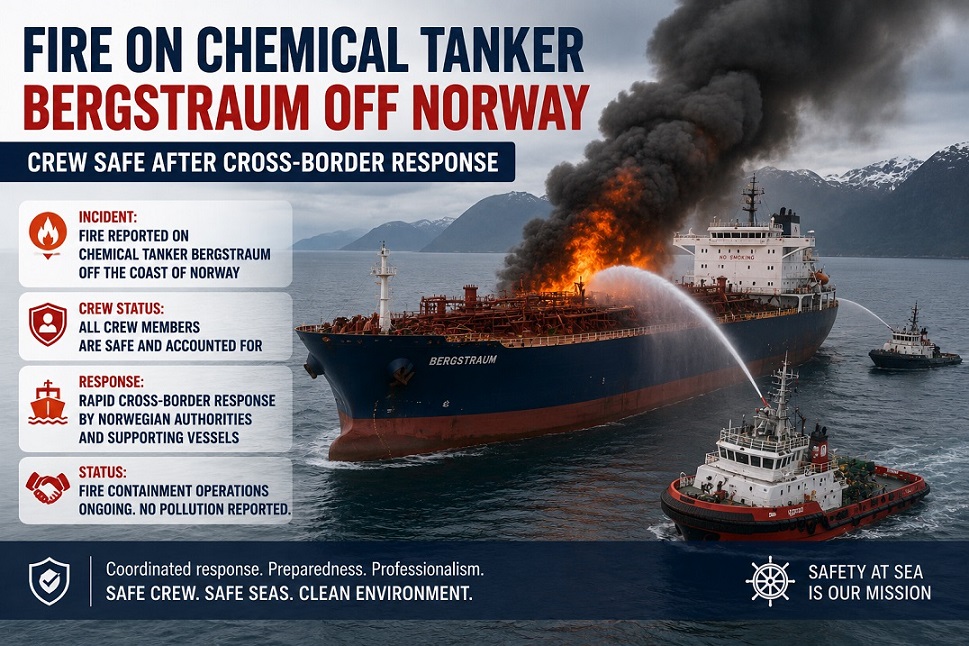
A fire broke out aboard the Norwegian-registered chemical tanker Bergstraum on 28 July 2026 while the vessel lay at anchor off Hvaler, near Fredrikstad, carrying a cargo of sulfuric acid. The incident, described as involving an explosion-like event, triggered a rapid, cross-border emergency response, and was brought under control with all 15 crew members accounted for and uninjured.
How the Incident Developed
The Bergstraum was anchored in Norwegian coastal waters when the fire ignited, prompting an immediate distress alert. Early, unconfirmed reports suggested the vessel may have run aground, but Norwegian authorities later withdrew that assessment and confirmed the tanker remained at anchor throughout the incident. The crew moved quickly to attack the fire directly, applying foam to bring the flames under control while continuing cooling operations to manage residual smoke and heat.
A Response That Crossed National Lines
What stands out about this incident is the scale and speed of the mutual-aid response. Local police, fire and rescue services mobilised alongside the Norwegian Coast Guard and a rescue helicopter, and Sweden sent vessels across the border to assist, a reminder of how closely Nordic maritime emergency services coordinate in shared waters like the Skagerrak and the approaches to the Oslofjord. That kind of fast, multi-agency, cross-border mobilisation is exactly what limited this incident to a contained fire with no injuries, rather than something far more serious.
Why the Cargo Made This a High-Stakes Response
Sulfuric acid is a corrosive, reactive cargo, and a fire aboard a vessel carrying it raises immediate concerns beyond the blaze itself: tank integrity, the risk of a hazardous release into a populated coastal area, and the potential for the fire to compromise cargo containment systems. The fact that responders treated this as a full-scale emergency, deploying a helicopter and cross-border vessel support for what was ultimately a contained fire with no injuries, reflects appropriately cautious protocol given what was at stake if the situation had escalated.
Takeaways for Chemical Tanker Operators
- Review onboard firefighting readiness specifically for anchored, laden conditions, since this incident occurred at anchor rather than underway, where response assumptions can differ
- Confirm mutual-aid and cross-border emergency response arrangements are documented and understood by masters operating in shared coastal waters, not just assumed to exist
- Reassess crew drills for corrosive-cargo fire scenarios specifically, given the added containment and exposure risks compared to a general cargo or engine room fire
- Maintain clear, early communication with shore authorities to avoid the kind of early misinformation seen here, where initial grounding reports had to be walked back
The Bottom Line
The Bergstraum fire ended without injury largely because two things worked as intended: the crew’s own firefighting response and a well-coordinated, multi-nation emergency mobilisation. For operators running chemical tankers through Nordic and other tightly linked coastal waters, this incident is a useful reminder that cross-border SAR and firefighting cooperation isn’t just a policy document, it’s an operational capability that needs to actually function when a hazardous cargo fire breaks out at anchor.
This article is based on publicly reported details of the fire aboard the chemical tanker Bergstraum off Hvaler, Norway, on 28 July 2026. Final findings on the cause of the fire were not confirmed at the time of writing.