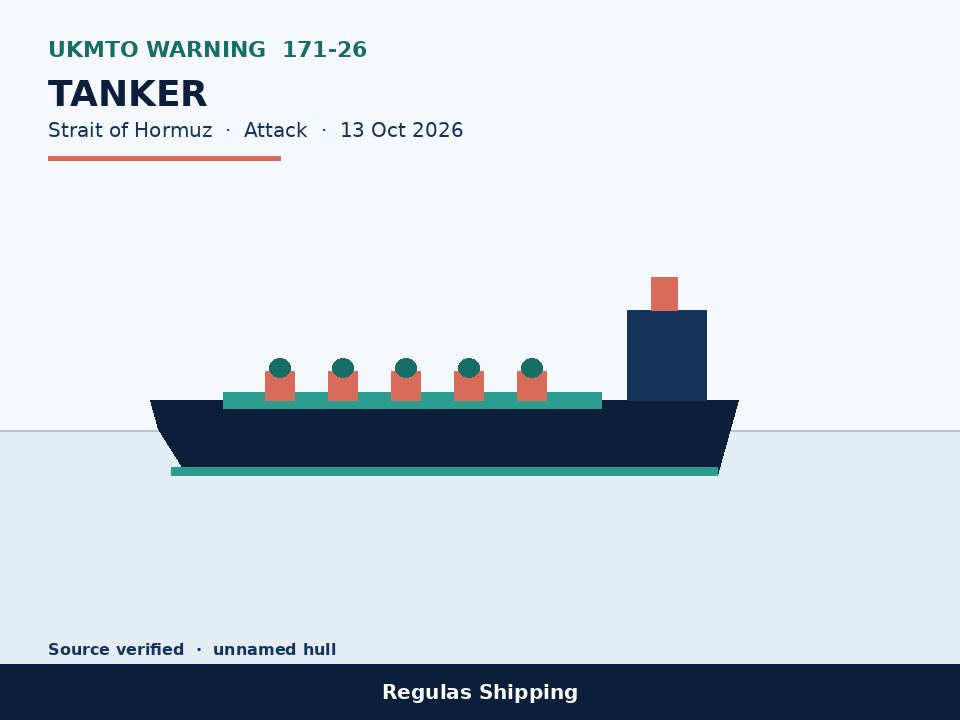
The United Kingdom Maritime Trade Operations centre issued Warning 171-26 on Tuesday, 13 October. It is an Attack product, source verified, incident date 13 October, time to be confirmed. UKMTO said it had received a report of an incident within the Strait of Hormuz. A verified source reported that a tanker was struck by an unknown projectile. Authorities are investigating. Vessels are advised to transit with caution and report any suspicious activity to UKMTO. The official PDF named neither hull, flag, cargo grade, projectile type, inbound or outbound heading, fire location, crew status, damage, environmental impact, position nor a responsible party.
That is the working primary. 171-26 is a same-day Hormuz tanker Attack file, not a time-late reprint of Monday’s dedicated Warnings 166-26, 168-26 and 169-26, and not a rewrite of Sunday’s Joint Maritime Information Center Update 104. Those Monday products were issued 12 October as time-late reports of 11 October hits — an outbound tanker with a crew-safe line, an outbound products tanker, and an outbound crude-oil tanker. Tuesday’s product prints a new incident date of 13 October, does not use the time-late formula, and does not print a heading, a cargo grade or a crew-safe line. Anadolu Agency and Iran International, writing Tuesday evening, both confirmed the notice named neither vessel and gave no casualty, damage or responsibility line. The time remained unconfirmed. Do not invent a VLCC, a Suezmax, a flag or a fire location to fill the PDF gap.
What UKMTO published on Tuesday, and what it left open
171-26 is an Attack warning, not a suspicious-activity note and not an Advisory. The verified-source line is short: tanker, unknown projectile, Strait of Hormuz, investigating. UKMTO did not say the ship was on fire. It did not say the ship was underway, adrift, at anchor or under tug after the hit. It did not report how many people were on board. It did not print a damage line or an environmental snapshot. Monday’s 166-26 outbound tanker at least printed crew safe and environmental impact unknown. Tuesday’s product prints neither. Those omissions are the operational fact, not an all-clear.
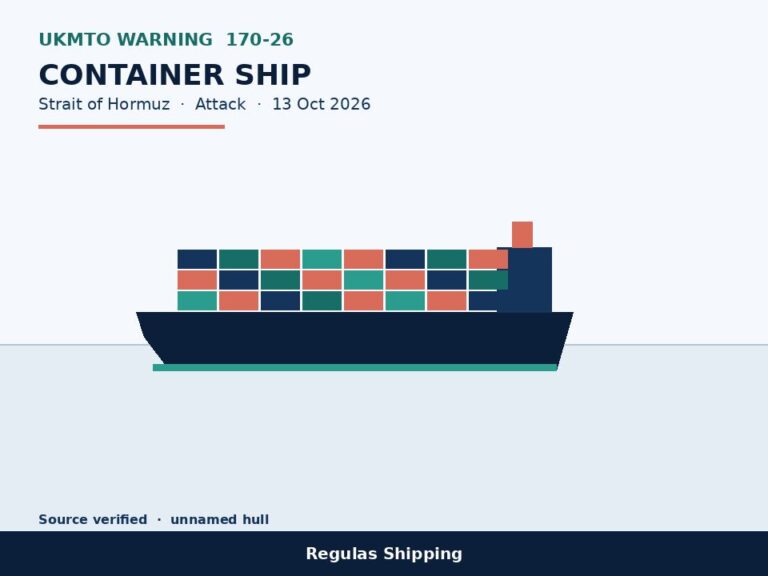
Hold the source tag and the clock. 171-26 is source verified, incident date 13 October, time TBC. Incident-tracking colour first logged Warning 170-26, Tuesday’s unnamed container ship, at about 1904 UTC, and 171-26 about two minutes later. TradeWinds published a joint tanker-and-container read at 1955 UTC, updated at 2138 UTC, under a line that Iranian media accounts and video purported to show a tanker ablaze in the strait. Anadolu followed at 2239 UTC. Those newspapers wrapped two official products. They did not merge the files and they did not convert the Iranian video into a UKMTO naming. Stay with “unknown projectile.” UKMTO did not name a UAV, a missile, a mine or the Islamic Revolutionary Guard Corps.
The geography is the Strait of Hormuz. UKMTO did not print a traffic-separation-scheme lane, a Musandam range, an eastern-Strait mark, or a territorial-sea call. OSINT colour timed an eastern-Strait fire clip at 1457 UTC on 13 October and said the IRGC Navy published the footage after hitting an oil tanker. That range and that attribution are not on the official PDF. Do not invent a latitude and longitude. Do not brief a coastal-state finding that UKMTO did not make.
A new 13 October tanker, not a 166–169 reprint
Monday’s dedicated four time-late warnings remain on their own clocks. 166-26 is an 11 October outbound tanker, crew safe, environmental impact unknown. 168-26 is an outbound products tanker. 169-26 is an outbound crude-oil tanker. 167-26, on the same Monday tape, is the inbound container, not this file. Tuesday’s 171-26 is a 13 October tanker with no heading and no crew line. Do not collapse Tuesday into Sunday’s six-ship wrap. Do not add 171-26 to Seatrade’s October running tally as if it were another 11 October time-late report.
Update 104, information cut-off 111500 UTC on 11 October, remains the last numbered JMIC regional note on the bridge. It held the Strait of Hormuz at SEVERE, printed confirmed files through 164-26 — including the unnamed outbound with steering-gear-room and port-water-tank damage then proceeding to Fujairah — and did not print 165-26 through 171-26. Tuesday’s tanker sits outside that cut-off. Do not treat Update 104 as a Tuesday all-clear for an outbound or inbound Hormuz tanker. Do not rewrite Update 104 on the strength of one later unnamed warning. NAVAREA IX 363/26 remains in force to 142359 UTC on 14 October. Update 104 assessed that warning as likely fishermen warning shots. It is not a tanker routing order and it expires tonight.
The dedicated 12 October 03:30 Warning 164-26 piece remains the Sunday 1200 UTC company-security-officer outbound: port-side unidentified projectile, damage, all crew safe, no environmental impact reported at the time of the attack, later Indian naming of Marshall Islands MT Valthera. The dedicated 12 October 03:30 Warning 165-26 piece remains the Sohar-anchorage UAV Attack and India’s Nicaragua-flagged MT Petro Dolphin naming. Tuesday does not reprint those hulls. Tuesday also does not name GEM NO.2, Ocean Molica, NV Sunshine or ST1.
What the Iranian video does not settle
TradeWinds, writing Tuesday evening, said Iranian media accounts and video purported to show a tanker ablaze in the strait. That is competing colour on the same night as 171-26. It is not a UKMTO fire line. The official PDF printed neither fire nor damage. A CSO can hold those two desks without forcing them into one completed class survey: an unnamed verified Attack warning, and an Iranian video of a burning tanker that UKMTO has not adopted.
The Al Maqam file stays where Monday’s dedicated 166-26 to 169-26 piece left it. Islamic Revolutionary Guard Corps-affiliated Tasnim published video of a tanker on fire that, on the IRGC account, had been making an unauthorised transit. Seatrade described an apparently laden Liberia-flag VLCC, Al Maqam, with a fire-blackened funnel and a tug attempting to extinguish a fire. TradeWinds identified the 298,800-dwt VLCC Al Maqam, built 2017, and said the UAE-based owner declined to comment. Maritime Executive said unverified stern footage displayed the name of the UAE-owned tanker Al Maqam, IMO 9732577, and that the timing — and whether the ship was the tanker in UKMTO’s Monday report — was not immediately clear. ADNOC Logistics & Services had not commented in those primaries. Open-register colour only: IMO 9732577, MMSI 636026818, call sign A8YN4, Liberia, 2017, about 333 × 60 metres, about 154,139 gt / 298,767 dwt, registered owner Al Maqam Inc. A later tracker recap of the same Tasnim clip on 14 October is recirculation of that unused colour, not a new UKMTO naming. Do not assign Al Maqam to 171-26. Do not brief a confirmed IRGC naming of Tuesday’s tanker.
Al Arabiya’s Monday IRGC Navy line — a supertanker hit after disabling transponders and ignoring warnings — and IRGC naval commander Ali Ozmaei’s hostile-transponder line remain Iranian messaging. They are not a UKMTO routing order and not a licence to go dark. Anadolu’s standing context on designated IRGC transit routes is the political backdrop, not a finding that the 171-26 tanker was on an unauthorised lane.
What this is not
171-26 is not a rewrite of Monday’s dedicated 166-26, 168-26 or 169-26. The incident date and the time-late tag differ. It is not Warning 170-26, which is Tuesday’s unnamed container ship on a separate PDF. It is not Sunday’s dedicated 164-26 CSO outbound or 165-26 Sohar UAV. It is not Advisory 163-26’s Gulf of Oman military file. It is not a JMIC Update 105. It is not a UKMTO naming of Al Maqam, Valthera, Petro Dolphin or Angola Prosperity.
Do not fold Tuesday’s tanker into Yanbu loadings, the 9 October OFAC/State 22-tanker package, Oman’s Article 10 AIS-on territorial-water rule, or Iran’s Persian Gulf Strait Authority declaration channel. Those are crude-export, sanctions and coastal-state products. Tuesday’s file is an unnamed tanker, unknown projectile, in the Strait of Hormuz, with no crew, damage or environment line. The unused IRGC weekend mine-contact claim remains unused unless UKMTO, JMIC or a flag prints mines against a named hull. Do not merge Tuesday with that unused desk.
Operational implications
A same-day tanker Attack with no heading, no crew snapshot and no damage line is a reporting and routing problem before it is a hull list. Passage plans written against Update 104 plus Monday’s three outbound time-late tankers still need a live 13 October tanker file in the master’s folder. CSOs who treated Monday’s cluster as the completed Sunday tape now have another unnamed tanker on a new clock. UKMTO did not say the ship is the same as 166-26, 168-26, 169-26 or Al Maqam. UKMTO also did not say the outbound-shuttle watch can stand down.
Masters already committed to a Hormuz transit still need a written projectile watch on the port quarter and after end. Citadel, fire-main isolation, inert-gas and cargo-tank integrity, emergency generator and steering-gear redundancy remain the standing orders even though UKMTO did not print a fire. TradeWinds’ Iranian-video line is a reason to keep boundary cooling and a foam watch in the night order, not a reason to invent a UKMTO engine-room or deck location. The absence of a crew-safe line is not a casualty finding. It is an incomplete welfare picture. Managers who later recognise the 171-26 hull as theirs should assume flag, class and P&I will ask for the master’s report, the CSO log, the VDR, the last position before the hit, whether a fire was fought, the casualty list, and whether emergency power and steering were restored.
Charterers still stemming Gulf crude or products through the southern Omani corridor should treat Tuesday as another kinetic day on a strait that Update 104 left at SEVERE. Do not brief the lack of a published spill as a reason to drop BMP, war-risk clauses or a lookout for a tanker that may be AIS-dark after a projectile hit. AIS-off remains a detection problem, not a shield. Ozmaei’s hostile-transponder line is IRGC messaging. It is not a UKMTO product. Hold Update 104’s outlook: further projectile or drone risk at Ras Al Khaimah, Umm al Quwain, Sharjah and possibly Fujairah, and on the outbound southern Omani corridor. Tuesday does not name those corridors. It also does not clear them.
Do not merge Tuesday with the dedicated 12 October 11:30 IMO-board count of 104, with Monday’s four time-late warnings, or with Warning 170-26’s unnamed container. 171-26 is an unnamed tanker Attack product issued the same day as the incident. It is not Update 105, not a Hormuz reopen, and not a UKMTO naming of Al Maqam.
What Operators Should Note
- Log a new Tuesday Attack product, not a Monday reprint. Warning 171-26, 13 October, time to be confirmed, source verified, tanker in the Strait of Hormuz, unknown projectile, authorities investigating. Transit with caution and report to UKMTO. The official PDF named neither hull, flag, cargo, heading, crew, damage nor attacker. Do not invent those fields.
- Keep 166-26, 168-26 and 169-26 on their own clocks. Monday’s dedicated time-late tankers are 11 October outbound files, one with a crew-safe line. Tuesday is a 13 October incident date with no heading and no crew line. gCaptain’s six-ship 11 October wrap is already closed on the dedicated 166–169 piece. Do not add Tuesday to that Sunday count.
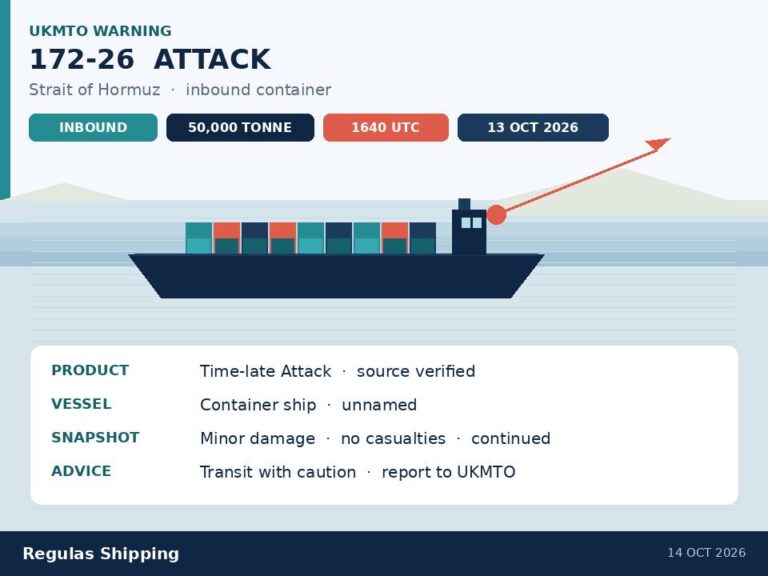
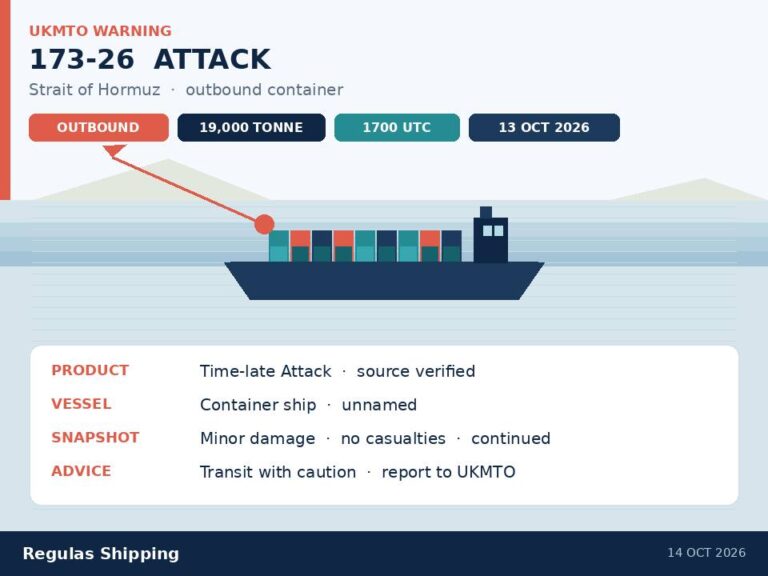
- Do not merge 171-26 into 170-26. The container warning is a separate PDF, same evening, same waterway, different type. Anadolu and Iran International wrapped both notices as unnamed, with times still unconfirmed. Tracker colour first logged 170-26 at about 1904 UTC and 171-26 about two minutes later. That is tape timing, not a combined casualty.
- Do not name Al Maqam against 171-26. UKMTO printed no hull. TradeWinds’ Tuesday line that Iranian media and video purported to show a tanker ablaze is competing colour, not a UKMTO fire finding. Liberia-flag VLCC Al Maqam, IMO 9732577, about 298,800 dwt, built 2017, ADNOC Logistics & Services on Seatrade and TradeWinds, remains unused colour from Monday’s tape unless UKMTO, JMIC or the flag prints that hull against a numbered product. Owner no-comment is still no-comment.
- Treat the missing crew and damage lines as incomplete, not as all-clear. UKMTO printed neither a crew-safe snapshot nor an environmental snapshot. Plan for a possible disabled or burning hull in the TSS and for a welfare check that has not yet reached the warning board. OSINT’s 1457 UTC eastern-Strait fire clip is not a UKMTO position. The omission on the PDF is not a completed MARPOL finding.
- Do not rewrite Update 104. ICOD remains 111500 UTC 11 October. Hormuz SEVERE. 171-26 sits outside that cut-off. Replace nothing in the master’s JMIC pack until Update 105, a UKMTO naming of 171-26, or a threat-level change appears. AIS-off is not a detection shield. Ozmaei’s hostile-transponder line is Iranian messaging, not a routing order. NAVAREA IX 363/26 remains in force to 142359 UTC 14 October.
Regulas Shipping will keep lining Warning 171-26 against Monday’s dedicated 166-26 to 169-26 tape and Update 104 so operators can treat Tuesday’s unnamed tanker hit as a live same-day Attack product, not as a UKMTO naming of Al Maqam or a completed Hormuz reopen.