Italy is preparing a national naval escort for its own merchant ships through the Bab el-Mandeb Strait rather than wait for the European Union’s Aspides mission to decide whether those hulls can pass. Defence Minister Guido Crosetto said on Thursday, 17 September 2026, that he and the chief of the defence staff had agreed to activate the navy to prepare “whatever is necessary” to guarantee the secure transit of Italian vessels. The remarks were made at the Risorsa Mare forum in La Spezia and carried on Friday by ANSA, Reuters, Anadolu and Al Jazeera. No sailing has been authorised. The operational fact for owners is that Rome is building a national product that Aspides, on present form, is not providing on an Italian timetable.
Crosetto’s argument was economic, not theatrical. “We cannot allow bureaucratic delays in decision-making to aggravate an already complex situation, with direct consequences for our economy and the lives of our citizens,” he said in a statement carried by Reuters. ANSA quoted him more directly on the EU mission: “We have decided, with the chief of staff, not to wait for Aspides to decide whether the ships can pass or not.” A sea route that is interrupted, he said, means goods arrive late, costs rise, and prices for families and businesses mount. That is a defence minister describing freight, insurance and supermarket inflation as the same problem. It is also a warning that Italian-flag and Italian-owned ships now sit in a different political queue from other European hulls on the same waterway.
What Rome has actually ordered
The Italian Defence Ministry said Crosetto had instructed the navy to prepare what was necessary to guarantee safe transit of Italian ships through Bab el-Mandeb. That is a planning order, not a deployment order. Crosetto said any deployment would be decided with the government and parliament. Authorities are examining whether existing rules allow Italian military assets already in the region to be placed temporarily under national command, or whether fresh parliamentary authorisation is required. Until that question is answered, treat “Italy will deploy warships” headlines as ahead of the ministerial paper.
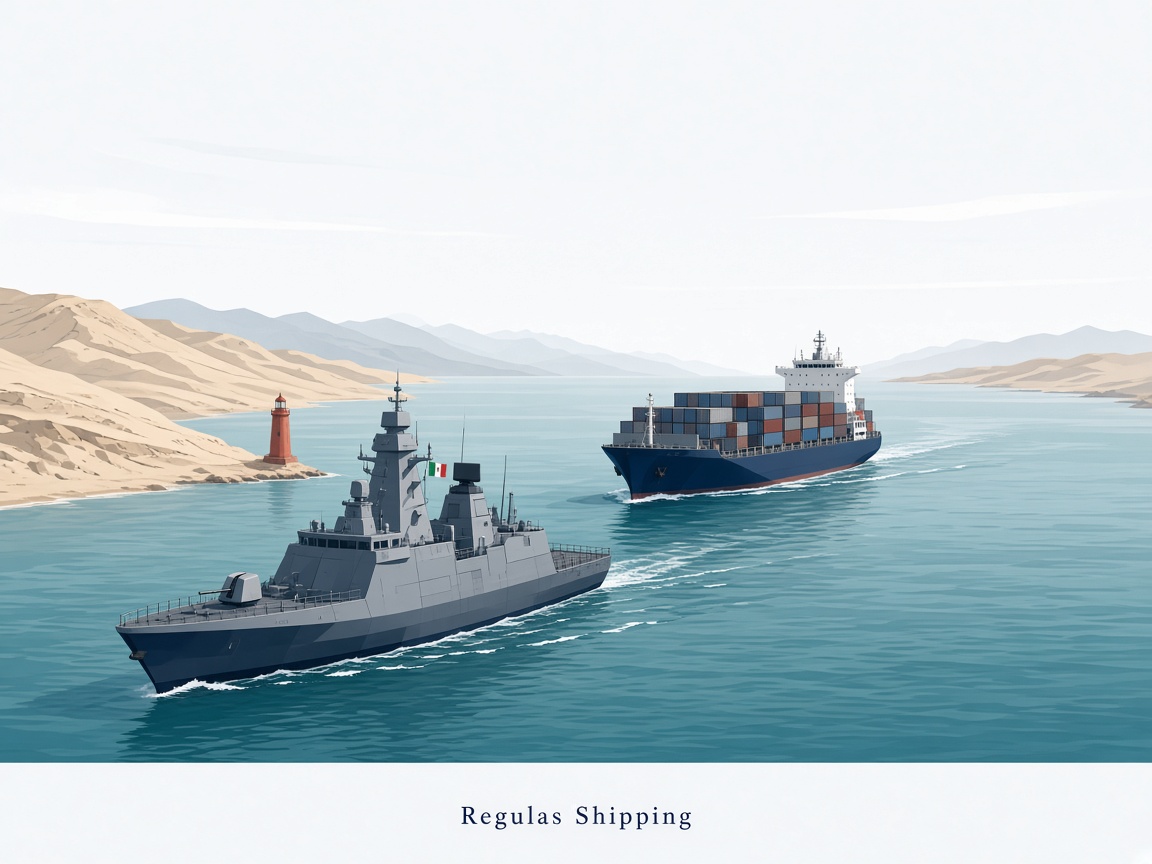
The hull most often named in the Italian reporting is the FREMM frigate Carlo Bergamini (F590), currently at Djibouti and assigned to EUNAVFOR Aspides. ANSA said Italy is assessing whether that ship could be used under national command. Bergamini has already provided close protection under Aspides, including a merchant-vessel transit completed safely on 1 August 2026; Aspides did not identify that commercial hull. A temporary recall to national command would pause, for the period of the escort, the ship’s availability to the EU tasking that other flags still rely on. Italian reporting also said the government is considering a second missile unit. Reaching Bab el-Mandeb from home waters would take on the order of two weeks. The international-missions decree may already allow that despatch. No second hull has been named in the English-language products.
ANSA put the commercial queue at around a dozen Italian-flagged or Italian-owned merchant vessels seeking escorted passage. That number is a bottleneck, not a convoy plan. Twelve ships cannot all sit in Bergamini’s wake on the same tide. Owners who assume that Italian beneficial ownership automatically puts them at the front of a national escort should wait for the navy’s actual grouping order, the flag and ownership tests it will use, and the war-risk warranty that will still attach to the voyage. A national escort is a naval product. It is not a substitute for additional premium, BMP, or a charterparty clause that still names the High Risk Area.
Why this strait, and why this week
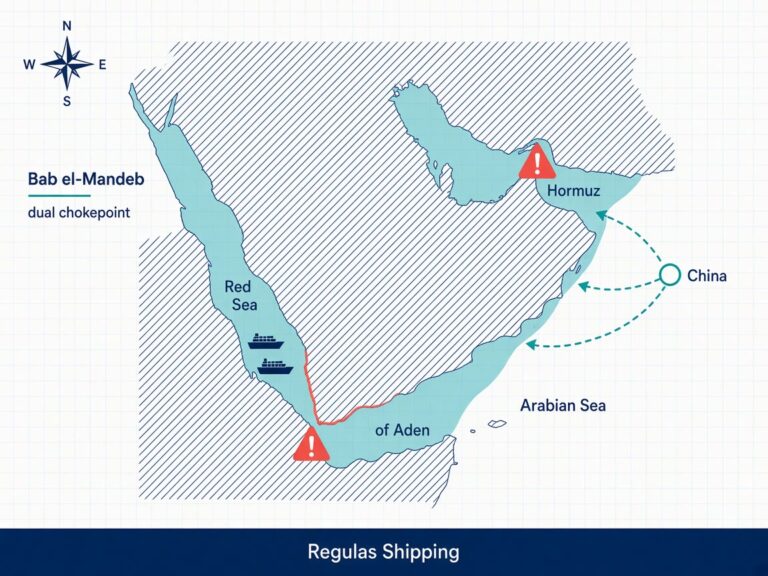
Bab el-Mandeb links the Red Sea to the Gulf of Aden. In peacetime it has handled on the order of 12 to 15 percent of global trade and the oil, gas and container traffic that feeds the Suez Canal. The strait’s importance has increased since Hormuz dropped to single-digit commodity transits and Saudi barrels that used to leave the Gulf have been pushed toward Red Sea outlets. That workaround is now itself under pressure. Houthi forces seized Mokha, then the Hanish islands, then Perim, giving the group effectively unrestricted access to Yemen’s Red Sea coastline. Their public targeting language has been Saudi-linked shipping. ACLED’s Valentin d’Hauthuille has already warned that the criteria for what counts as Saudi-linked can be widened. During the earlier Red Sea campaign the group struck vessels with no known link to the original dispute.
Kpler data reported by Reuters on Friday put Thursday’s Bab el-Mandeb commodity transits at 23, against a ten-day average of about 26: 13 heading toward the Red Sea and 10 toward the Gulf of Aden, including a Panamax, a Suezmax, four Supramaxes and six Aframaxes. That is residual traffic, not a closed strait, and it is still an order of magnitude above Hormuz. It is also thin enough that a national escort for one flag will be watched closely by every other owner still using the lane. Liner operators that have started to put selected strings back through Suez — MSC’s westbound Indusa, COSCO’s southbound OOCL Portugal, Gemini’s conditional AE5/AE11/AE12/ME2 restorations — are doing so against this 20-to-25-ship daily picture, not against a cleared corridor.
Aspides and earlier U.S. and EU operations have not restored a peacetime TSS. They have provided defensive close protection to some transits. Crosetto’s complaint is that waiting for that mission to declare the waterway passable is itself a cost. A national escort is Italy’s answer to that delay. It does not change Houthi targeting criteria for a Greek, Marshall Islands or Liberia-flagged ship in the next column of the AIS display. It does not reopen Yanbu as a Hormuz bypass while Petroline remains stopped. It does not answer the undersea-cable and energy-link vulnerability Crosetto also flagged in the same remarks. Those are a separate navy problem. They should not be briefed as part of a merchant-escort product.
What it changes for ships that are not Italian
A national escort for Italian hulls can have three effects on everyone else, none of them automatic. First, if Bergamini is pulled from Aspides tasking, the EU mission has one fewer escort unit for non-Italian ships on the days of the Italian convoy. Second, a visible Italian escort may change how militias and coastal batteries read the traffic picture: a warship in company is both a deterrent and a marker. Third, charterers will ask whether Italian beneficial ownership, Italian-managed crews, or Italian cargo interests are enough to get onto the list. Until Rome publishes the eligibility test, the only safe assumption is flag plus registered owner as reported by ANSA, and even that is a journalistic figure, not a navy notice.
War-risk underwriters will not treat a promised escort as a reason to drop the additional premium. They may treat a completed escorted transit as evidence. The distinction matters for the next fixture. So does the two-week lag if Italy has to send a second unit from home waters. Ships that are already waiting in the Gulf of Aden or the southern Red Sea cannot plan on a second hull that has not left La Spezia. Coordination with Aspides, Atalanta and national units already in Djibouti remains the stated intent. Coordination is not the same as a published convoy schedule.
Liberia’s ISPS Level 3 designation for the Red Sea and Gulf of Aden remains in force for ships on that register. BMP, citadel readiness, and the standing instruction to report to UKMTO and MSCIO are unchanged by an Italian planning order. Thursday’s other security file in the wider basin — a westbound tanker reporting a skiff attempting to intercept it about 75 nautical miles east of Aden — is a reminder that the threat is not only a Houthi missile problem at the strait. It is also a small-boat problem on the approaches.
What Operators Should Note
- Treat Crosetto’s order as a planning instruction, not as a published convoy. The navy has been told to prepare a national escort. Government and parliamentary approval still sit in front of any sailing. Al Jazeera’s “will deploy” language is ahead of Reuters and ANSA. Do not alter a passage plan on a headline.
- If the ship is Italian-flagged or Italian-owned, ask the CSO for the eligibility test in writing. ANSA put the waiting list at around a dozen hulls. That is a queue. It is not a guarantee that beneficial ownership, Italian cargo or an Italian crew is enough. Get the navy’s grouping criteria, the reporting gate, and the window before offering a charterer an escorted-Suez option.
- Do not assume Aspides cover is unchanged. Bergamini (F590) is at Djibouti on the EU mission. A temporary shift to national command would take that frigate off the tasking that other flags still use. A second Italian unit is on the order of two weeks from home waters. Non-Italian ships should plan as if Aspides capacity could tighten on the days of an Italian escort, not as if it will expand.
- Keep Bab el-Mandeb’s traffic picture in the same brief as the escort talk. Thursday’s Kpler count was 23 commodity vessels against a ten-day average of about 26. The lane is open enough to argue about escorts and thin enough that a single-flag convoy will be conspicuous. Liner restorations through Suez remain case-by-case and conditional on Red Sea stability.
- Do not drop war-risk, BMP or HRA clauses because a national escort is being prepared. An escort is a naval product. Additional premium, crew-refusal rights, Liberia ISPS Level 3 where it applies, and UKMTO/MSCIO reporting still govern the commercial go/no-go. Underwriters will reassess after escorted transits, not before the first one.
- Keep the Houthi targeting file on Saudi-linked shipping, and assume the criteria can widen. A national escort for Italian hulls does not make a Marshall Islands or Liberia-flagged ship safer. It may make the next AIS plot more complicated. Extra lookouts, a written small-boat standoff on the Aden approaches, and a citadel drill remain live, including after Thursday’s 75-nautical-mile skiff report east of Aden.
Regulas Shipping will keep lining Crosetto’s planning order against Aspides tasking, the Bergamini position and the daily Bab el-Mandeb count so operators can treat a national escort as a flag-specific option, not as a reopening of the strait.