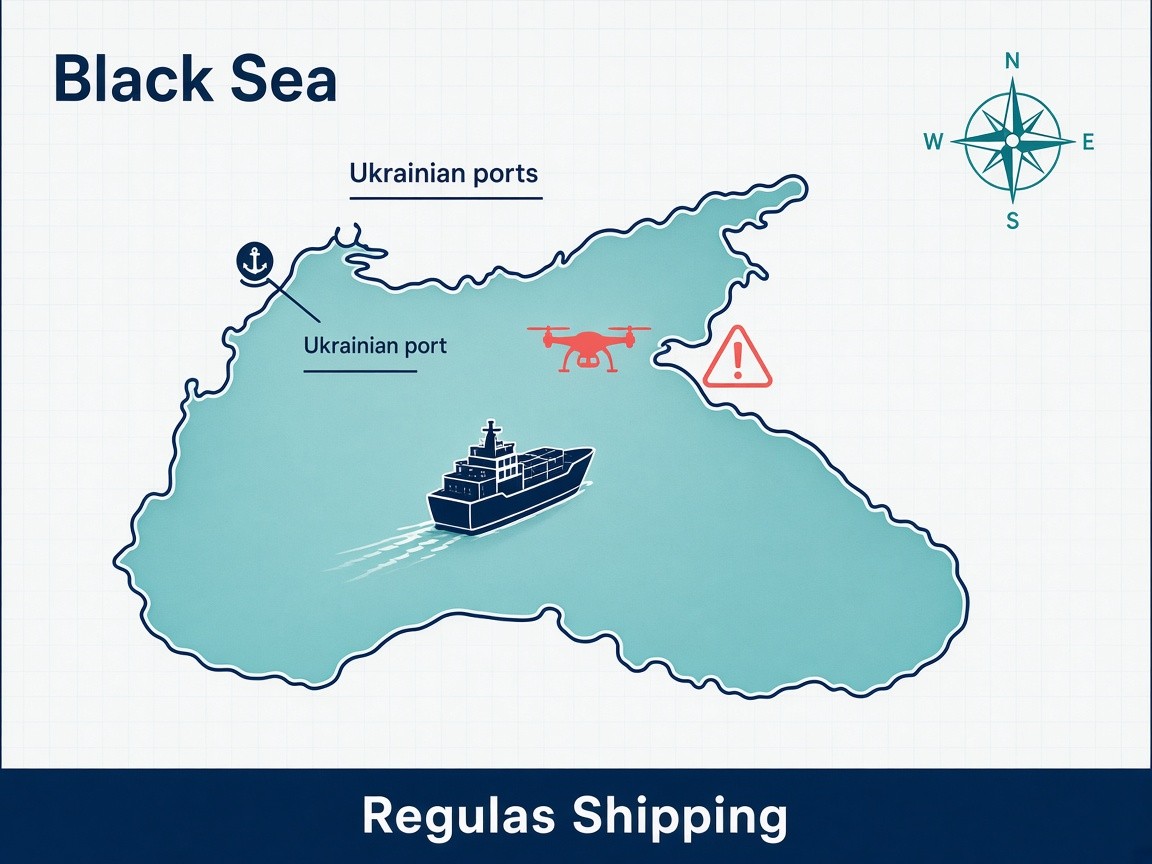
Ukraine’s Sea Ports Authority and the Ministry for Development of Communities and Territories said on Thursday, 17 September 2026, that a Russian drone struck a civilian merchant vessel flying the Tanzanian flag while the ship was heading to a Ukrainian port. The captain was killed. Three other crew members were injured. Information on the ship’s technical condition is still being established. The vessel’s name, IMO number, type, cargo and destination port have not been released. Russia has not commented on the claim. Treat the hull as unnamed until a flag circular, an MRCC product or a company statement identifies it.
The strike is a crew-casualty event on a commercial approach to Ukraine, not a near-miss against a shadow-fleet tanker on the Russian coast. That distinction matters for the next fixture. Ukrainian authorities framed the attack as part of a continuing campaign against ports, port infrastructure and civilian merchant ships. Oleh Kiper, head of the Odesa Regional State Administration, said the captain’s death and the three injuries confirmed that attacks on civilian commercial vessels were violating international humanitarian law and endangering international shipping. AMPU asked for a coordinated international response to protect civilian shipping and logistics routes. Those are political statements. The operational facts that can go into a voyage order are simpler: a UAV reached a merchant ship bound for a Ukrainian port; the master is dead; three seafarers are injured; the ship’s ability to make way is not yet known.
IMO Secretary-General Arsenio Dominguez told Member States on 16 September that attacks on merchant ships in the Black Sea and Sea of Azov have caused dozens of fatalities in recent months, though precise numbers are hard to verify, and that the attacks are not attributable to one actor. Thursday’s Tanzanian-flagged casualty is the latest named-flag, unnamed-hull data point in that file. It lands in the same week as a drone hit on the Turkish feeder Lionfish underway toward Novorossiysk and an accommodation hit on the Russian bulker Matros Koshka alongside at that port. The Black Sea is producing crew deaths on both the Ukrainian-port approach and the Russian-port approach. A passage plan that only hardens one coast is a half-measure.
What is known, and what is not
Ukrainska Pravda, Anadolu Agency and RBC-Ukraine all attribute Thursday’s account to the same Ukrainian official sources: AMPU and the ministry responsible for communities, territories and infrastructure. The strike date is 17 September. The ship was en route to “one of Ukraine’s ports.” The flag is Tanzania. The captain is dead. Three crew are injured. The ministry said information on the vessel’s technical condition “is currently being clarified.” No UKMTO-style position, no MMSI, no cargo and no statement on whether the ship remained underway, anchored, or required SAR. Company security officers should not invent a name, an IMO number or an Odesa/Chornomorsk/Pivdennyi assignment to fill that gap. A wrong identification in the master’s orders is worse than an unnamed hull.
The July casualty that Ukrainian outlets cited as background is the cargo vessel Golden Leo, hit by Russian missiles near Odesa, with nine crew and a Ukrainian sea pilot killed and eight sailors rescued. That is context for the human cost on the Ukrainian-port approach. It is not Thursday’s ship. Do not merge the two into a single briefing paragraph. Thursday’s facts are a UAV, a Tanzanian flag, a dead master and three injured seafarers on a ship whose condition is still being established.
Attribution in this case is a Ukrainian government claim of a Russian drone. Moscow had not commented as of Thursday afternoon. Earlier in the month Kremlin spokesman Dmitry Peskov, asked about the effect of Black Sea attacks on Russia–Turkey relations, said commercial vessels “used to transport weapons” would be “destroyed and continue to be destroyed.” That is a targeting theory, not an identification of Thursday’s hull. Passage plans for Ukrainian ports should assume that Russia will describe inbound merchant ships as military logistics. The SMS answer is still BMP, lookout, citadel, fire party and a written abort, not an argument about cargo.
How this sits in the September pattern
The Black Sea in the first half of September has already produced an underway container-bay hit, a alongside accommodation hit, and a products-tanker strike off Sochi. Lionfish (IMO 9162667), a Turkish-flagged 13,059 dwt feeder on an Ambarlı–Novorossiysk run, took a drone in the container section on 13 September; the crew extinguished the fire and diverted to Trabzon; no casualties were reported; the shooter was not identified. Matros Koshka (IMO 9550137), a Russian-flagged bulker, was hit on 12 September while alongside at Novorossiysk, with damage to the bridge and cabins and three seafarers injured. Ukraine’s Unmanned Systems Forces released footage of a drone that hit the Russian products tanker Armada Leader (IMO 9260483) near Sochi after a helicopter escort failed. Ukrainian authorities separately reported a Russian drone damaging a Panama-flagged corn carrier leaving Chornomorsk. Thursday’s Tanzanian-flagged inbound is the Ukrainian-port-approach counterpart of that sequence, with a dead master instead of a contained fire.
IMO’s maritime safety briefings have already put the Black Sea in the same four-theatre set as Hormuz, the Red Sea and Somalia. Grain sailings from Ukrainian ports have been described in those briefings as a handful of ships against the 20-to-30 range that operators treated as a working corridor. Azov traffic has been effectively closed since mid-July. Novorossiysk’s grain terminals were reported suspended in August. FAO food-price readings in August were the highest since November 2022. Sovecon put Russian wheat exports in August at about 2 million tonnes, down 56 percent. A UAV that kills a master on an inbound to a Ukrainian port is a crew event first. It is also another reason some owners will not offer the next grain or general-cargo voyage, which is how a corridor closes without a formal blockade notice.
Turkey has been trying to put a political floor under the same problem. Foreign Minister Hakan Fidan called in August for a mechanism that would allow a moratorium on attacks against commercial ships, after Turkish-linked vessels including the Cameroon-flagged ro-ro Nadezhda were hit. Ukraine said it was ready to accept a moratorium. Moscow showed no interest. Türkiye’s Directorate General of Coastal Safety was reported in August to have slowed or withheld Dardanelles transit permits for some ships bound for Novorossiysk, with some owners told the delay could also touch Ukrainian destinations. No moratorium has been announced. Thursday’s fatality is what the absence of that mechanism looks like on the Ukrainian approach: a flag of convenience, a dead master, and no published hull identity for the next ship to avoid.
What it changes on the bridge
A UAV that kills the master is an ISPS, SAR and command-succession problem before it is a cargo problem. Standing orders for Ukrainian-port approaches need a named person who takes command if the master is incapacitated, a citadel and casualty plan that can be run with three injured, and a written rule for when the ship aborts to a Romanian, Bulgarian or Turkish port rather than continuing into the UAV envelope off Odesa. Fire parties still belong in the same briefing. Thursday’s public record does not yet say whether the drone hit accommodation, cargo or machinery. Lionfish was a cargo-bay fire. Matros Koshka was an accommodation hit. The next inbound may be either, or both.
War-risk underwriters will ask whether the ship was bound for a Ukrainian port, whether AIS was transmitting, whether the company had a named diversion port, and whether crew contracts allowed seafarers to refuse the area. Flag and P&I will want VDR, the security message to MRCCs, and the medical log. Charterers who still send bulkers, general cargo and tankers into the north-western Black Sea need a written abort and a written rule for when the voyage is no longer worth the UAV envelope. Open-register flags, including Tanzania, do not reduce the targeting risk on an inbound to Ukraine. They can complicate the casualty response if the flag state is slow to confirm the hull.
Company security officers should not brief Thursday’s ship as a confirmed identification of a grain carrier, a tanker or a shadow-fleet hull. They should brief it as a UAV casualty on a commercial inbound, with a dead master, three injured, and a condition report still outstanding. That is enough to raise ISPS and medical readiness on the next Ukrainian-port voyage without waiting for an IMO number.
What Operators Should Note
- Treat Thursday’s event as a crew-casualty UAV inbound, not as a near-miss. AMPU and Ukraine’s communities-and-territories ministry say a Tanzanian-flagged civilian ship bound for a Ukrainian port was hit on 17 September, the captain was killed, and three crew were injured. The ship’s condition is still being established. Russia has not commented. Brief command succession, medical response and abort criteria before the next Ukrainian-port stem.
- Keep the hull unnamed until a flag, MRCC or company product carries IMO/MMSI. No vessel name, type, cargo or destination port has been published. Do not assign this casualty to Golden Leo, to a Chornomorsk corn carrier, or to any other named Black Sea hull. A wrong name in the SMS is a liability.
- Put the Ukrainian-port approach in the same briefing as Novorossiysk and Sochi. This week already has Lionfish (underway, container bay, fire extinguished, Trabzon abort) and Matros Koshka (alongside, accommodation, three injured). Thursday’s inbound fatality is the other coast. Hardening only Russian calls, or only Ukrainian calls, misses the theatre.
- Write a named abort port west or south of the Odesa UAV envelope. If the master is dead and three crew are injured, the ship may not complete an inbound. Name the diversion port, the person who may order it, and what happens to cargo interests if the ship never berths. Romanian, Bulgarian and Turkish ports are the practical options; pick one that can take the ship type you actually operate.
- Close up fire parties and accommodation hardening on the same passage plan. Public sources have not said where Thursday’s drone hit. September’s other Black Sea strikes have already shown both geometries. Bridge windows, citadel, extra lookouts, cargo-bay boundary cooling and a casualty plan belong on one checklist.
- Do not treat an open-register flag as mitigation. Tanzania is the reported flag. Open registers do not reduce UAV targeting on an inbound to Ukraine. They can slow flag-state confirmation, next-of-kin notification and casualty investigation. Manning, P&I and the DPA need a named contact path that does not wait on Dar es Salaam.
- Re-read war-risk, IBF/ITF area lists and crew refusal rights before the next Black Sea offer. There is no announced Russia–Ukraine moratorium. Fidan’s August proposal has not produced a mechanism. Peskov’s “used to transport weapons” line is how inbound merchant ships will be described. If seafarers can refuse the area, an owner cannot sail a ship that cannot be manned. Price that in the fixture, not after a fatality.
- Preserve VDR, AIS, medical logs and MRCC traffic from the moment of impact. P&I, flag and cargo underwriters will ask whether the ship reported, whether the casualty plan ran, and whether the diversion was ordered in time. A clean log is part of the defence of the remaining crew as well as of the company.
Regulas Shipping will keep lining AMPU, flag and MRCC products against Black Sea UAV casualties so operators can treat a dead master on an unnamed Tanzanian-flagged inbound as a routing and crewing decision, not as a residual grain-corridor risk.